




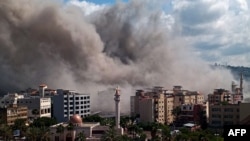
The temporary truce between the United States and Iran wobbled less than a day after being agreed as Israel launched massive attacks on Iranian proxies in Lebanon, while Tehran launched strikes at oil centers in several Persian Gulf countries after claiming its energy facilities were targeted.
US and Iranian delegations are scheduled to meet in Islamabad on April 10 to begin detailed talks on a peace deal after the temporary truce was reached late on April 7. Vice President JD Vance will lead the US delegation, the White House said on April 8.
But even as teams prepared for the meetings, reports of violations tempered the optimism seen just hours earlier as the first ships passed freely through the Strait of Hormuz, which Iran is to fully open as part of the cease-fire deal.
Further clouding the outlook, Israel carried out its heaviest strikes in Lebanon on Iran-backed Hezbollah, which has been designated a terror organization by the United States, amid disputes about what is covered under the cease-fire. Israel’s military said it targeted over 100 Hezbollah sites in Beirut, the Bekaa Valley, and southern Lebanon.
Lebanon's Health Ministry said 182 people were killed but that this was not the final toll, and UN Human Rights Chief Volker Türk said the "scale of the killing and destruction in Lebanon today is nothing short of horrific."
"The United States will work closely with Iran, which we have determined has gone through what will be a very productive Regime Change!" President Donald Trump said in a social media post, before later being quoted by US public broadcaster PBS as saying Lebanon is not part of the agreement with Iran "because of Hezbollah."
"That's a separate skirmish," he added.

Iran's powerful Islamic Revolutionary Guards Corps (IRGC) said in response to the Israeli attacks on Hezbollah that "if the aggression against beloved Lebanon does not cease immediately, we will fulfill our duty and deliver a response."
In a post on X, Iranian Foreign Minister Abbas Araqchi added: "The Iran–U.S. Ceasefire terms are clear and explicit: the U.S. must choose-- ceasefire or continued war via Israel. It cannot have both."
And Iranian parliament speaker Mohammad Baqer Qalibaf, who is reportedly expected to lead Tehran's delegation at the Islamabad talks along with Araqchi, claimed that three parts of Iran's 10-point proposal for a resolution had been violated and that, in such a situation, a "bilateral cease-fire or negotiations" were "unreasonable."
In a post on X, Qalibaf asserted that the violations were attacks on Lebanon, the entry of a drone into Iranian airspace, and what he said was a "denial of Iran's right to [uranium] enrichment."
Washington and Tehran agreed late on April 7 to a two-week Pakistani-brokered cease-fire, pulling back from the brink to allow the two sides time to negotiate a peace deal.
Trump, who early on April 7 wrote that "a whole civilization will die tonight" if Iran fails to reach a deal, said in a social media post that he had received a 10-point proposal from Tehran and he believes "it is a workable basis on which to negotiate."
Iranians' Relief, Conerns
Iranians have expressed relief but also concern after the United States and Iran announced a deal to suspend hostilities for two weeks. After more than five weeks of strikes, some Iranians say they expect challenging days ahead with infrastructure destroyed -- but also want their own government to restore basic rights and to release political prisoners.
"I'm glad there is a cease-fire, but I won't rest until there's lasting peace," one man from inside Iran said in a message sent to RFE/RL's Radio Farda.
"I know there will be difficult days ahead of us. A lot of infrastructure has been destroyed, and [the authorities] are [likely] to become more violent, but we must stand together and distance ourselves from the warmongers."
Trump gave no details of the Iranian proposal but added the agreement hinges on Tehran allowing the free passage of ships in the Strait of Hormuz, a key shipping lane through which some 20 percent of the world's oil and gas passes.
According to data from maritime monitor Marine Traffic, three ships passed through the waterway on April 8.
"Early signs of vessel activity are emerging in the Strait of Hormuz following a cease-fire announcement, which includes a temporary reopening of the strategic waterway to allow for negotiations," the monitor said in a post on X.
A senior Iranian official said ships navigating the strait, however, still require Tehran's permission to pass, and Reuters reported that shippers were awaiting more clarity before resuming transit.
'Legitimate Misunderstanding'
White House press secretary Karoline Leavitt told reporters on April 8 that Trump's "immediate priority...is the reopening of the strait without any limitations, whether in the form of tolls or otherwise."
"I will reiterate the president's expectation and demand that the Strait of Hormuz is reopened immediately, quickly, and safely," Leavitt said, adding that any closure "is completely unacceptable."

Israel said it supports Trump's decision to stop attacking Iran for two weeks subject to the immediate reopening of the Strait of Hormuz and the cessation of attacks against the United States, Israel, and other countries in the region.
But the statement, released by the office of Prime Minister Benjamin Netanyahu, said the cease-fire did not include Lebanon, which contradicted an earlier statement from Prime Minister Shehbaz Sharif of Pakistan.
On the US side, Leavitt echoed Trump in saying Lebanon was not included in the cease-fire terms. However, she told journalists, "This will continue to be discussed, I am sure, between the president and Prime Minister Netanyahu, the United States and Israel, and all of the parties involved."
Vice President JD Vance said he believes there was a "legitimate misunderstanding" about the terms of the truce. "I think the Iranians thought that the cease-fire included Lebanon, and it just didn't."
"If Iran wants to let this negotiation fall apart... over Lebanon…that's ultimately their choice," he told reporters before departing Budapest to return to the US. But he added that Israel was ready to show restraint.
“The Israelis, as I understand it...have actually offered to, frankly, to check themselves a little bit in Lebanon, because they want to make sure that our negotiation is successful," Vance said without providing details.
Meanwhile, the Gulf States of Saudi Arabia, Kuwait, Bahrain, and the United Arab Emirates reported fresh attacks on their territory.
Highly Precarious
Anne Dreazen, vice president of the American Jewish Committee's Center for a New Middle East, told RFE/RL that while the pause is a "tactical de-escalation," the maritime terms remain highly precarious.
She noted that because passage is still being coordinated via the Iranian military, the agreement represents a "controlled and conditional access regime" rather than a true return to international norms.
"In practical terms, Iran is retaining the ability to regulate, restrict, or politicize maritime traffic using the strait as leverage rather than restoring the principle of free navigation," Dreazen said, adding the burden is now on Tehran to prove it is ready to "shift course from coercion and disruption toward meaningful negotiation and de-escalation."
Senior Trump administration officials have called the deal "a win," while Jason Brodsky, policy director at United Against Nuclear Iran, characterized the agreement as "a tactical pause -- a delay" by the United States to see if Iran will hold to the deal.
"I think President Trump retains the option of escalating. The attack plans have been prepared. That credible military threat remains," he told RFE/RL, adding that both nations remain in a position to strike.
"The Iranians have the ability to threaten the Strait of Hormuz. So both can revert to previous postures if this deal fails to hold."
The last-minute move came amid global concerns over Trump's remarks on wiping out Iranian civilization, with Pope Leo, an American, suggesting it was "truly unacceptable" and others warning against attacks on civilian infrastructure.

There had been few signs that the sides were ready for compromise in the war, which began with US and Israeli air strikes on Iran on February 28, and little overlap between proposals put forth by Washington and Tehran.
"The cease-fire, should it hold, could serve as a more general off ramp to future hostilities. In this sense, escalation -- even the threat of it -- may have been necessary to precipitate the current de-escalation," Cale Brown, a former deputy spokesperson during Trump's first administration and chairman of Polaris National Security, told RFE/RL.

