




We are now closing the live blog for the day. We'll be back tomorrow at 7:30 a.m. Central European time to cover the latest events across the Middle East.
Report: US To Let Iran Oil Sanctions Waiver Expire
The administration of US President Donald Trump will allow a 30-day waiver on sanctions covering Iranian oil shipments to expire later this week, as Washington intensifies pressure on Tehran alongside a naval blockade, according to Reuters
One official told the news agency that the US Treasury "is going full force on Economic Fury,” an apparent reference to Operation Epic Fury, the US-led military campaign against Iran.
The move underscores a renewed push in the United States' long-running “maximum pressure” campaign over Iran’s nuclear program and Tehran's support for its proxies in the Middle East.
The waiver, issued on March 20 and due to expire April 19, allowed about 140 million barrels of oil onto global markets, easing supply strains during the recent US-Israeli war with Iran, according to US Treasury Secretary Scott Bessent.
US Lawmakers have criticized the temporary easing of sanctions on both Iran and Russia.
Reuters said one US official also warned that with the “snapback of UN sanctions” and Iran’s “history of trying to hide behind seemingly legitimate activity,” any dealings with Tehran may trigger further penalties.
Washington also did not renew the waiver on Russian oil at sea, which expired on April 12, according to one of Reuters' sources.
With reporting by Reuters
US Military Says 'No Ships Made It Past' Naval Blockade Targeting Iran
- By Ray Furlong
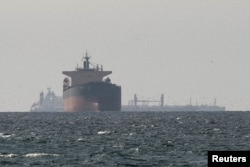
The US military said that no ships slipped through a naval blockade targeting vessels headed to or from Iran in the first 24 hours of the restrictive measure, while tracking-service data indicated that a few Iran-linked ships exited the Strait of Hormuz during that time period.
"During the first 24 hours, no ships made it past the US blockade and 6 merchant vessels complied with direction from US forces to turn around to re-enter an Iranian port on the Gulf of Oman," the US Central Command, which is responsible for operations in the region, said in a post on X.
"The blockade is being enforced impartially against vessels of all nations entering or departing Iranian ports and coastal areas, including all Iranian ports on the Arabian Gulf and Gulf of Oman," CENTCOM said. "U.S. forces are supporting freedom of navigation for vessels transiting the Strait of Hormuz to and from non-Iranian ports."
Data from ship tracking services listed at least four ships, two of which had recently called at Iranian ports, that had passed or were passing through the 30-kilometer-wide Strait of Hormuz in the hours after the blockade came into force at 10 a.m. US Eastern Time on April 13.
A Liberian-flagged ship that had delivered corn to the Iranian port of Bandar Imam Khomeini passed Iran's Larak Island in the strait a few hours after that, and a Comoros-flagged tanker that was carrying methanol and had left the Iranian port of Bushehr on March 31 exited the strait around the same time, the AFP news agency reported, citing data from Kpler.
Also citing tracking services, Reuters separately reported that three Iran-linked vessels that transited the strait were not headed for Iranian ports and were not affected by the blockade. Two of the three vessels are under US sanctions and one of those two is Chinese-owned, Reuters reported.
US President Donald Trump ordered the blockade after US-Iranian peace talks in Islamabad on April 11-12 failed to produce an agreement to end the war, which began with US and Israeli air strikes on Iran on February 28. Washington and Tehran agreed to a two-week cease-fire on April 7.
Trump suggested on April 14 that negotiations could resume in Islamabad in the next couple of days.
"You should stay there, really, because something could be happening over the next two days, and we're more inclined to go there [than to another location]," an Islamabad-datelined story in the New York Post quoted Trump as saying.
Read more here.
Trump Slams Italian PM Over Iran War Stance
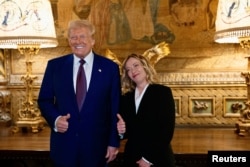
US President Donald Trump has sharply criticized Italian Prime Minister Giorgia Meloni for refusing to join the war against Iran, straining ties with one of his closest European allies.
“I'm shocked at her. I thought she had courage, but I was wrong,” he said in an interview with Corriere Della Serra, published on April 14.
Trump added that “she doesn't help us with NATO” and “doesn't want to help get rid of a nuclear-weaponed Iran,” calling her stance “very sad” and saying she was “much different than I thought.”
The remarks come after Meloni said Trump’s criticism of Pope Leo after the pontiff's calls for an to the war was "unacceptable."
The Italian far-right leader has been one of Trump's closest allies in Europe and has often sought to act as a mediator between diverging US and European views.
Trump also criticized Europe’s broader stance on security, including reluctance to defend the Strait of Hormuz.
Italian officials, including Foreign Minister Antonio Tajani, defended Meloni, stressing national interests and calling for unity "built on mutual loyalty, respect, and honesty."
With reporting by AFP
CENTCOM: Says 6 Ships Returned To Iranian Port
The US Central Command said on April 14 that no ships have made it past the US blockade of Iranian ports and that six merchant vessels "complied with direction from U.S. forces to turn around to re-enter an Iranian port on the Gulf of Oman."
Israel, Lebanon Talks Conclude In Washington, Signal Rare Common Ground
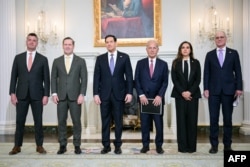
WASHINGTON -- Israel and Lebanon concluded a rare round of direct talks in Washington on April 14 after roughly two hours, marking their first such engagement since 1983.
The meeting at the US State Department, hosted by Secretary of State Marco Rubio, was described by officials as a “historic opportunity” despite “decades of history and complexities”.
Israel’s ambassador to the US, Yechiel Leiter, offered an upbeat assessment, saying the sides found alignment during the talks.
“We discovered today that we’re on the same side of the equation. That’s the most positive thing we could have come away with,” he told reporters, adding both countries were “united in liberating Lebanon from an occupation power dominated by Iran called Hezbollah.”
Hezbollah is an Iran-backed militant group and political party that controls much of southern Lebanon and is considered a terrorist organization by the United States, while the European Union has only blacklisted its armed wing.
The meeting had been planned before the US-Israeli war with Iran, and Israel had ruled out discussing a potential cease-fire at the talks, which Hezbollah denounced.
Leiter described the discussions as focusing on a long-term vision including a clearly defined border and normalization.
“The only reason we’ll need to cross each other’s territory will be in business suits to conduct business or in bathing suits to go on vacation,” he said.
He also reiterated Israel’s security stance.
“We made it very clear that the security of our civilians is not up for negotiation. That is understood by the government of [Lebanese President] Joseph Aoun,” he said, calling the talks “a victory for sanity, for responsibility and for peace”.
Leiter said a joint statement would be issued, outlining positions from both sides, and confirmed work was under way toward a broader agreement.
“We’re working on the agreement on every front… to try to achieve together a complete peace treaty,” he said.
Leiter also said the Lebanese side had signaled a shift.
“What gives me hope is the fact that the Lebanese government made it very clear that they will no longer be occupied by Hezbollah,” he said, though Lebanese officials have not publicly confirmed that position.
He added that Iran’s influence had weakened, creating an opening. “This is the first time our two countries are sitting together in over three decades. Let’s seize the moment,” he said.
On the regional impact, he said it was “imperative” to delink Lebanon from Iran, describing Tehran as a “malign influence”, and said progress on security could pave the way for ties similar to those between Israel and Arab states under normalization agreements.
A US official said the meeting was not linked to separate US-Iran talks, reiterating Washington’s support for disarming Hezbollah and restoring Lebanese sovereignty.
The State Department said the participants "held productive discussions on steps toward launching direct negotiations between Israel and Lebanon," and that all sides "agreed to launch direct negotiations at a mutually agreed time and venue."
"The United States congratulated the two countries on this historic milestone and expressed its support for further talks, and for the government of Lebanon's plans to restore the monopoly of force and to end Iran's overbearing influence," State Department spokesman Tommy Piggott said in a statement.
No date was set for additional talks, and no other specific agreements were announced following the meeting.
The discussions come amid continued cross-border fire between Israel and Hezbollah despite a fragile cease-fire, with more than one million Lebanese displaced by ongoing Israeli strikes, according to US estimates.
Trump Says US-Iran Talks Could Resume 'Over The Next 2 Days,' NY Post Reports
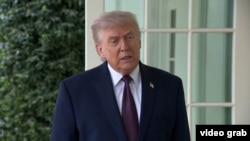
US President Donald Trump has said that US-Iran talks could resume in Pakistan "over the next two days," the New York Post reported on April 14.
"You should stay there, really, because something could be happening over the next two days, and we're more inclined to go there [than to another location]," the Post quoted Trump as telling a reporter who was apparently in Islamabad.
"It's more likely, you know why? Because the field marshal is doing a great job," Trump said in a reference Pakistani army chief Asim Munir.
Pakistan hosted and mediated talks between high-level US and Iranian officials on April 11-12, with the US team led by Vice President JD Vance.
The talks -- the first of their kind in nearly half a century -- did not produce an agreement and the US delegation leaders left Pakistan after they broke up early on April 12.
The United States and Iran agreed on a two-week cease-fire on April 7, five weeks after the war began with US and Israeli air strikes on Iran on February 28.
Red Cross Sends First Cross-Border Aid Into Iran
The International Red Cross movement said its first cross-border aid shipments have reached Iran since the start of the conflict, as humanitarian supply lines remain severely disrupted.
A convoy organized by the International Federation of Red Cross and Red Crescent Societies (IFRC) that left Turkey on April 11 has since reached Iran to deliver "one of the first cross-border shipments of medical supplies" by any organization since the conflict began on February 28, IFRC spokesman Tommaso Della Longa told reporters in Geneva.
Della Longa said the IFRC had sent trauma kits, "designed to provide immediate, life-saving care."
"The operation is critical as humanitarian supply chains into Iran have been severely disrupted in recent weeks due to the conflict, making it increasingly difficult and more costly for essential medical and relief items to reach those in need," he said.
Separately, the International Committee of the Red Cross (ICRC) sent 171 tons of relief items from Jordan, including essential household goods for over 25,000 people, along with generators and pumps to support rescue operations.
Officials warned that needs remain high, while Della Longa also paid tribute to Iranian Red Crescent workers, four of whom have been killed during relief efforts.
With reporting by AFP
Iran Claims Initial War Damages Are '$270 Billion'
Based on preliminary estimates, the damage caused by US and Israeli attacks on Iran is currently estimated at around $270 billion, an Iranian government spokesperson said.
“One of the issues that our negotiating team is pursuing, and which was also pursued in the Islamabad talks, is the issue of war reparations,” Fatemeh Mohajerani told Russia’s RIA Novosti, according to Iran’s Tasnim news agency, which is close to the powerful Islamic Revolutionary Guards Corps.
"Preliminary and very crude figures put the damage at $270 billion so far," she said.
Without providing details, she suggested that the figure is not final and that “damages usually have to be examined in several layers."
During the nearly six-week US-Israel war with Iran, many of the country’s military and security centers were attacked. According to the US and Israeli militaries, this included more than 16,000 targets.
Parts of Iran’s infrastructure-- including steel factories, petrochemical complexes in Mahshahr and Asaluyeh, as well as bridges -- were also targeted, leading to their complete shutdown.
Iran’s permanent mission to the United Nations also reportedly announced in a letter to the organization that it was seeking compensation from five Middle Eastern countries-- Bahrain, Saudi Arabia, Qatar, the United Arab Emirates, and Jordan-- for their participation in the US-Israeli war with Iran.
This request comes while Iran also targeted various military and economic sites in those countries during the war and also blocked the Strait of Hormuz, preventing the transfer of oil, gas, and other products from the Persian Gulf to global markets.
Defying US Blockade, Iran-Linked Ships Reportedly Transit Hormuz
Ships linked to Iran are reported to have transited the Strait of Hormuz on April 14, the first full day of a US naval blockade targeting vessels "entering or departing Iranian ports and coastal areas."
Data from ship tracking services listed at least four ships, two of which had recently called at Iranian ports, that had passed or were passing through the 30-kilometer-wide waterway in the hours after the blockade came into force the previous day.
There were no reports of Washington taking direct action against the ships to enforce the blockade.
The voyages are the first test of the blockade, launched after failed US-Iranian peace talks in Islamabad on April 11-12. Media reports on April 14 said Pakistan was seeking to facilitate a new round of talks later this week.
To read the full report, click here.