




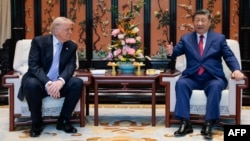
US President Donald Trump departed Beijing on May 15 after a two-day summit with Chinese leader Xi Jinping that highlighted how the war in Iran is reshaping the contours of their relationship and testing whether the rivals can coordinate to tackle global crises.
The meeting, Trump’s first visit to China since 2017, was initially expected to focus heavily on trade disputes, tariffs, and technology restrictions. Instead, the war in Iran and fears over global energy disruptions took center stage.
"We did discuss Iran. We feel very similar about [how] we want it to end," Trump told reporters on May 15 while sitting next to Xi. "We don’t want them to have a nuclear weapon. We want the strait open," he added, referring to the almost total closure of the Strait of Hormuz, the strategic waterway that normally carries roughly one-fifth of global oil supplies.
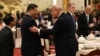
The summit, which blended grand ceremony with cautious diplomacy, produced some modest trade deals, as well as carefully calibrated language from Beijing and Washington on maintaining open shipping routes through the Strait, and a renewed effort by both leaders to present their relationship as manageable despite widening distrust.
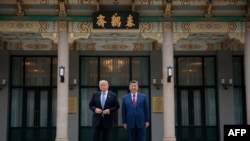
Amid a lavish state banquet and a tour of Beijing landmarks, Trump praised Xi as a “friend,” while the Chinese leader called for a “constructive strategic stable relationship” intended to guide ties between Beijing and Washington over the coming years.
“The summit sets a stabilizing tone,” Ketian Zhang, an associate professor at George Mason University, told RFE/RL. “But what comes next, especially on difficult issues, will depend heavily on domestic politics in both countries and how conflicts like Iran and Ukraine evolve.”
Beyond the warm rhetoric, analysts say the summit has so far yielded limited tangible progress and underscored how deeply entrenched the rivalry between the two countries remains.
“Beijing agreed that the Strait of Hormuz should remain open and that Iran should not have a nuclear weapon. Those rhetorical commitments cost China very little,” Craig Singleton, a senior fellow at the Foundation for Defense of Democracies, told RFE/RL. “The harder test is whether Beijing pressures Tehran, curbs Chinese purchases of Iranian oil, or helps Washington turn general language into observable outcomes.”
War In Iran Takes Center Stage
China’s Foreign Ministry said on May 15 that Beijing supports preserving the fragile cease-fire around Iran and reopening maritime routes.
Trump said in an interview recorded in Beijing with Fox News that Xi offered to help broker a deal with Tehran and vowed to not provide the country with military equipment.
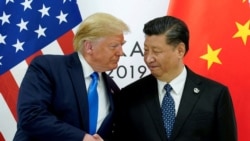
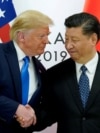

“I don’t think China wants Iran to have a nuclear weapon either,” Trump said. “[Xi] would like to see an end.”
The issue has taken on increasing urgency for both governments. Washington wants Beijing to use its economic leverage over Tehran – China remains Iran’s largest oil customer – to help stabilize the region and reduce pressure on energy markets. Beijing, meanwhile, is seeking to avoid a prolonged conflict that could damage global growth, disrupt supply chains, and deepen uncertainty for China’s already slowing economy.
“[It is] in China's self-interest to see the situation calm down in the Middle East,” Dali Yang, a professor of Chinese politics at the University of Chicago, told RFE/RL. “So strategically, I'm pretty sure there is almost an agreement [on Iran], more or less, although clearly China did express opposition to the war.”
“The Chinese side said they are not in favor of militarizing the Strait of Hormuz, and they’re not in favor of a tolling system, and that’s our position,” Rubio told NBC News on May 14.
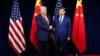
Trump repeatedly insisted the United States does not need China’s help to resolve the Iran conflict, while US Secretary of State Marco Rubio rejected suggestions Washington was seeking Beijing’s assistance.
“He didn’t ask him for anything,” Rubio said. “We don’t need their help.”
US Trade Representative Jamieson Greer said in a Bloomberg TV interview on May 15 said that the United States believed China was being “very pragmatic” in respect to its involvement with Iran, and that he was confident Beijing would do whatever it could to limit material support for Tehran.
Trade Progress, But Core Rivalry Remains
Trade and economic issues remained central throughout the summit, even as geopolitical concerns increasingly overshadowed them.
Greer said Washington expects Beijing to purchase “double-digit billions” of dollars worth of US agricultural products annually over the next three years. Trump also told Fox News during his interview that Xi agreed to order 200 Boeing jets.
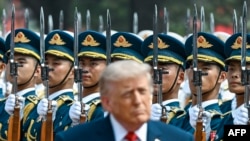
Chinese customs authorities also renewed export licenses for hundreds of US beef producers after many permits expired during tariff disputes last year.
The two governments are additionally discussing a proposed $30 billion “Board of Trade” covering non-sensitive goods, Greer said.
Trump also traveled to Beijing alongside a delegation of major business executives, including Tesla CEO Elon Musk, Nvidia CEO Jensen Huang, and Apple CEO Tim Cook, underscoring the continued importance of economic ties despite years of escalating tensions.
But analysts say the summit ultimately reinforced that the relationship is increasingly defined by competition management rather than reconciliation.

Taiwan remained one of the clearest unresolved flashpoints.
Xi warned Trump during the talks that the self-governing island could become a source of “clashes and even conflicts” if mishandled, while Beijing continued pressing Washington to curb arms sales and political support for Taipei.
At the same time, disputes over export controls, artificial intelligence, rare earth minerals, and military influence across Asia remain largely unresolved.
“Trump is getting modest movement he can market at home. Xi is laying the groundwork for the stability Beijing needs while preserving the leverage it has built,” Singleton said. “Both sides are trying to keep momentum alive without changing the underlying terms of the rivalry.”