





The White House has outlined four objectives of its ongoing aerial assault against Iran, carried out in tandem with Israel, now in its fourth day.
Announcing the aims of Operation Epic Fury, as the campaign has been named, the White House wrote on X on March 3 that "America will win. The terrorist Iranian regime will be defeated."
It listed the steps to this goal as being to "destroy the Iranian regime's missiles," "Annihilate their Navy," Ensure their terrorist proxies can no longer destabilize the world," and "Ensure Iran can NEVER obtain a nuclear weapon."
Analysts, however, were quick to note that "regime change" was absent from the objectives.
"White House releases objectives for Operation Epic Fury. Regime change not [any longer] a specific goal," wrote political scientist and author Ian Bremmer on X.
Meanwhile, speaking at the White House alongside the visiting German Chancellor Friedrich Merz, US President Donald Trump said that "something had to be done" about Iran.
"I had a feeling Iran would have attacked us first," he told journalists on March 3.
"They are even attacking countries, which were kind of friendly with them and were doing nothing hoping to sit it out," Trump continued, noting that Iranian drones and missiles have hit the UAE, Qatar, Saudi Arabia, and Oman -- which had been mediating talks between Washington and just days before the aerial campaign began on February 28.
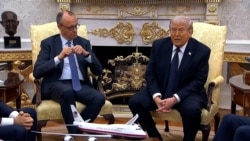

Merz later told reporters it would be "good news" for Iran and its people if the current regime in Tehran were to come to an end.
He added, though, that he was unsure if military strikes would bring internal government changes there and said he supported the Iranian people's right to decide their future. "This [action against Iran] is not without risk, and we would also have to bear the consequences," he told reporters.
Merz said Iran was threatening Israel's security, destabilizing the region, and spreading terror, adding that he wanted to work toward a deal with Tehran that would end Iran's nuclear program for all time.
Earlier, in an opening statement before his talks with Trump, Merz said, "We are on the same page [with Washington] in terms of getting this terrible regime in Tehran away," although he added that there has not been a request for German direct participation in hostilities.
Trump, asked about rising oil and gas prices as the result of the conflict, said he was confident they would return to normal as soon as military actions are over and that it would not be in too distant future. "Pretty much everything is being knocked out" in Iran already, he said.
'Too Late' For Talks
Earlier on March 3, Trump said it was "too late" for talks with Iran after Tehran made a bid to hold discussions amid the US-Israeli strikes.
"Their air defense, Air Force, Navy, and Leadership is gone. They want to talk. I said 'Too Late!'" Trump wrote in a social media post on March 3. He did not say when Iranian officials had indicated they were willing to enter talks.
Iran's ambassador to the United Nations in Geneva also cast doubt on any talks, saying that "for the time being we are very doubtful about the usefulness of negotiation."
With diplomacy appearing at a standstill, air-raid sirens wailed across the Middle East.
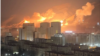
Reports from inside Iran indicate that American and Israeli fighter jets attacked a number of military, police, and intelligence sites in various Iranian cities on March 3.
Among these places are the Assembly of Experts building in Qom, intelligence news headquarters for the Islamic Revolutionary Guards Corps (IRGC) in Urmia, the Revolutionary and Public Court in Urmia, the IRGC's "Unity" base in the city of Paveh, and the Najafabad missile base in the north of Isfahan Province.
US Diplomatic Posts, Allies Hit
As the United States and Israel wage war against Iran, Tehran is widening the theater of the conflict and raising the costs for Washington in a bid to secure an eventual cease-fire, experts say.
Iran has fired hundreds of missiles and drones targeting US military bases as well as key energy and commercial sites in Saudi Arabia, the United Arab Emirates, Kuwait, Bahrain, and Qatar -- all American allies -- since February 28.
Officials in Qatar said an Iranian ballistic missile hit the US military base at Al-Udeid on March 3 without causing casualties.
Explosions were heard in Tehran and Beirut, while Iranian drones slammed into the US Embassy in Saudi Arabia, which subsequently said it was suspending in-person services a day after Washington's embassy in Kuwait did the same.
The US Embassy in Riyadh was struck by two drones, causing a "limited fire" and "minor material damage," Saudi Arabia's Defense Ministry said, as tensions escalate across the Middle East.
The ministry said an initial assessment pointed to a drone attack on the diplomatic compound in the Saudi capital. Later reports said additional drones were targeting the site as Iran continued its retaliatory attacks across the Persian Gulf following US and Israeli strikes that have resulted in rocket and drone fire across the region.
The Riyadh embassy building was empty at the time of the attack and no casualties were reported.
A fire was contained near the US Consulate in Dubai on March 3 after a drone strike, US authorities confirmed. US Secretary of State Marco Rubio said a drone had struck a parking lot near the consulate and said all personnel were safe and accounted for.
Senior State Department officials told RFE/RL that the affected diplomatic outposts were continuing to operate, although most of the work was being done remotely.
Rubio told reporters that "our embassies and diplomatic facilities are under direct attack from a terroristic regime."
Injuries In Israel
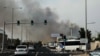
Israel, meanwhile, said at least seven people were injured in the central part of the country after Iranian missiles rained down on the area, which includes Tel Aviv.
"Search and rescue forces, together with numerous emergency teams, are currently operating at the impact sites in central Israel," the military said. "The circumstances of the impact are under review."
The fighting has reverberated outside the region, with stock markets, currencies, and commodities prices reflecting concerns that the conflict may spin out of control.
The price of Brent crude oil in global markets rose to more than $82 per barrel on March 3, about $10 higher than it was before the United States and Israel launched attacks on Iran on February 28.

