




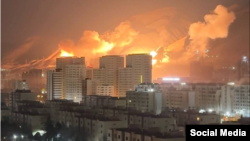
In just a few days, the United States and Israel's massive bombardment of Iran has sprawled into a regional war that has dragged in key America allies in the Middle East and sent global energy prices soaring.
Iran has responded to the joint US and Israeli campaign, which killed Supreme Leader Ayatollah Ali Khamenei on February 28, by unleashing unprecedented barrages of missiles and drones at US military and diplomatic facilities and striking key energy infrastructure in the Persian Gulf.
Fighting an existential threat, experts say, Tehran is aiming to raise the economic, political, and military pain of the conflict for the United States and secure an end to hostilities.
"Tehran appears to be wagering on [US President] Donald Trump's reluctance to become entangled in messy and costly wars, seeking to demonstrate that it possesses the capability to prolong the conflict and make it increasingly complex and expensive," said Hamidreza Azizi, a fellow at the German Institute for International and Security Affairs.
Incurring Direct Costs On US
Iran is imposing direct costs on the United States, which has so far lost six service members in the war.
Iranian ballistic missiles and drones have hit at least six of the estimated 19 US military facilities across the Middle East that house around 40,000 American troops. That includes sites in Kuwait, Qatar, the United Arab Emirates, Bahrain, and Iraq.
Tehran has also targeted US diplomatic facilities in the region. The US Embassy in Riyadh was struck by two suspected Iranian drones on March 3, causing a fire. A fire was also reported near the US Embassy in Kuwait on March 2 following Iranian drone attacks.
Global Energy Rattled
Iran is also pressuring the United States by targeting Washington's Arab partners. Iranian attacks on the Gulf states have not been limited to US military installations. Major airports, luxury hotels, and key energy facilities have also been struck.
Iranian drones targeted a power plant and energy facility in Qatar on March 2, leading one of the world's largest exporters of liquefied natural gas to stop production. A key oil refinery in Saudi Arabia was partially shut down after Iranian drones targeted the facility.
Meanwhile, the Strait of Hormuz has effectively been closed, and vessels have rerouted since the start of the war. About a fifth of the world's oil supply flows through the narrow waterway connecting the Persian Gulf to the open ocean.
The combination of attacks on key energy facilities and disruption to shipping in the Persian Gulf, a region that produces around 40 percent of the world's oil, has sent the prices of oil and natural gas soaring and raised fears over global supplies.
New War Front
Iran's key nonstate ally, Lebanese militant group Hezbollah, opened a second front in the war when it launched rocket and drone attacks on Israel on March 2. Israel has retaliated with air strikes that have killed scores of people and sent in additional forces into southern Lebanon on March 3.
Other members of Iran's so-called axis of resistance -- Tehran's regional network of armed proxies and partners -- have pledged to join the war, including Yemen's Houthi rebels and pro-Iranian Shi'ite militias in Iraq.
The Houthi rebels have threatened to withdraw from a cease-fire deal reached with the United States last year. The armed group agreed to halt their missile and drone attacks on international shipping in the Red Sea. In exchange, the United States pledged to stop air strikes targeting the group.
"The potential entry -- or deeper engagement -- of Hezbollah and possibly the Houthis would significantly expand escalation boundaries," said Danny Citrinowicz, a senior researcher on Iran at the Institute for National Security Studies at Tel Aviv University on March 2.
"Such involvement would both increase pressure for de-escalation internationally and raise the economic and security costs for Israel and Gulf states. This aligns with Tehran's longstanding doctrine of expanding the geographic scope of confrontation in order to dilute direct pressure on the Iranian homeland."

