




Ukrainian President Volodymyr Zelenskyy accused Russia of failing to adhere to President Donald Trump's cease-fire on air strikes targeting energy infrastructure as officials across Europe looked for clarity on the truce and the US leader's deal with Moscow to allow Russian diesel exports.
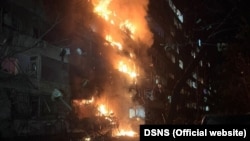
In the latest social media post on October 13, Zelenskyy said Russia used ballistic missiles to hit a power plant in Kyiv, He said Ukraine did was not alerted about the incoming air strike and that a residential building was damaged.
"It certainly is not fair." Zelenskiyy wrote. "Russia is showing that it does not see it necessary to respect what the US president says. It is important that the United States sees what is actually happening."
Trump has maintained that the truce -- which he unilaterally announced on October 11 -- is in place despite a lack of confirmation from either side.
Zelenskyy, who was quoted as saying the truce was "news to me," said in a social media post that, over the past two days, Ukraine has held back from striking Russian oil refineries as demanded by Trump.
But, he added, Russia has not acted in kind.
"During this time, the Russians have attacked both our energy facilities and our critical infrastructure, sending absolutely clear signals that they have no intention of refraining from strikes on Ukraine," Zelenskyy wrote on October 13.
The US leader has in the past declared that the sides had agreed to cease attacks on energy sites, most recently on September 14, only to see Russian President Vladimir Putin continue the attacks, ending any hopes of a lasting truce.
Later on October 12, Zelenskyy said Ukraine is willing to halt attacks on Russian refining operations if Moscow agrees to stop its strikes on Ukrainian energy systems.
Speaking to reporters on the White House lawn on October 12, Trump told reporters: “They agreed [to the cease-fire]. You know why? Because I said, ‘You agree’ -- that's why. They agreed because I said they agreed, and that thing has to get settled.”
Asked on October 13 about the violations of the cease-fire by Russia, Trump said he both Putin and Zelenskyy were "a little bit off." He said they are both "hitting each other," but it would "soon come to an end," because they both" want it, they just don't know how" to get there.
Kyiv Power Plant Hit
Just hours after Trump's announcement, Russian drones hit a power plant in Kyiv and energy facilities in the city of Kharkiv, sowing further confusion on the situation.
That prompted Zelenskyy to tell a security conference in Warsaw that "if Russia wants us to stop our long-range strikes against its oil refineries and oil exports, then Russia must stop its strikes against our energy system and critical infrastructure and stop killing our people."
Russian air strikes continued on October 13, with Ukrainian authorities saying at least three people were killed and 11 others injured when a Russian missile hit a four-story residential building. Kyiv Mayor Vitali Klitschko said the capital also came under attack. It was not clear if Russia targeted any energy facilities in its attacks.
Trump also defended an agreement on allowing diesel exports from Russia, which he first announced after a conversation with Putin on October 9.
He argued that Europe had continued buying Russian energy despite the war. While some European countries do still purchase Russian natural gas and crude oil, imports have fallen dramatically as the continent weans itself off Russian supplies.
Trump has said that under the deal, the United States would immediately import 300,000 metric tons of Russian diesel, with millions more expected to follow.
As part of the move, the US Treasury Department's Office of Foreign Assets Control issued a General License 135, authorizing transactions involving Russian diesel, including imports into the United States, through April 7, 2027.
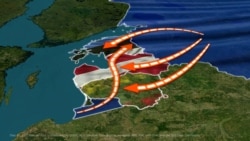

At a forum in Singapore on October 13, Finnish Foreign Minister Elina Valtonen told Reuters that as the leader of the free world, the United States should stand with Ukraine, which she said has chosen to be free from Russia's oppression.
"The rest of the world should be on the side of the victim and certainly those countries who want to still be strong for the concept of freedom," she said.
Ahead of November 3 midterm elections, the Trump administration has presented the deal as a response to high fuel costs.
But the move has sparked a wave of criticism from Democrats and even some Republican officials, who warned it would embolden Putin to continue his war on Ukraine.
Trump dismissed the Republicans who criticized the deal as lawmakers who "can't really be serious.”
Senators Push Back
A bipartisan group of seven senators has urged the administration to reverse its decision, warning that Russian energy revenue helps finance Moscow's war against Ukraine.
The US “should not provide Putin with a financial lifeline while Russia continues to kill Ukrainian civilians,” they said.
The statement was signed by Republican Senators Susan Collins, Thom Tillis, John Curtis, and Lisa Murkowski, along with Democrats Jeanne Shaheen, Richard Blumenthal, and Ron Wyden.
On October 12, another Republican Senator Jerry Moran of Kansas warned that allowing Russian diesel imports risked “erasing our leverage, damaging our credibility with allies, and emboldening our adversaries.”
Republican House Majority Whip Tom Emmer defended the president, calling the deal “another example of our president thinking out of the box” and describing it as another step toward resolving the war.
Energy analysts who spoke with RFE/RL questioned whether the additional supplies could significantly affect prices before the vote.
Mark Temnycky, a nonresident fellow at the Atlantic Council's Eurasia Center, told RFE/RL that the announced 300,000 metric tons of diesel would amount to roughly half a day's US consumption, based on figures from the US Energy Information Administration.
Temnycky questioned whether Russia could deliver the promised volumes, citing restrictions on production and exports following Ukrainian attacks on Russian refineries.
He warned that easing sanctions without securing concessions from Moscow could weaken international pressure on Russia and provide Moscow with potential revenue and a political victory for Putin.
Ariel Cohen, managing director of energy, growth, and security at the International Tax and Investment Center, said Trump should use US leverage to secure a cease-fire rather than treat an energy agreement as a substitute for progress toward peace.
Cohen added that any energy truce should be reciprocal, covering Ukrainian power-generation facilities and electricity grids as well as Russian energy ports, pipelines, and refineries.
“It's either all energy infrastructure, including all the power generation and grid in Ukraine, versus in exchange for energy ports, energy pipelines, energy refineries in Russia,” he said.
William Taylor, a former US ambassador to Ukraine who served under President George W. Bush and during Trump's first administration, told RFE/RL that a cease-fire could not take effect without agreement from both sides.
Taylor said Zelenskyy had indicated his willingness to participate but that he had seen no evidence Putin had agreed to halt attacks.

