




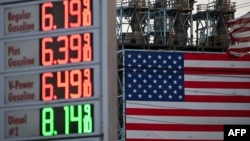
WASHINGTON -- Republican Representative Brian Fitzpatrick plans to force a House vote on legislation blocking Russian oil purchases, challenging President Donald Trump's decision to ease restrictions on Russian diesel exports as lawmakers warn the move could help finance Moscow's war against Ukraine.
Fitzpatrick (Republican-Pennsylvania), co-chair of the House Ukraine Caucus, announced on October 10 that he would introduce the Ronald Reagan Peace Through Strength Act.
“We will be introducing bipartisan legislation to block any and all purchases of Russian oil,” Fitzpatrick wrote on X. “It will be forced to the Floor via discharge and it will pass overwhelmingly.”
Representative Don Bacon (Republican-Nebraska) has agreed to co-sponsor the bill. A Democratic sponsor had not been identified.
A discharge petition can force a House vote without approval from the relevant committee or House leadership if it secures 218 signatures.
The effort faces time constraints: Congress is not scheduled to resume voting for several weeks, and the current congressional term ends in January. Any bill would also need Senate approval and could face White House opposition.
Fitzpatrick invoked former President Ronald Reagan's approach to confronting Moscow and reaffirmed congressional support for Ukrainian President Volodymyr Zelenskyy, whom Trump has again criticized.
“Russia illegally invaded Ukraine. Russia is squarely to blame,” Fitzpatrick wrote, adding that Congress and the American people stood behind Zelenskyy “until Ukrainian victory is achieved.”
Republicans Question Sanctions Reversal
The proposed legislation reflects concern among some Republicans that easing Russian energy restrictions could undermine pressure on Russian President Vladimir Putin.
Representative Michael McCaul (Republican-Texas), the former chairman of the House Foreign Affairs Committee, warned that lifting sanctions could “fund the Kremlin's war machine -- emboldening more violence and destruction.”
He cited the Lindsey O. Graham Sanctioning Russia and Iran Act, which Trump signed in September. The law authorizes the president, under specified conditions, to impose tariffs of up to 100 percent on major purchasers of Russian energy. McCaul said it gave Trump leverage over Russia and China to help secure a negotiated end to the war.
Senator Lisa Murkowski (Republican-Alaska) urged Trump to use those authorities instead of allowing Russia to earn more from diesel exports.

“We can discuss Russia's return to global energy markets once the war is over, but in the meantime, we need to cut off everything fueling it,” she wrote on social media.
Democrats Cite Existing Oil Ban
Democrats and former officials have also pointed to the Ending Importation of Russian Oil Act of 2022, which prohibits Russian oil imports into the United States unless the president certifies that Russia has met specified conditions, including withdrawing from Ukraine, recognizing Ukrainian sovereignty and posing no threat to NATO.
The law passed the Senate 100-0 and the House 413-9 after Russia launched its full-scale invasion in February 2022.
Former Representative Tom Malinowski, also a former top State Department official, urged Democratic leaders to use the law's expedited procedures to challenge the administration's decision.
“Under this law, House and Senate Democratic leaders can introduce a ‘Joint Resolution of Disapproval’ to prevent the purchase of Russian oil, which Congress then has to vote on in an expedited manner,” Malinowski wrote on social media.


“Schumer and Jeffries should do so ASAP,” he added, referring to Senate Democratic leader Chuck Schumer and House Democratic leader Hakeem Jeffries.
Whether the 2022 law applies to the latest arrangement remains a key question as the administration's temporary authorization for Russian diesel exports faces scrutiny.
Advocates Warn Of Damage To Sanctions
Daniel Balson, advocacy director at Razom for Ukraine, told RFE/RL that Trump's decision undermined the purpose of the sanctions legislation passed weeks earlier.
“Three weeks ago, Congress passed the Lindsey Graham Sanctioning Russia and Iran Act. This bill was designed to force other countries to lower their Russian energy dependence. President Trump's recent decision just increased our own,” Balson said.
He urged lawmakers to challenge the move to protect Ukraine and the credibility of congressional action. Although he had not seen Fitzpatrick's bill, Balson said pro-Ukraine advocates would pursue “any and all legislative avenues” to oppose the decision.
Senator Angus King, an independent from Maine who generally votes with Democrats, said in a statement that the agreement would offer little relief to American consumers while benefiting Russia.

Citing administration figures, King said the deal covered 300,000 tons of diesel for October and 500,000 tons for November -- roughly equivalent to a day's diesel consumption in the United States.
“This so-called deal with Russia will do little for America and much for Vladimir Putin as he seeks to sustain his murderous campaign on Ukraine,” King said. He called the agreement “a fraud.”
Trump Again Calls For Zelenskyy To Be Replaced
Trump on October 10 renewed his attacks on Zelenskyy, saying Ukraine should hold an election and replace its president with a leader willing to reach an agreement with Russia.
“Well, I think he should have an election. And he could have settled this thing many times,” Trump told reporters.
Earlier, Trump had said Ukraine should “get a new leader who can make a deal.” He also demanded that Kyiv “damn well stop” attacking Russian oil refineries, which Ukraine has targeted to disrupt Moscow's war economy and fuel supplies.
Trump blamed Zelenskyy for failing to secure a settlement, a claim at odds with Kyiv’s position that any agreement must protect Ukraine’s sovereignty and with lawmakers’ calls to maintain pressure on Moscow. Trump also portrayed Putin as eager for peace and praised the release of Russian oil onto global markets.
“It surely looks bad. The president has always had a moral blindness when it comes to Putin. Propping up Russia's war economy is terrible,” Bacon told RFE/RL.
Trump's remarks came hours after Russian strikes killed at least 20 people in the southeastern Ukrainian city of Zaporizhzhya.
Zelenskyy has said elections cannot be held under martial law and amid the security risks created by Russia's invasion. Ukrainian officials have also cited the need to ensure soldiers and displaced citizens can participate in a credible vote.
Ukrainian Foreign Minister Andriy Sybiha issued a statement late on October 10 backing the Ukrainian president.
Zelenskyy "leads our nation in a time of war -- a war for independence, freedom, and dignity. He has the support of the Ukrainian people, and they have the right to decide. Statements from abroad only confirm that he is doing his job well. He deserves support," Sybiha wrote on X.
EU Rejects Easing Pressure On Russia
European officials criticized the diesel agreement, warning that additional Russian energy revenue could help sustain the war.
EU foreign policy chief Kaja Kallas said Russian strikes had killed more than 80 Ukrainian civilians over the past two days and that Moscow had intensified hybrid attacks against EU member states and NATO allies.
“This is not the time to ease pressure on Russia, and Europe won't,” Kallas said, adding that EU foreign ministers planned to announce a major new round of sanctions on October 12 targeting people and organizations supporting Moscow's war effort.
Germany also reaffirmed its commitment to existing sanctions and said it would work with European partners on further measures.
A spokesman for Chancellor Friedrich Merz said Berlin stood by its restrictions, while government spokesman Stefan Kornelius reiterated support for Ukraine. Economics Minister Katherina Reiche also backed the EU sanctions packages.
Germany's Fuels and Energy Trade Association said it did not expect the agreement to have a major effect on petrol-station prices.

