



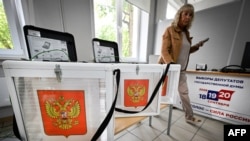
Russians cast ballots to choose lawmakers for the State Duma, with the all-out war on Ukraine and a slowing economy looming over the country's first parliamentary elections since the start of the 2022 invasion.
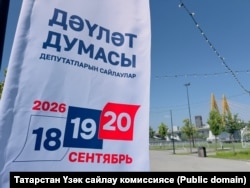
Voters in the Pacific region of Kamchatka, nine time zones ahead of Moscow, kicked off the September 18-20 balloting. Official results on the new composition of the 450-seat lower house of parliament are expected by September 22.
United Russia, the Kremlin-linked party that dominates the Duma as well as legislatures and regional governments nationwide, has been projected to maintain or increase its majority.
Since President Vladimir Putin came to power over a quarter-century ago, the Kremlin has increasingly stifled dissent, marginalized political opponents, and manipulated elections, leaving little room for surprises.
Meanwhile, the only prominent political party opposing the full-scale war, now in its fifth year, was barred from the ballot weeks ahead of the vote.
Amid Kremlin fears of apathy and frustration, Putin, who frequently accuses the West of seeking to weaken or destroy Russia, exhorted Russians to vote, calling the election a barometer of support for the war. More than 1.5 million Russian soldiers have been killed or wounded in the conflict, according to Western estimates.
"Your choice and your will once again demonstrate that millions of people stand behind our troops, that we are a united people bound by shared values, historical memory, and love for the Motherland, and no one will succeed in dividing or intimidating us or in undermining our sovereignty or our social-political system," Putin said in a speech released on September 16.
Russian authorities have set up voting precincts in the Russian-occupied portions of five Ukrainian regions that Moscow has claimed as Russian territory. Kyiv has denounced the effort.
While no dramatic changes are expected in the composition of the Duma, the Kremlin and the powerful domestic policymaking body known as the Presidential Administration were expected to watch results for hints of the national mood.
Though opinion polling is difficult inside Russia due to oppressive policies that have criminalized dissent or opposition to the war, several polls have pointed to slipping popularity for Putin, as well as United Russia.
Putin himself won reelection in 2024 in a vote that was seen largely as a foregone conclusion and was marred by evidence of fraud.
A growing number of Russians have grown impatient with the war, the largest in Europe since World War II. Russia's total casualties exceed those the country suffered in all wars Moscow has fought since 1945.
Ukraine's casualties are fewer overall but still staggeringly high.
Military commanders have consistently painted a rosy picture of how Russian troops are performing on the battlefield, and the Kremlin has repeatedly suggested that victory is assured.
Russians are also nervous about the potential for another mobilization, similar to the one Putin ordered in September 2022. That effort, which called up 300,000 men, mostly reservists, stunned Russian society, and led to an exodus of hundreds of thousands of people.
The economy, meanwhile, has downshifted sharply after months of torrid growth fueled by government spending on war-related things like soldiers' salaries, death benefits, and investment in armaments and weaponry.
The Central Bank has struggled to tame inflation running well above expectations.

A wide-ranging Ukrainian drone and missile campaign has caused fuel shortages across the country, and has disrupted the country's largest online retailers.
Russia's fractious and beleaguered opposition has called on people to vote for any candidates espousing an anti-war message.
However, the country's best-known liberal political party, Yabloko, was barred from fielding candidates in the Duma vote on a technicality. Yabloko had embraced an anti-war platform for the campaign, and some polls had indicated a sharp uptick in support.