


Last month, in Ryazan, a small city southeast of Moscow, the local affiliate of state-run Rossia TV hosted a televised debate for six local political candidates. All were running for seats in Russia’s lower house of parliament, the State Duma, in upcoming elections beginning later this week.
The channel tried again the following day.
None showed up then either.
The Ryazan event is one small window into Russia’s national mood, as the country holds its first national parliamentary elections since the 2022 launch of the all-out assault on Ukraine --a war that has killed or wounded more than 1.5 million Russian soldiers and put the country on a glide path toward outright police-state authoritarianism.
There are few illusions about the 450-seat State Duma, which stopped being a venue for genuine democratic lawmaking years ago, as President Vladimir Putin and his administration reengineered it into a rubber-stamp legislature.
So why bother holding elections in the first place? And what will the process tell us about Russia and the war on Ukraine?
Here are five things to know ahead of three days of voting, which kick off on September 18.
(Sovereign) Democracy In A Time Of War
It’s not the first nationwide vote that Russia has staged since the February 2022 invasion.
Putin, who has been the country’s preeminent political figure since 1999, won the 2024 presidential election by a landslide, over three candidates from parties that are nominally in the opposition but mostly do the Kremlin’s bidding.
Ahead of the vote, no one doubted the outcome.
Buried with the numbers of the voting, however, were other indicators that were closely watched, especially by the Presidential Administration, a powerful group inside the Kremlin that is charged with ensuring the domestic political system retains a veneer of legitimacy.
Like turnout, for example. Low turnout means an apathetic electorate, and apathy is dangerous for the legitimacy of the Kremlin and the political system.
“These elections are important for the Kremlin because they offer a way to nominally legitimize the regime and the war it is waging against Ukraine, by showing that the public remains supportive of the Kremlin’s militarized political course,” said Natalya Kovaleva, a research fellow at the Russia and Eurasia Program at Chatham House, a London think tank.
“The Kremlin has been trying to strike a difficult balance between rallying public support behind the war effort and avoiding an election that might expose growing dissatisfaction or war fatigue,” she told RFE/RL.
Mobilization Anyone?
The unspoken question looming over the balloting: Afterwards, will there be another nationwide call-up of men to fight in Ukraine?
When Putin last ordered a mobilization in September 2022 – around 300,000 men, mainly reservists – the move stunned the country. Hundreds of thousands of people fled the country.
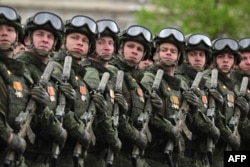
Four years on, Russian forces continue to suffer eyewatering casualties: a top British military official last week said at least 500,000 soldiers have been killed. Other estimates say at least 1 million others have been wounded, many with no chance of returning to the battlefield.
Military recruiters have managed to keep up a pipeline of volunteers heading for the front lines mainly through exorbitant wages and benefits; in some cases, the amount exceeds an entire year’s salary. The benefits paid to widows and survivors of soldiers killed in combat are also substantial.
But the money has drained coffers in many regions, causing financial heartburn for local governments. That has led to a slowdown in the number of monthly recruits -- even as Ukrainian attacks continue to decimate Russian forces.
In recent months, speculation has grown that Putin may seek to escalate the war -- and order a new call-up sometime after the Duma vote.
"As of today, there is no scenario that would require mobilization," Putin said earlier this month during an investment forum in Vladivostok.
“As of today” is the operative phrase.
“The election, as far as I can see, is a combination of a national plebiscite on the war and the Kremlin's policy,” said Aleksandr Kolyandr, a director with Eurasia Group and fellow with the Center for European Policy Analysis, a Washington think tank.
“On the other hand, it’s a national pageant of the bureaucracy: to what extent can the bureaucracy preserve this modicum of normalcy, to what extent the bureaucracy -- and I mean wider bureaucracy, from local governors to schoolteachers -- can ensure that everything goes nicely,” he said during in a roundtable discussion last week.
Vote Vets
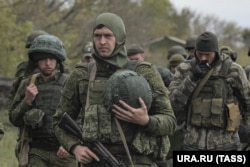
This is the first national election in which a substantial number of war veterans are seeking office.
The Kremlin has built a base of support in part on the enormous economic benefits conferred on men who have voluntarily signed up to fight.
Hundreds of thousands of men, meanwhile, have served and survived in Ukraine -- and returned home, battle-hardened and accustomed to accolades, as well as generous compensation. Some of those were violent criminals sprung from prison to fight.
Two years ago, under First Deputy Prime Minister Sergei Kiriyenko, the Presidential Administration launched a program called “Time of Heroes,” which aimed to identify veterans and train them for public service -- either as bureaucrats or administrators -- or as political candidates.
Putin has labeled veterans Russia’s “new elite.”
The results of Time of Heroes have been mixed.
Still, at least 200 veterans have qualified to appear on the ballot for the Duma elections; about 1,400 others have been cleared to compete for political office on regional and local balloting.
Another thing weighing on the Kremlin’s mind where veterans are concerned is what happened after the Soviet invasion of Afghanistan – when thousands of discharged soldiers returned home and posed major social problems as the Soviet Union was falling apart.
'Those Who Count The Votes Decide Everything'
Russian elections have been under a magnifying glass for years.
In the past, independent voting monitors, as well as statisticians, have documented scores of cases where vote tallies appears to be manipulated in favor of a certain result.
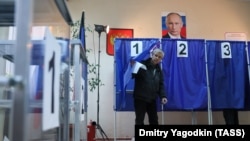
There are other electoral shenanigans too: for example, carousel voting -- where voters are bused from one precinct to another to cast multiple ballots -- or, say, bribing or pressuring public sector workers to cast ballots for a certain candidate.
These days, however, there are no independent monitors. One of the best-known Russian groups, Golos, has been outlawed by authorities. Foreign entities like the Organization for Security and Cooperation in Europe, or groups affiliated with European or American political parties, have been barred for years.
Other groups -- like the political organization founded by the late anti-corruption founder Aleksei Navalny -- have also been outlawed or driven out of the country entirely.
“There are regions, of course, where they'll get whatever [results] they want, without any particular pushback,” Stanislav Andreichuk, a former co-chairman of Golos, told Current Time. “And then there are regions where they won't be able to get what they want; there won't even be a team [of candidates] to do so.”
“It's clear that the authorities, of course, have every opportunity to rig elections to achieve the desired result,” political analyst Ruslan Aisin said.
Though public opinion polling is difficult, some surveys have found a visible drop in support for the war -- as well as a visible drop in support for Putin himself.
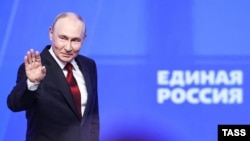
Though Putin is not on the Duma ballot directly, he has been campaigning for the ruling party, United Russia, which, despite wide unpopularity, is expected to continue dominating the Duma.
What About The Opposition?
Under Russia’s “sovereign democracy” -- a variation on the concept of “managed democracy” -- opposition parties are allowed to participate in electoral politics -- but only if they’re authorized by the government.
The result is a contrivance whereby “systemic” opposition parties, like the Communist Party, give lip service to opposing the government but in reality end up voting for government legislation.
Then there’s Yabloko, a longtime liberal standard bearer. Though the party hasn’t had Duma representation since the mid-2000s, it still served as a pressure release valve for Russian society. Russians opposed to the war, for example, could express their dissent by voting for Yabloko.
This time around, however, authorities took no chances. Last month, a Moscow court banned the party from participating in the Duma, citing a series of head-scratching legal complaints.
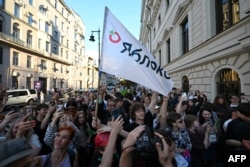
“We understand that Yabloko itself represents a relatively small number of voters, but its agenda brings together a huge number of people,” Andrei Pivovarov, a political activist who was imprisoned for his opposition work, told RFE/RL’s Russian Service.
“Maybe they didn't even know about Yabloko before, or didn't support the organization itself, but its 'For Peace' platform is very much in demand.”
"Yabloko is the only party that opposes the war. It is the only party around which virtually all opposition forces have rallied,” he said.
Since then, several regions have followed suit , and barred the party from fielding candidates in local elections as well.
Authorities also went after another independent candidate, Boris Nadezhdin, who tried to challenge Putin two years ago on an anti-war platform, and sought to do the same thing with this year’s Duma election.
Over the summer, law enforcement authorities quashed that effort with a series of criminal measures against him. He fled Russia last month and now lives in France.
So-called “non-systemic” political organizations include the late Putin opponent Aleksei Navalny’s group. His widow, Yulia Navalnaya, has taken up the mantle, аs have other prominent Russian opposition figures who also now live in exile outside the country.
On September 14, Navalnaya and another opposition personality, Maksim Kats, released a list of candidates they were endorsing for their opposition to the war against Ukraine.