




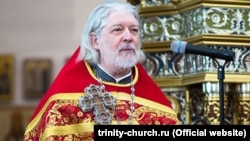
For more than 20 years, Father Aleksei Uminsky served as the rector of a church in a quiet corner of central Moscow. His dismissal and defrocking took about 10 days.
On January 4, 2024, three days before Russian Orthodox Christmas, the archpriest responsible for the area phoned Uminsky and told him to appear before him the following day. When he did so, the archpriest handed him a decree suspending him from the ministry -- revoking his authority to preach to his flock.
Less than an hour later, Uminsky stood before a disciplinary committee whose four members did not identify themselves but asked him several questions about why he was not reading a prayer in support of Russia’s war on Ukraine in his services, then confirmed his suspension and ordered him to remove the cross from around his neck immediately.
In the days after Christmas, Uminsky was repeatedly summoned by e-mail and phone to appear before a church court for a hearing on his potential defrocking. He did not show up instead leaving Russia after a fellow priest told him he was to be arrested after the ecclesiastical trial.
He soon received an e-mail notification that the head of the Russian Orthodox Church, Moscow Patriarch Kirill, had approved the January 13 diocese court decision to defrock him for “refusing…to read the prayer for Holy Rus during the Divine Liturgy,” Uminsky told Systema, RFE/RL’s Russian investigative unit.
Uminsky, 65, is one of about 50 Russian Orthodox priests who have been persecuted by the church for opposition to Russia’s war against Ukraine or support for Ukraine in its defense against the invasion, according to Christians Against War, an international monitoring group.
Several of them, like Uminsky, were punished for declining to read the Prayer for Holy Rus, which the Moscow Patriarchate has used to make explicit support for the war against Ukraine part of services nationwide.
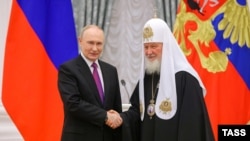
Kirill, a vocal backer of President Vladimir Putin and the full-scale invasion he launched in February 2022, invented the prayer and read it in a service that September. Now mandatory, it says that “those who wish to wage war have risen up against Holy Rus” and asks God to “grant us victory by Your power.”
When the disciplinary committee asked him why he wasn’t reading the prayer, Uminsky replied, “I don't know what Holy Rus is," he told Systema. He said he frequently receives letters from former colleagues struggling with a dilemma: they find it impossible to pray for the war, but fear denunciations and ecclesiastical judgment.
The church crackdown on critics of the war has affected clerics and parishioners from Khabarovsk in the Russian Far East to Vilnius, where several clerics from the Lithuanian diocese of the Russian Orthodox Church have been punished for opposing the war.
'This Is A Closed Hearing'
They include Vladimir Selyavko, who was defrocked in 2022 along with a handful of colleagues at the main Russian Orthodox cathedral in the capital of the NATO and EU nation – including its senior cleric -- who made no secret of their anti-war stance.
Selyavko suspects that the church’s prosecution of him and the others was initiated by the same cleric who then decided their fate as the judge in their church trials, a newly installed bishop who saw printouts of their antiwar statements on his desk when he took up the post.
The Russian state has ramped up its persistent clampdown on dissent since the start of the full-scale invasion, seeking to silence all criticism of the war against Ukraine -- like Russia, a mostly Orthodox Christian country.
In some ways, defrocked priests say, the disciplinary system in the Russian Orthodox Church echoes the temporal Russian justice system -- particularly in politically motivated cases, the outcome is often predetermined and acquittals are vanishingly rare.
But some aspects of the church system seem even less transparent than Russia’s temporal courts, where the judicial branch is formally separate from the executive and a show of playing by rules is part of the pantomime.
Accounts from clerics like Uminsky and Selyavko point to an opaque series of developments in which a priest facing discipline or defrocking has little recourse to lawyers or other forms of protection.
“There is no procedural code at all. The requirements for the court are not described anywhere,” Andrei Kurayev, a priest who was fined in 2022 for criticizing the war and fled Russia the following year, told Systema. Patriarch Kirill had barred Kurayev from conducting services in 2020, and a church court ordered him defrocked the same year.
“If, for example, witnesses may be called in a case, no one knows how to call them, who will pay for their travel, and so on. The prosecutor and the judge are one and the same. The indictment is brought by the same person who delivers the verdict,” he said. “A person summoned to court is not informed of the subject of the charge.”
Diocesan court judges are appointed by the bishop, receive no salary, and continue to serve in ordinary parishes, meaning they are entirely dependent on the bishop, he said.
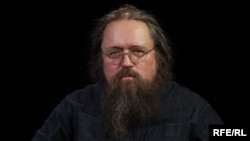
“When you ask, ‘Can I bring a lawyer?’ they answer, ‘No, this is a closed hearing.’ This is contrary to tradition; in the Byzantine Empire, such lawyers were provided, and an entire staff was supported by the Patriarchate,” said Kurayev, the author of an 800-page book about church courts.
"Before the 1917 Revolution, Russia had ecclesiastical courts, and there were very serious ecclesiastical lawyers…. Nothing like this existed in Soviet Russia, nor does it exist in post-Soviet Russia,” Sergei Chapnin, director of communications at the Orthodox Christian Studies Center of Fordham University in New York, told Systema.
Russian Orthodox Church courts “functioned normally” before the Bolshevik Revolution, Kurayev said, but “the Soviet regime destroyed this tradition.” It was restored in 2004, he said, but “only began to function” under Kirill, who “drafted church court rules on the fly because he doesn't always find it convenient to deal with undesirable priests himself.”
Sadness But No Regret
Formally, defrocked priests can appeal rulings handed down by a diocesan court to the Supreme Ecclesiastical Court, Chapnin said.
But with little hope of a successful appeal inside the system, defrocked priests have shunned that option. Some have turned instead turned an approach that “had not been used for centuries in relation to the Russian Orthodox Church,” Chapnin said: appealing to the Ecumenical Court under Ecumenical Patriarch Bartholomew of Constantinople.
Moscow’s war against Ukraine has badly damaged already tense ties between the Russian Orthodox Church and Bartholomew, the spiritual head of all Orthodox Christians.
Kurayev, Uminsky, and Selyavko have had their ecclesiastical ranks reinstated by Bartholomew, following lengthy and painstaking efforts. All three speak with sadness over the separation from their flocks at the hands of a church whose support for Russia’s war against Ukraine they could not accept.
The Constantinople Patriarchate assigned Uminsky to a small church in Paris and provided him with a small apartment above the church but no salary; he makes a living by giving lectures and sermons on social media. He likened his separation from the parishioners at his former church in Moscow to separation from his family.
Selyavko remains in Lithuania, where he now serves at a church that was converted into a concert hall in the Soviet era. It has a stage but no iconostasis, and his services are attended by two dozen people instead of thousands.
Every Sunday morning, Selyavko takes a folding lectern, a couple of icon stands, and candle holders from a storeroom, conducts a service -- and puts it all back in the storeroom afterwards.
He does not regret opposing the war, but laments what he has lost.
“My conscience forced me to do it,” he said. “But it feels like you’re walking, on your own two feet, into an operating room where they’re going to amputate something…. I dreamed of being a priest since I was six. There are hundreds of people I baptized, married, and performed funeral services for their parents, and now they don’t greet me, they cross to the other side of the street…. My uncle, a priest, no longer speaks to me, [and neither do] one of my brothers and my father-in-law, who’s a priest. I can’t calmly visit my father’s grave, because I’ll end up on the grounds of a community that no longer accepts me.”