




KYIV -- Russia fired its newest hypersonic missile at a Kyiv region town, along with hundreds of drones and other missiles, in one of the biggest attacks on the Ukrainian capital in recent memory. At least four people were reported killed and the death toll was expected to climb.
Firefighters struggled to douse flames at buildings in multiple parts of the capital on May 24, and rescuers dug through the rubble of apartment buildings looking for survivors.
At least two people were killed in the capital, and more than 77 people were wounded, including two children, Kyiv Mayor Vitali Klitschko said. Two more people were killed in the wider Kyiv region.
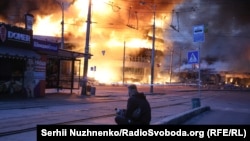
Oleskandr, a 30-year-old Kyiv resident, said he and his relatives had heeded the alerts of an incoming attack and took shelter in their apartment's hallway.
"If we'd been sleeping in our bedroom, they would have found two dead bodies there. Everything was smashed, the wall collapsed," he told RFE/RL's Ukrainian Service.
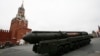
In the barrage, which included more than 600 drones, Russia also used its newest hypersonic, nuclear-capable missile -- the Oreshnik -- to hit Bila Tserkva, a town about 80 kilometers south of Kyiv.
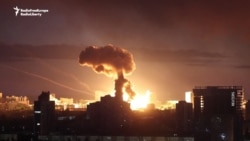

It's the third time that Russia has used the Oreshnik against Ukrainian targets; once in a city near the Polish border, and the other, on the central city of Dnipro. It's the first time the missile was fired at the Kyiv region.
In addition to being a show of force, Russia's Defense Ministry also said the Oreshnik attack was also intended to be retaliation for "Ukraine's terrorist attacks on civilian infrastructure."

That appeared to be a reference to a strike on a school dormitory last week in a Russian-occupied Ukrainian region, which officials said killed more than a dozen people. Russian President Vladimir Putin had called the incident "terrorism."
Overall, the Russian assault hit a water supply facility, a commercial market, and dozens of residential buildings, Ukrainian President Volodymyr Zelenskyy said.
Ihor, a Kyiv resident in his mid-20s, said he was home when the first strike came, and he took shelter in the bathroom.
"The second blast followed. I held the door with my hands. I was lucky, nothing happened to me," he said. "I ripped the door handle off, broke the door down and saw that the next room was on fire. I only took my shoes and ran outside. All I have is my phone, my t-shirt, and my sneakers. That’s it.”
The attack followed warnings by Zelenskyy -- and unusually, by the US Embassy in Kyiv -- saying a massive attack was possible, including possible use of an Oreshnik, and urging people to take shelter.
The specificity of the warnings suggested Western intelligence had detected preparations for the missile ahead of time -- or were warned by Moscow.
Across the country, the Russian strikes wounded 12 people in the Kharkiv region, 11 in the Cherkasy region and seven in the Dnipropetrovsk region, officials said.
An Angry Putin Speech
In his May 22 speech, Putin asserted Ukraine deliberately attacked the dormitory in Russian-occupied Luhansk, and he said the building served no military purpose.
Russian officials said at least 16 people were killed.
Ukrainians officials have made no comment on the allegations.
Putin's televised speech was unusually bellicose, and had echoes of the rhetoric he used in the immediate run-up to the February 2022 invasion.

“The reasons behind the behavior of the Kyiv regime are obvious," Putin said. "These are constant failures on the front line, the loss of positions, towns, and territories. The situation for the Ukrainian military is gradually turning from difficult and critical, into catastrophic."
On the battlefield, Ukrainian forces have fought Russian troops to a standstill. In some places, military observers say, Ukraine has regained some territory, underscoring Russia’s struggles to achieve some of the initial war goals laid out by Putin.
Ukraine's campaign of long-range drone strikes has also rattled Russian authorities. Russia's ability to export oil -- a crucial source of hard revenue -- has been curtailed.
Last month, the Kremlin was forced to drastically scale back the annual Victory Day parade on Red Square, typically a triumphant celebration of Russian military glory.
The Kremlin cited the threat of Ukrainian drones.