




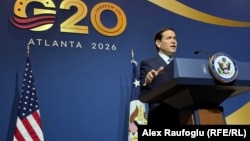
ATLANTA, Georgia -- US Secretary of State Marco Rubio said he was unsure whether a negotiated end to the war in Ukraine was possible, while European officials told RFE/RL the top US diplomat also privately expressed doubts that Russian President Vladimir Putin would attend December's Miami G20 summit.
The European officials, who spoke on condition of anonymity, said Rubio also privately shared his doubts with Western counterparts of a peace deal in the coming months during the two days of G20 foreign ministers' talks in Atlanta, which wrapped up on October 31.
Rubio's public remarks at his closing news conference were notably cautious. Asked by RFE/RL whether he believed a negotiated settlement was achievable given Moscow's unchanged position, he said Washington was still trying to establish whether an agreement could be reached.
"I don't know if negotiated peace is achievable in Ukraine. That's what we're trying to find out," Rubio said. "I don't think anyone here is claiming that we're on the verge of a negotiated settlement."
He said President Donald Trump's envoys, including Jared Kushner and Steve Witkoff, were devoting much of their time to the Ukraine and Iran portfolios. "But I'm not here to tell you we're on the verge of one," Rubio said, adding that he hoped an agreement could eventually be reached.
He also clarified that Ukraine negotiations were not discussed at the Atlanta G20 gathering itself.
Putin's Miami Invitation
Rubio was equally careful when asked whether Putin would attend the December summit, which Trump plans to host at his Doral resort in Florida.
"I don't even know if President Putin is going to come to Miami. They haven't announced that and they haven't confirmed that," he said.
The three European officials told RFE/RL that Rubio had privately expressed doubts the Russian leader would accept the invitation.
They also said the secretary of state defended the administration's decision to invite Russian Foreign Minister Sergei Lavrov to Atlanta and extend an invitation to Putin, arguing that diplomatic engagement was necessary to achieve a settlement.
"How can you have a negotiated settlement between Russia and Ukraine if you don't have the ability to talk to both Russia and Ukraine?" Rubio later asked when pressed by reporters.
He said Trump did not regard meeting or talking with a foreign leader as legitimizing that leader's actions or agreeing with everything they stood for.
Rubio also cited Russia's nuclear arsenal as a reason for maintaining communication between Washington and Moscow, regardless of the state of bilateral relations.
"It is always important that the United States and Russia have communications at some level because of the danger of escalation in the future," he said.
Describing his own interaction with Lavrov in Atlanta, Rubio said the two had not held a formal meeting. They spoke briefly about the possibility of their countries' leaders interacting at the upcoming Asia-Pacific Economic Cooperation (APEC) gathering, but made no firm commitments concerning the G20 summit.

The Western officials said Rubio's private assessment also covered Ukraine's potential NATO membership, which he reportedly described as unrealistic in the short term and unacceptable to Putin.
Rubio reportedly warned that Russia's acquisition of the entire Donbas region would not satisfy the Kremlin's territorial ambitions. It "will not end Russian appetite," he told the Europeans, according to the officials.
The State Department did not immediately respond to a request for comment on the reported private remarks.
Black Sea Opening
While Rubio offered little public optimism about a comprehensive peace agreement, he identified a more limited diplomatic objective that Washington hopes could produce results: a cease-fire covering the Black Sea.
European officials pressed Moscow during the Atlanta talks to halt attacks affecting shipping in the strategic waterway, which is vital for Ukrainian agricultural exports.

Rubio warned that disruptions to grain and energy shipments were creating serious consequences for vulnerable countries, particularly those dependent on food imports. "This is threatening the world for food security and some energy security as well," he said.
The issue was also raised by Ukrainian President Volodymyr Zelenskyy during talks with Turkish President Recep Tayyip Erdogan in Istanbul on October 31. Zelenskyy thanked Ankara for supporting Ukraine's sovereignty and efforts to ensure safe navigation in the Black Sea.
Europeans Challenge Lavrov
The Atlanta gathering exposed deep divisions between Moscow and European governments, with Lavrov's presence prompting several delegations to refuse participation in the traditional G20 family photograph. The photograph was ultimately canceled.
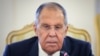
EU foreign policy chief Kaja Kallas accused Lavrov of presenting false narratives about the war during the discussions.
Kallas told reporters that Russia did not appear ready for peace negotiations, pointing to the continued intensity of attacks on Ukraine.
Lavrov, meanwhile, criticized what he called Europe's "arrogant boycott" and praised the Trump administration's willingness to engage with Moscow.
Rubio said the US remained committed to exploring a diplomatic solution, describing the war as devastating for both countries.
He pointed to Russian attacks on Ukrainian energy infrastructure and rising civilian casualties, while also citing the heavy Russian military losses. He estimated that around 20,000 Russians were being killed each month.
"It's a very deadly and destructive war," Rubio said, warning that every additional month of fighting would make the eventual reconstruction of Ukraine more difficult.
He described Washington's central objective as determining whether it could use its contacts with both sides to facilitate an end to the conflict.
The two-day ministerial ended without a joint communique, as disagreements over Ukraine, the Middle East, trade, and maritime security prevented the world's largest economies from reaching consensus.

