




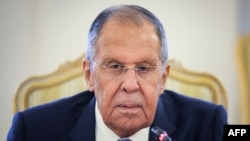
Russian Foreign Minister Sergei Lavrov's return to a major diplomatic gathering in the United States has exposed widening divisions between Washington and its European allies over how to deal with Moscow as Russia continues its war against Ukraine.
The Group of 20 foreign ministers' meeting in Atlanta opened on October 30 with an unusual diplomatic snub: US Secretary of State Marco Rubio canceled a traditional group photograph after European officials, Britain, and Australia refused to appear alongside Lavrov. A US official said Washington decided to cancel the ceremony rather than allow it to become a diplomatic distraction.
US President Donald Trump's administration is seeking to restore diplomatic engagement with the Kremlin, while European governments insist that Russia cannot be treated as a normal international partner while its full-scale invasion of Ukraine continues.
Despite the objections, Lavrov -- who last attended a G20 meeting in February 2025 in Johannesburg -- remained part of the gathering. Later on October 30, an RFE/RL reporter spotted the Russian foreign minister at a welcome reception for ministers hosted by Rubio at Atlanta's Georgia Aquarium.
Missiles, But Not Soon
Meanwhile, the war that has driven much of the diplomatic friction remained a central concern for Ukraine's supporters. The US State Department approved a possible $2.1 billion sale of 500 Patriot air-defense interceptors to Ukraine, financed by contributions from G20 members Germany and Canada, as well as Norway and funds backed by an EU loan. But the missiles are newly manufactured, with deliveries not expected to begin until after 2030.

The decision comes as Ukraine faces an acute shortage of interceptors needed to protect its cities and critical energy infrastructure, as Russia continues to target Ukraine ahead of winter.
Ukrainian President Volodymyr Zelenskyy has repeatedly urged Washington to accelerate deliveries, saying earlier this week that Kyiv had been waiting nearly a month for approval of critical Patriot and NASAMS missile supplies. In a social media post, Zelenskyy said that “500 PAC-3 interceptors is a substantial number” but expressed his dismay over the possible delivery delay.
Alex Plitsas, a nonresident senior fellow at the Atlantic Council and a former Pentagon official, said the Patriots announcement was significant but would not address Ukraine's immediate needs, warning that Russia's continued attacks on energy infrastructure were aimed at terrorizing civilians and forcing Ukraine to capitulate by freezing its population during winter.
Dan Rice, president of American University Kyiv and a former special adviser to the commander-in-chief of Ukraine's armed forces, welcomed the decision. "I think that's fantastic. It gets Ukraine critical weapons that only the US makes," Rice told RFE/RL, referring to the Patriot system's ability to intercept Russian ballistic missiles.
Rice praised Canada, Germany, and Norway for financing the purchase, saying their contributions would help Ukraine protect its civilian population.
A Divided G20
Rubio opened the two-day G20 meeting with an appeal for cooperation, warning that interconnected geopolitical and economic crises threatened global energy and food supplies, trade, supply chains, and freedom of navigation.
"We are facing a series of interconnected economic and geopolitical crises," he told his counterparts.
But discussion of Ukraine quickly exposed the limits of that appeal. British Foreign Secretary Ed Miliband confronted Lavrov over Russian attacks on Ukrainian civilians, saying Russian drones had killed 15 people the previous day. "If we are serious about our values and our interests, we must also work harder to secure just and lasting peace in Ukraine," he said.
EU foreign policy chief Kaja Kallas said ministers had challenged Lavrov directly over what she described as Russian lies and false narratives about the war.


Lavrov showed no indication that Moscow was prepared to soften its position. He reiterated that Russia would not accept a settlement in which Ukraine could pose what Moscow considers a military threat to its security interests.
The Kremlin has also repeatedly rejected proposals for direct talks that would take place outside Russia. Lavrov declined to say whether Russian President Vladimir Putin would attend the G20 leaders' summit in Miami in December, where there has been discussion of a possible meeting with Trump.
The tensions in Atlanta reflect a broader fragmentation of the international order that is making consensus among the world’s major economies increasingly difficult. The wars in Ukraine and the Middle East have only increased these divisions.
Western officials told RFE/RL that G20 participants broadly agreed that the conflict in the Middle East was creating serious economic pressure, particularly through disruptions to energy markets and trade. There were also concerns that renewed US military strikes against Iran could push oil prices sharply higher.
Ministers were expected to discuss freedom of navigation in the Black Sea and the Strait of Hormuz, as well as food security and supply-chain vulnerabilities. The meeting ends on October 31.
Access to critical minerals needed for advanced technologies was also on the agenda, an issue Rubio has sought to address through the US-backed Pax Silica initiative, aimed at reducing dependence on China's dominance in the sector.
But diplomats were skeptical that the meeting would produce a joint declaration. Such statements require consensus, which has become increasingly elusive since Russia launched its full-scale invasion of Ukraine in February 2022.
Poland's Bid
Another dispute in Atlanta centered on Warsaw's efforts to become a full member of the G20.
Poland attended the meeting as a guest at Washington's invitation, with the Trump administration supporting its bid for permanent membership.
Polish Foreign Minister Radoslaw Sikorski said his country deserved a place in the grouping, citing its economic growth and growing international influence.
Rubio backed the proposal at a reception for foreign ministers at Atlanta's Georgia Aquarium, saying Trump believed Poland's economic success and global influence would strengthen the G20.
Lavrov opposed the idea, arguing that inviting Poland violated the principles of multilateral diplomacy and consensus. He also said Poland added nothing to the grouping.
At a news conference following the plenary sessions, Sikorski pushed back against suggestions that Ukraine was losing leverage on the battlefield. He told reporters that Russia's much-hyped offensive had come at an extraordinary human cost and that Ukraine had actually regained territory.
Asked by RFE/RL whether he feared Western allies could push Kyiv toward concessions that would undermine its interests, Sikorski said Europe must stay the course.
The Polish foreign minister also said that Moscow had underestimated Europe's staying power, pointing to frozen Russian assets, European financial support, and weapons purchases. His prescription was to keep Ukraine supplied through the winter.

