




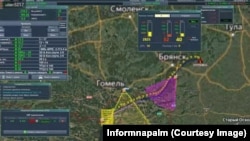
They look like innocent TV transmitters or cellphone towers but are secretly guiding Russian attack drones to targets in Ukraine, according to the Ukrainian authorities.
This is the alleged network of signal relay stations in Belarus that has become a focal point of tension between Kyiv and Minsk.
At its heart is a modification to Russian unmanned aerial vehicles (UAVs) enabling them to switch target mid-flight, becoming more difficult to predict and potentially more deadly. The UAVs are a development of the Iranian-designed Shahed drone, widely used by Russian forces to hit both civilian and military targets in Ukraine.

"These stations can provide the first line of drones with high-quality and reliable communication at a distance of up to 150 kilometers," Ukrainian military aviation and drone expert Anatoliy Khrapchynskiy told RFE/RL’s Belarus Service.
Khrapchynskiy is the development director of the defense enterprise Fly Group Ukraine, a company that specializes in UAV countermeasure systems.. We’ll hear more from him later. But first, how did this start?
Zelenskyy's Ultimatum
The equipment made headlines following an ultimatum by Ukrainian President Volodymyr Zelenskyy that hinted at Ukrainian military or covert action to remove it.
Speaking at a news conference on June 19, Zelenskyy claimed Russia was using signal relay stations in Belarus to help steer their missiles at targets in Ukraine.
"What's the point of [Lukashenko] saying he doesn't want to be in the war? Let him remove this equipment, let him switch it off. I think a week will be enough for him to do that," he said, adding: "If he doesn't do it, we'll do it."
The deadline for the ultimatum was June 26.
On the early evening of June 24, Ukrainian public broadcaster Suspilne reported on its Telegram channel that Belarus had turned off the relay stations two days earlier, citing comments by Zelenskyy.
But Zelenskyy added that it was not yet clear if the equipment had been dismantled, Suspilne said.
Belarus has not made any response to Zelenskyy’s ultimatum and has neither confirmed nor denied the existence of the transponders.
The situation has underlined the fine line being walked by the country’s Kremlin-backed authoritarian ruler, Aleksandr Lukashenko, as he tries to avoid getting dragged into the war without upsetting Moscow.



On June 25, Lukashenko said during a meeting with the Russian ambassador to Minsk, Boris Gryzlov, that he’d met with Zelenskyy’s representatives and warned them not to try to involve Belarus in the war.
The next day, Belarusian state media announced he had traveled to Russia for talks with President Vladimir Putin on bilateral ties and the "regional and global situation."
So, what do we know about the equipment at the heart of the dispute between Minsk and Kyiv?
From Dumb Drones To Smart Drones
Khrapchynskiy explained that the relay stations are needed due to improvements in the Russian-modified Shahed drone technology.
"The first Shaheds were programmed to certain coordinates. They simply flew to a predetermined point,” he said.
“Now we say that the Shaheds used by Russia can be partially controlled by an operator or their flight mission can be changed on the fly. This allows you to change targets, to dynamically form an air attack, for example, thanks to obtaining new intelligence about Ukrainian antiaircraft groups. Accordingly, for this, operators need to be able to communicate with the drones."
Serhiy Beskrestnov, a Ukrainian Defense Ministry adviser, wrote in a social media post in February that the new drones also communicated with each other -- and were linked to ground stations based in Belarus.
“Several such points were discovered in Belarus, and they served the Shaheds in different parts of our country. For example, one of the points reached Kyiv…Another point supported attacks by the Shaheds on western Ukraine,” he wrote.
Khrapchynskiy told RFE/RL that the transmitters were often installed on TV or cellphone masts, and that it would be almost impossible for a nonspecialist to distinguish them from other telecommunications equipment there.
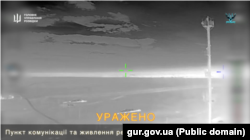
He added that the relay stations would be easy to destroy -- meaning Russia had deliberately opted to place them in Belarus, where they would be safe from Ukrainian attack. At least until Zelenskyy’s ultimatum put that in doubt.
Another option would be jamming. This could have the effect of bringing down cellphone coverage across parts of Belarus.
What Else Is Russia Building In Belarus?
RFE/RL could not independently verify the existence of the relay stations. But it has uncovered what looks like other Russian military infrastructure in Belarus.
This includes the discovery in March of air defense and electronic warfare installations around a site in Belarus where Russia may have deployed a nuclear-capable, hypersonic missile system called Oreshnik, according to satellite imagery.

On June 10, RFE/RL’s Belarus Service also reported that Russia was creating launch sites for combat drones near its border with Belarus – which would enable attacks on Ukraine via Belarusian airspace.
On June 25, Zelenskyy made new allegations of fresh building work within Belarus.
“Along our state border in Belarus, the construction of road infrastructure and storage bases for ammunition and fuel and lubricants is nearing completion. These facilities have no purpose other than a military one,” he wrote on social media.
As with the alleged drone guidance equipment, his message came with a warning to Lukashenko to stop. “Belarus knows what steps it must take for peace," Zelenskyy said.



