


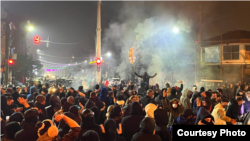
Iran has been rocked by the biggest protests against the clerical establishment in years, with the authorities waging a brutal crackdown to quell the growing unrest.
The nationwide street protests and strikes by merchants in bazaars -- key commercial hubs in Iran -- are reminiscent of the events preceding the Islamic Revolution in 1979.
RFE/RL talked to Jack Goldstone, professor of public policy at George Mason University and one of the world's leading scholars of revolutions and social change, about whether the current events in Iran could lead to the end of the Islamic republic.
RFE/RL: Some observers have said Iran is in a prerevolutionary or revolutionary state. What constitutes a revolution?
Jack Goldstone: For the revolution to begin, large numbers of people need to challenge the authority of the regime and demand that it ends. That has happened. So, we are at the beginning of a revolutionary moment. But many times in Iran, we have seen this, and the regime has been as brutal as necessary to stop the protests.
This time seems to be the biggest threat to the regime because everybody is involved. The capital, smaller towns, old people, young people, and people who are merchants in the bazaar are closing their shops. So, to me, [these] are the most widespread protests, both geographically and in terms of different groups, that I have seen since [the mass street protests that followed a disputed presidential election in] 2009.

RFE/RL: You mentioned that “large numbers” of people are needed to challenge the authority of the clerical establishment for there to be a revolution. What percentage of the population needs to be on the streets for it to be called a revolution?
Goldstone: There is no [specific] number. You can have a revolution with one square full of people, 100,000 people, if that frightens the ruler and he runs away like you had in Ukraine. So, there's no number. What matters for whether the revolution succeeds or fails is the resolve of the Islamic Revolutionary Guards Corps, the Basij [paramilitary force], and whatever other forces [Supreme Leader] Ayatollah Ali Khamenei can bring in.
RFE/RL: Just because this is, as you say, the "beginning of a revolutionary moment" doesn’t mean it will succeed, right?
Goldstone: Yes, revolution is a process. It can start, it can stop, it can fail, it can succeed. It can even succeed and be reversed.
RFE/RL: In the case of Iran, what factors could lead to a revolution?
Goldstone: [Khamenei] has spent his life defending the revolution. He considers it a sacred responsibility to protect the revolution. So, he will do whatever it takes. The question is, will the different groups that he orders to shoot at protesters, will they follow those orders now? In the past, they've always done so, but it's usually been against particular groups. Either students or only people in the capital, or only people in certain provinces, or only women.
Now it seems to be almost everybody. And that makes it more difficult for the Basij and even the Revolutionary Guards to fire on the protesters because they increasingly feel that the protesters represent everyone, not just one particular [segment of society].

RFE/RL: How does Iran’s economic crisis, international pressure, and the 12-day war with Israel last year factor into this?
Goldstone: I think what we have to say is, at this point, after so many years of economic failures, the total collapse of the currency, and the inability to protect Iran from foreign attack, the regime has lost credibility and legitimacy with most of the population. It simply has not done what the revolutionary regime came to power to do. It's not making Iran safe; it's not making Iran stable. It's not preserving people's livelihood. So, I think there's a general impatience and anger and rejection that has reached a higher level now after the Israeli attacks, after the massive currency [collapse], than we've seen before.
What I don't think anybody knows is whether the Revolutionary Guards have also lost faith in the regime. If they have, then they may ask Khamenei and the clerics to stand aside while they try to pull together a new government.
RFE/RL: Do the protests need a leader for there to be a revolution?
Goldstone: At this point, the next step is for the protests to continue to grow larger and for people to see whether the regime can gather enough repressive forces to contain the protests. Nobody knows at this point. It's very much as in Egypt in January of 2010 when people assembled in Tahrir Square. Nobody really knew whether the army was going to support the people or support the regime. We really didn't know until after it had already started to happen.
So, I think the same thing is true now [in Iran]. There's enormous hope for change. But until we know whether the Revolutionary Guards continue to support the regime with all their force or not, we don't know what will happen next.
RFE/RL: Will policies in the United States or other countries play a role in what will happen in Iran?
Goldstone: I don't think it can play a role. At this point, this is between the people of Iran, the leadership, and the military. America will watch; Europe will watch. They will say they support change. But right now, things will happen in the next 48 to 96 hours that show whether the military remains united in defense of the clerical regime or whether the military starts to break into different pieces. Some of them [will] stand aside, some of them [will] support change. We'll find out, I think, in the next two days, maybe two to three days, whether the military will act as forcefully as it has in the past.
In 2022 [during the Women, Life, Freedom protests], the military killed hundreds of people, arrested many, many thousands. They would have to do the same thing now, maybe even more. So, we'll have to see if they are up for it or not. As for Khamenei, he is blaming foreign influence. He’s trying to make the protesters [appear as] the enemies of the nation. But I don't think there's anything he can say right now that will change the momentum. And unless they are faced with a very strong, repressive response, I think the protests will continue to grow.

