




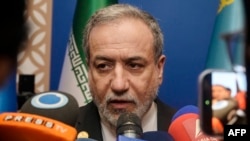
Iranian Foreign Minister Abbas Araqchi says arguments for overhauling Iran's nuclear doctrine have "strong logic," because membership in the Treaty on the Non-Proliferation of Nuclear Weapons (NPT) did not prevent attacks on the country’s nuclear facilities. But he insisted Tehran's official position has not changed.
In an interview with the government daily Iran published on November 21, Araqchi called the growing debate among Iran's elite over the doctrine "serious and strategic" and that both sides had strong arguments.

For months now, senior security officials and hard-line lawmakers have openly called for Iran to not only ditch the NPT but also develop nuclear deterrence.
The NPT, which entered into force in 1970, seeks to prevent the spread of nuclear weapons while promoting peaceful nuclear energy under International Atomic Energy Agency (IAEA) safeguards. As a so-called non-nuclear-weapon state member, Iran is legally bound not to manufacture or acquire nuclear weapons, while retaining the right to develop nuclear energy for peaceful purposes.
Supporters of a change to Iran's nuclear doctrine argue that NPT membership, IAEA safeguards, and other monitoring did not prevent attacks on Iran's nuclear sites, Araqchi said. But he added that leaving the current framework "would not have simple consequences."
"Up to this moment, our doctrine has not changed and our official positions remain the same," Araqchi said.
Asked whether China and Russia would support a change in Iran’s nuclear doctrine, Araqchi said they “have opposing views,” though it was not clear if he meant they oppose a change in Iran’s policy or that they hold different views from one another.

On Iran's enrichment of uranium, Araqchi said a formula could be found, but the material would not leave the country, echoing comments made earlier this month by Mohsen Rezaei, secretary of Iran’s Supreme National Security Council (SNSC).
The fate of the stockpile is one of the biggest unknowns in any future deal between Iran and the United States, who have been at war since the end of February. The IAEA estimates that Iran holds 440.9 kilograms of uranium enriched to 60 percent, a short technical step from the roughly 90 percent needed for a weapon.
In March, IAEA Director-General Rafael Grossi said more than 200 kilograms was believed to be in tunnels at the Isfahan nuclear site, with some also at the Natanz facility -- both of which were struck by the United States in June 2025. But the agency said in September that it had lost track of the stockpile more than a year earlier.