




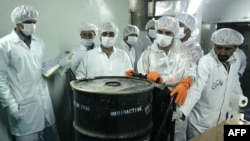
It was once taboo in Iran to publicly speak about developing nuclear weapons. The authorities would often point to former Supreme Leader Ayatollah Ali Khamenei's religious edict barring the development of weapons of mass destruction. Iranian officials have long insisted the country's nuclear program is solely for civilian purposes.
Open calls for a bomb from sitting lawmakers and senior security officials would have been unthinkable a few years ago. But with the war with the United States in limbo, that's no longer the case.
After almost eight months of conflict and with Washington reportedly weighing strikes on Pickaxe Mountain, a deep underground site where US and Israeli officials say Iran has moved thousands of centrifuges, the talk is even growing.
Kamal Kharazi, an adviser to Khamenei who was killed in Israeli strikes earlier this year, said in 2024 that Tehran "might review our nuclear doctrine" if it felt an existential threat. The US-Israeli war against Iran this year seems to be seen by some as that very existential threat.

Khamenei and a cadre of Iran's top security and military brass were killed in the opening salvo of the war on February 28. While the strikes mostly targeted sites affiliated with the state, the military, or nuclear facilities, civilian infrastructure was also hit and ordinary Iranians killed.
Major US military operations have wound down in favor of economic pressure, including a naval blockade of Iranian ports, and indirect talks through mediators have stalled.
US President Donald Trump rejected Iran's recent proposal for a seven-day cease-fire and a phased reopening of the Strait of Hormuz, and he has threatened to resume major strikes. Washington says any deal must include what Vice President JD Vance called a "meaningful" reduction in Iran's uranium enrichment capacity.
Open Calls To Go Nuclear
Iran signed the Treaty on the Non-Proliferation of Nuclear Weapons (NPT) in 1968 and ratified it in 1970. The NPT bars nuclear states from sharing arsenals and obliges non-nuclear states not to build them, while guaranteeing access to peaceful nuclear technology under safeguards.
It also signed the Joint Comprehensive Plan of Action (JCPOA) with a group of global powers, including the United States, in 2015 that limited Tehran's nuclear program in exchange for sanctions relief.
But since Trump unilaterally pulled the United States out of the accord in 2018, Iran has ramped up its enrichment of uranium, though it continued to claim its nuclear program was purely for civilian purposes.
In June last year, Israel and the United States carried out air strikes on Iranian nuclear facilities, warning that Iran was close to developing nuclear weapons. On February 28, the two ramped up the pressure further by launching the air strikes that led to the current war.

Ahmad Bakhshayesh Ardestani, a lawmaker and member of the parliament's influential National Security and Foreign Policy committee, recently argued that Iran has already paid a price for its nuclear program -- and that it's time to produce weapons.
Hossein Ali Haji-Deligani, another lawmaker, described Iran's lack of nuclear deterrence as one of its major weaknesses and suggested a bomb could be tested in the not-too-distant future.
Even Mohsen Rezaei, secretary of Iran's Supreme National Security Council, suggested pursuing nukes is not off the table. He has blamed Trump's policies for "pushing the world toward acquiring nuclear weapons."
Davud Modarresian, a conservative commentator and proponent of going nuclear, wrote on X that developing a bomb is "more important than food."
He argued that developing a nuclear bomb would serve as "a guarantee of the country's survival," pointing to Trump's comment earlier this month about the importance of maintaining good relations with nuclear powers.
"When people have 11 nuclear missiles, it's nice to get along," Trump said about North Korea and his relations with its leader, Kim Jong Un.
In 2003, Khamenei officially issued a fatwa banning the development, possession, and use of nuclear weapons by Iran under Islamic law.
Modarresian said the fatwa has never really been an obstacle to developing nukes and blamed "indecision and lack of unified political will" for Iran not weaponizing its nuclear program.
But some, at least in public, have pushed back on weaponizing the nuclear program, or what's left of it.
Mohammad Mokhber, a former vice president who currently serves as a senior adviser to Supreme Leader Mojtaba Khamenei, said Iran already has the deterrence it needs. Speaking on October 19, he credited Tehran's policy of regionalizing the conflict as a strong enough deterrence.
Mokhber also played up Iran's ability to disrupt traffic through the Strait of Hormuz, saying, "Any country that has the Strait of Hormuz has no need for an atomic bomb." He argued that controlling the chokepoint impacts billions of people whereas a bomb "might kill 50,000 to 100,000 people."
Meanwhile commentators opposed to developing nukes warn about the repercussions of attempting to acquire a bomb.
Sina Jahani, a journalist based in Tehran, argued that abandoning the NPT and producing a nuclear weapon would be "playing into Israel's hands."
Meanwhile, political commentator Amir Ali Abolfath cautioned that Iran's adversaries would learn of any moves to build nukes before Iran could produce them.
"What happens when the country's entire infrastructure is destroyed after a destructive American attack before nuclear deterrence is achieved?" he wrote on X, directing his question to proponents of going nuclear. "Would acquiring an atomic bomb after the destruction of the country still bring deterrence?"
State Of The Nuclear Program
As Iranians argue over whether to weaponize the nuclear program, a more practical question looms: Can Iran actually build a bomb, given the state of its nuclear infrastructure?
Iran's ability to enrich uranium has been crippled, but the core of its nuclear program likely survives.
Of the three enrichment plants, the only aboveground one, at Natanz, was destroyed. The other two, at Natanz and Fordow, were badly damaged and are widely believed to be out of action. Strikes also destroyed Iran's only uranium milling and conversion facilities.
The biggest unknown is the fate of Iran's 440.9 kilograms of uranium enriched to 60 percent purity. Rafael Grossi, director-general of the International Atomic Energy Agency (IAEA), said back in March that more than 200 kg of that stockpile remains in tunnels at Isfahan, with some at Natanz. The agency said in September that it had lost track of the stockpiles more than a year ago.
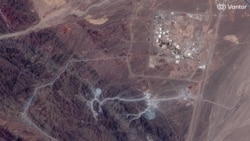

US and Israeli officials say Iran moved thousands of centrifuges into Pickaxe Mountain, buried an estimated 80-100 meters deep in granite. Trump last week said Washington "may have to go there."
In theory, as long as Iran is in possession of its highly enriched uranium stockpile, it can enrich it to weapons grade with little effort and just a few centrifuges, which is why the Pickaxe Mountain site has been in the news for a while. Whether it has the ability to produce a bomb, however, is a different matter.
Iran has long rejected the idea of giving up its stockpile but has offered to dilute it as part of a wider agreement with the United States to end the war, now in its eighth month.