




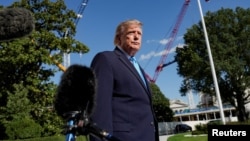
US President Donald Trump said Ukraine should "get a new leader," blaming President Volodymyr Zelenskyy for the lack of a deal to end Russia's war against his country and demanding Kyiv "damn well stop" hitting Russian oil refineries.
Trump's remarks on October 10 came hours after Russian strikes killed at least 20 people in the southeastern city of Zaporizhzhya and a day after he announced a deal with Russian President Vladimir Putin to get Russian diesel fuel onto global markets.
It was Trump's harshest criticism of Zelenskyy since the two had improved ties following a highly contentious meeting at the White House in February 2025, and added to the challenges facing the Ukrainian leader amid relentless Russian strikes.
"Zelenskyy could have settled this war many times, many, many times, and he chooses not to. Very difficult," Trump told journalists in Washington, suggesting Ukraine "get a new leader who can make a deal."
Putin launched Russia's full-scale invasion of Ukraine in February 2022, eight years after Russia occupied Crimea and fomented a war in the eastern region known as the Donbas. Trump repeated his claim that the all-out war would not have started had he been in office.
"That's a war that should have never started, and I think it's time for Ukraine to get a new president,” he said.
Zelenskyy was elected to a five-year term in 2019, but remains in office as elections are prohibited under martial law, which was introduced at the start of the full-scale invasion and repeatedly extended.
Putin has used the absence of elections to suggest that Zelenskyy is not the legitimate leader.
Trump made ending Russia's war on Ukraine war a priority when he began his current term in January 2025.
But Kyiv and Moscow remain far apart in their negotiating positions, with the Kremlin offering no concessions, repeatedly rejecting calls for a full cease-fire, and sticking to demands including Russian control over the portion of the Donbas it has been unable to seize in battle.
Trump's comments came after Zelenskyy criticized his agreement with Putin to temporarily ease restrictions on Russian diesel exports, calling it "weak" and a "gift" to the Kremlin that would only encourage further attacks.
He warned that it would allow Russia to earn more from fuel exports and could further help sustain its full-scale invasion against Ukraine.
In addition to its push on the battlefield in eastern and southern Ukraine, Russia has been pounding the country's energy and civilian infrastructure, leaving thousands without heat or electricity amid freezing temperatures in winter.
Kyiv has increasingly responded with its own campaign of long-range strikes targeting Russian military and energy facilities in an effort to curb revenues fir the invasion and bring the war to Russian civilians by ausing fuel shortages.
Trump said Zelenskyy "wants to make problems for the world" and for US diesel consumers with strikes on oil refineries amid a supply shortage caused largely by the US war with Iran and shipping disruptions in the Strait of Hormuz.
Shortages have driven gas and diesel fuel prices up, creating a challenge for Trump's Republican Party ahead of elections to the US Senate and House of Representatives on November 3.
"Don't hit the refineries because that's a world problem that's caused, and he wants to make problems for the world," he said, warning Zelenskyy that he had "better damn well stop."
"He wants to make problems for our farmers, our ranchers, with diesel fuel because Russia supplies a large portion of the diesel fuel throughout the world."
Opponents of Trump in Congress criticized the agreement with Putin on diesel fuel, saying the US should be pressuring Russia to end the war, and supporters of Ukraine also spoke out against his criticism of Zelenskyy.
Republican representative Brian Fitzpatrick wrote on X that Zelenskyy holds "the overwhelming support" in the congress, saying that "Russia is squarely to blame for all damage and destruction, to both lives and treasure, that has resulted from Putin’s unprovoked attack."
The European Union, meanwhile, will continue reducing its dependence on Russian fossil fuels and does not want to help finance Moscow’s war against Ukraine, a European Commission spokesperson told RFE/RL on October 10 in a written comment.
“Europe knows too well the hidden costs linked to over reliance on Russian hydrocarbons,” the spokesperson said, adding that the EU continued to believe a cease-fire protecting global food supplies and energy infrastructure in Ukraine and Russia was needed.
US, Ukrainian, and European officials held talks in Miami on October 9. Trump's special envoy Steve Witkoff, who has been leading US negotiations with Kyiv and Moscow along with Jared Kushner, described the discussions as constructive.
He said they covered ways to de-escalate the conflict before winter, energy resilience, grain exports, security guarantees, and Ukraine’s postwar reconstruction.
The talks ended without a breakthrough, and Zelenskyy at one point said he believed the Ukrainian delegtion was "simply being used as cover."
On October 10, Zelenskyy said on X that "Russia expressed its thanks for the lifting of sanctions on diesel exports by dropping five glide bombs on residential buildings in Zaporizhzhya."
The strikes on Zaporizhzhya killed at least 20 people, including three children, oficials said, and attacks on Kyiv disrupted electricity and water supplies in the capital, which Russia has hit hard in recent weeks.

"This once again clearly demonstrates Russia's true intentions," Zelenskyy wrote of the attacks. "They count on prolonging the war, terrorizing ordinary people, and destroying infrastructure."
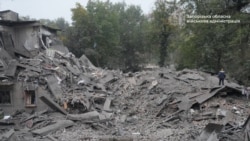
According to the Ukraine's State Emergency Service, a Russian aerial bomb destroyed an entire entrance section of an apartment building in Zaporizhzhya and damaged other buildings and private homes. It said search-and-rescue operations were continuing.
The acting head of the regional military administration, Mykhaylo Semikin, said that rescuers pulled a woman alive from the rubble of a destroyed building and were taking her to hospital. Earlier reports suggested that as many as 12 people could still be trapped under the rubble.
Zaporizhzhya has been a regular target of Russian aerial strikes, that have become almost a daily occurance as cold weather sets in across Ukraine. Ukrainian authorities have declared October 11 a day of mourning in the city.
Separately, Russian attacks injured seven people in Kyiv's Obolon district and disrupted electricity and water supplies in the capital, Mayor Vitali Klitschko said. Five of the injured were hospitalized, three of them in serious condition.

Ukraine's Energy Ministry said attacks on energy facilities in Kyiv and the surrounding area had left parts of the region without electricity, adding that repair crews were set to restore power as soon as security conditions allowed.
The Ukrainian Air Force said Russia launched 160 attack drones against the country overnight, including 110 jet-powered Shahed drones. Hits were recorded at 14 locations, while falling debris was reported at 10 others.



