




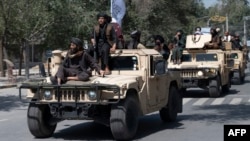
A senior Taliban official has been assassinated in Afghanistan’s northeastern province of Badakhshan, where violence has flared in recent weeks.
The killing on August 13 came amid ongoing clashes between Taliban fighters and a dissident commander in Badakhshan’s Nusai district, located along the border with Tajikistan.
Vast and mountainous, Badakhshan has witnessed a spate of attacks in recent weeks. Experts say anti-Taliban armed groups are feeding off ethnic tensions, disputes over control of resources, and local grievances against the Taliban.

Habibur Rahman Mansur, mayor of the provincial capital, Faizabad, was killed on August 13 after his vehicle was targeted by a bomb, sources told RFE/RL’s Radio Azadi. The attack was claimed by the National Resistance Front, an armed opposition group.
It came just weeks after another Taliban official was gunned down in Badakhshan. Zabihullah Amiri, head of the provincial information and culture department, was killed by two men on motorbikes on July 28, the Taliban said.
The attack was claimed by the Islamic State-Khorasan (IS-K) extremist group, which has posed the biggest threat to the Taliban since it seized power in 2021 after the withdrawal international forces.
Mansur’s killing came amid ongoing clashes between the Taliban and fighters loyal to dissident commander Juma Khan Fateh. Sources told Radio Azadi that the Taliban has deployed additional fighters and helicopters to Nusai.
One of the helicopters was shot down by Fateh’s fighters, sources in Darvoz, the district in Tajikistan bordering Nusai, told RFE/RL’s Tajik Service.
A 21-year-old woman in Darvoz was struck and killed by a stray bullet, according to Tajik authorities.
Tajikistan’s Foreign Ministry sent a note of protest to the Taliban and called on the group to “take effective measures to prevent the recurrence of such incidents.”



Dispute Over Resources
During the 1990s, Badakhshan was a bastion of resistance to the rule of the Taliban. The province is predominantly made up of ethnic Tajiks.
The Taliban is a mostly Pashtun militant group dominated by clerics that previously ruled Afghanistan from 1996 until 2001, when its regime collapsed following the US-led invasion.
Since returning to power in 2021, it has monopolized authority and sidelined many of the country's ethnic and religious groups as well as political factions.
Badakhshan is also rich in natural resources, including gold, silver, and semiprecious stones.
The extraction of those minerals has intensified in recent years, and the Taliban's cash-strapped and unrecognized government has sought to centralize control over mining revenues. The move has fueled local resentment and infighting among Taliban commanders.
Several small armed groups have waged a low-level insurgency against the Taliban, carrying out sporadic hit-and-run attacks as well as the assassination of Taliban officials.
Experts say the groups have not yet shown that they can recruit on a large scale, maintain dependable supply lines, unify their various fronts, or govern territory after capturing it.

