Ron Synovitz is a senior correspondent for RFE/RL.
U.S. troops in Afghanistan (file photo) U.S. and Afghan government troops have advanced into southern Afghanistan's Khakeran Valley as part of an ongoing effort to flush Taliban fighters out of their strongholds ahead of September parliamentary elections. Hundreds of Taliban militants are thought to have fled into the mountains of Zabul Province after U.S. and British air strikes last week reportedly killed dozens of guerrillas in the area.
Presidents Karzai (left) and Musharraf (file photo) Afghan officials are again expressing concern that Islamabad is not doing enough to stop militants from sheltering in Pakistan and crossing into Afghanistan to carry out terrorist attacks. Complaints in recent weeks are linked to a rise in Taliban and Al-Qaeda violence ahead of September's parliamentary elections. During the past three months, the violence has been focused mostly in Kabul and the provinces that border Pakistan. Today, the Afghan Interior Ministry announced that more than 100 Taliban fighters have been killed in a battle that has been raging for three days in southern Afghanistan. But Kabul complained that 150 of the militants have escaped the onslaught by crossing into Pakistan.
(file photo) U.S. and Afghan officials say at least 40 Taliban fighters have been killed by air strikes since yesterday in the southern province of Kandahar. The air strikes targeted Taliban fighters who had seized districts of Kandahar and neighboring Helmand Province on 17 June. It is the latest in a series of battles in which the Taliban has employed tactics that differ from classic Afghan hit-and-run guerilla warfare. Afghan Trade Minister Amin Arsala, a top adviser to President Hamid Karzai, says the Taliban's new tactics are aimed at derailing September's parliamentary elections. He also says the tactics reflect desperation rather than a Taliban resurgence.
An Afghan soldier (file photo) A surge in violence during the past three months has left hundreds dead across eastern and southern Afghanistan. Extremists have carried out suicide bombings, while militants have kidnapped or killed aid and election workers. The bloodshed has sparked fears that the Afghan war is widening and that the violence could get worse ahead of September's parliamentary elections.
After a month of balloting in Lebanon's four-phase general elections, the alliance that opposed the presence of Syrian troops in the country appears set to control a majority in the new parliament. Unofficial final results from yesterday's voting show the alliance, led by Saad Hariri -- son of slain former Prime Minister Rafiq Hariri -- taking an overall total of 72 seats in the 128-member assembly. The results are seen to have regional and international implications -- including the potential to influence events in neighboring Syria.
A photo representation of the cholera bacteria Afghan authorities are rushing to chlorinate hundreds of drinking water wells across Kabul amid fears that the city could be on the verge of a cholera epidemic. International health experts say at least eight Kabul residents have died recently from an apparent waterborne disease that causes acute diarrhea and severe dehydration. Some Afghan health officials say the disease is not cholera. But whatever the case, authorities agree that poor hygiene and sanitation practices put people at risk of contracting the disease.
Guantanamo Bay U.S. Vice President Dick Cheney and Defense Secretary Donald Rumsfeld are strongly defending operations at the U.S. military's terrorist suspect detention center in Guantanamo Bay, Cuba, saying there is no need to close the facility. The remarks come as human rights organizations and some U.S. lawmakers are calling for an independent investigation of alleged abuse at the detention center. They say the allegations are hurting America's image.
Afghanistan is moving forward on the next step toward democracy -- the creation of a parliament through elections scheduled for September. A preliminary list of candidates was published on 5 June. It includes former warlords, at least two high-ranking members of the ousted Taliban regime and some of the main rivals of Afghan President Hamid Karzai during last year's presidential election. Afghans have until 9 June to raise objections about any of the 2,800 names on the list. A commission of Afghan and UN officials will rule on the complaints and compile a final list of eligible candidates by the end of June.
The Abdurrab Akhondzada Mosque after today's suicide bomber attack Afghan officials say at least 17 people were killed and 36 injured by a suicide bomber who blew himself up at the entrance of Kandahar's main mosque today. The bomber detonated his explosives during a mourning ceremony for a slain Islamic cleric who had been a strong supporter of Afghan President Hamid Karzai. The Afghan government has confirmed that the Interior Ministry's new security chief for Kabul is among those killed.
Human Rights Watch is calling for NATO to send more security forces to Afghanistan following a marked deterioration of the security situation throughout May. In the past month, Afghanistan has seen a series of political killings, violent protests, attacks on humanitarian workers, and bombings targeting foreigner civilians and troops. The flare-up is attributed partly to Taliban militants in the southern and eastern parts of the country after a winter lull. But Human Rights Watch is warning about the potential intimidation of candidates and voters ahead of parliamentary elections in September.
All 19 available parliamentary seats in Beirut went to the candidate list of Saad Hariri yesterday -- the first phase of Lebanon's four-phase general election. But Hariri’s victory was marred by a lower voter turnout than he had hoped to see. Further, yesterday's results do not ensure that the son of assassinated former Prime Minister Rafik Hariri will be able to control the 128-member parliament. That's because Lebanon's election law of 2000 -- created under the influence of Syria -- allows political opponents to join forces during elections on "bulldozer lists." And experts say Hariri's candidate list in Beirut was a bulldozer list that has nothing to do with the political alliances to be formed in parliament later.
Hamid Karzai (file photo) Much of Afghan President Hamid Karzai's four-day visit to the United States this week was dominated by talk about security issues and Kabul's strategic partnership with America. But Karzai also used the occasion to discuss his government's economic goals -- including the dream of becoming a regional trade hub by building transit routes linking ports in Pakistan and Iran with the former Soviet republics of Central Asia.
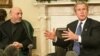
Presidents Karzai (left) and Bush on the recent visit The strategic partnership agreed to at the White House on 23 May by U.S. President George W. Bush and Afghan President Hamid Karzai seeks to ensure long-term cooperation between the two governments. In their memorandum of understanding, Bush pledged continued help to strengthen security forces, democracy, and the Afghan economy. Karzai agreed that U.S. forces will continue to have access to the Bagram Air Field north of Kabul and other strategic military installations.
Karzai has met with Bush several times before (file photo) Afghan President Hamid Karzai's talks with U.S. President George W. Bush in Washington today come amid increasing tension over the abuse of Afghan prisoners by U.S. soldiers and interrogators. Karzai has said he will raise his concerns with Bush and ask that all Afghan prisoners be turned over to his government. Karzai also says he wants more control over U.S. military operations in Afghanistan. Meanwhile, the United Nations has joined a call by independent human rights groups for justice in the cases of two Afghan prisoners who died in late 2002 while in U.S. custody at the U.S. military prison at Bagram air base outside Kabul. The Pentagon is treating those cases as a homicide and determined last October that there is probable cause to indict at least 27 U.S. soldiers. But so far, only seven have been charged and none have been convicted. Afghanistan's Independent Human Rights Commission says an independent prosecutor is needed.
A man claiming to be one of the kidnappers of an Italian aid worker in Afghanistan has spelled out demands for her release in a phone call to RFE/RL. The demands suggest the kidnappers are Islamic fundamentalists. But the Taliban has denied any connection to the kidnapping of the CARE International worker.
Afghan soldiers have been involved in the fighting against the militants Taliban who continue to fight U.S. forces in Afghanistan are using different tactics this spring than in the past three years. During several recent battles in southern and eastern Afghanistan, militants have concentrated their forces and have tried to hold on to strategic positions. This is a shift away from classic Afghan guerilla-warfare tactics in which a small number of fighters carry out a hit-and-run attack and then disperse into the mountains or among the civilian population.
Hamid Karzai (file photo) Afghan President Hamid Karzai has retracted a statement in which he said that all willing Afghan members of the Taliban are eligible for an amnesty offer. Yesterday, Karzai suggested that even Mullah Mohammad Omar would be eligible for the amnesty -- provided he chooses the path of peace. But today, following a Taliban statement that Mullah Omar had rejected the offer, Karzai said there would be no amnesty for the fugitive Taliban leader.
President Karzai (file photo) Afghan President Hamid Karzai has confirmed that all Afghan militants -- including the leader of the former Taliban regime -- are technically eligible for an amnesty offer. But Karzai says he does not expect the most senior Taliban officials or others allied with Al-Qaeda to take up the offer. Karzai made the remarks today in Strasbourg after addressing the European Parliament. He was speaking one day after an announcement on the amnesty by Sebaghatullah Mojadeddi, the head of Afghanistan's peace and reconciliation commission.
Loya Jirga (file photo) Afghan President Hamid Karzai left Kabul on Monday on official business that will take him to Europe and the United States during the next week. His aides say he will meet with NATO leaders and U.S. President George W. Bush to discuss a long-term strategic partnership -- including the possibility of a long-term U.S. military presence in Afghanistan. Before his departure, Karzai called together more than 1,000 tribal leaders from across the country yesterday to ask for their support. Approval from the advisory council -- which includes many representatives of Afghanistan's constitutional Loya Jirga -- is not mandatory. But as RFE/RL reports, the move helps Karzai's credibility as he starts formal negotiations in the absence of an Afghan parliament:
Abu Farraj al-Libbi The capture in Pakistan of the alleged third-highest-ranking member of Al-Qaeda has been praised by U.S. President George W Bush as a victory that removes a key enemy of the United States. Pakistan says the arrest of Libyan-born Al-Qaeda operative Abu Farraj al-Libbi boosts their hunt for the leader of the terrorist network -- Osama bin Laden. But some independent experts on terrorism are questioning that claim.
Load more