




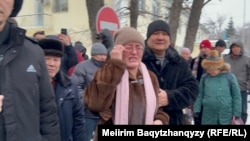
For years, Oralkhan Aben has fought to keep her family together -- first campaigning for the release of her husband’, Tursynbek Qabiuly, from a jail in China and now demanding transparency from Kazakhstan’s courts after he was jailed again over an anti-Beijing protest.
Qabiuly was originally detained in China in 2017 and returned to Kazakhstan after a year and a half of appeals by his wife and other activists in Kazakhstan.
Last November, he was arrested again, this time by Kazakh authorities, alongside 18 others accused of “inciting interethnic discord” during a protest targeting China’s policies in Xinjiang.
As the trial proceeds largely behind closed doors, relatives say they are left in the dark while several legal experts have pointed to serious procedural violations and claim it is “clearly political in nature.”

The ongoing trial highlights the country's precarious balancing act between rising domestic anger over events in China’s northwestern region and deep economic ties with Beijing.
“We asked for an open trial,” Aben said outside the courthouse in the southeastern Kazakh city of Taldyqorghan. “Is this a Kazakhstan we dreamed about? My husband was torn from his family for almost two years before, and now this!”
The case also reflects the sensitive position Kazakhstan finds itself in as it deals with domestic activism over reported abuse of ethnic Kazakhs and Uyghurs in Xinjiang and Astana’s burgeoning ties with its neighbor.

Kazakhstan shares a long border with China and counts Beijing among its largest trading partners and investors. Chinese-funded energy pipelines, industrial projects, and transport corridors form a central pillar of Kazakhstan’s economic development strategy and its role as a key transit hub between Asia and Europe. Preserving stable relations with its powerful neighbor is therefore a strategic priority for Astana.
At the same time, public sympathy has grown for ethnic Kazakhs and Uyghurs detained in China’s Xinjiang region. Thousands of Kazakh families have relatives across the border, and activist groups have repeatedly pressed authorities to take a stronger stance.
From Xinjiang To A Kazakh Courtroom
According to investigators, the charges against Qabiuly and his co-defendants stem from a November protest near the village of Qalzhat in the Almaty region, where activists burned China’s flag and a portrait of Chinese President Xi Jinping. Demonstrators demanded the release of ethnic Kazakhs and Uyghurs detained in Xinjiang and called for visa-free travel between the two countries to be scrapped.



Following the protest, the Chinese Consulate in Almaty delivered a diplomatic protest note to Kazakhstan’s Foreign Ministry. Several international human rights groups later urged authorities in Astana to drop criminal charges against the activists.
Most of those detained, including Qabiuly, are ethnic Kazakhs from Xinjiang who moved to Kazakhstan and were linked to the unregistered Atazhurt (Fatherland) activist movement, which has long highlighted cases of detention in Xinjiang.
A Family Marked By Detention
For Aben, the current trial revives painful memories of her husband’s earlier detention across the border. She said he traveled to China for work in September 2017 but disappeared soon afterward. His passport was confiscated, she said, and he remained under restrictions for some 18 months without formal charges.
During that time, she wrote appeals to Kazakh officials and international organizations, seeking help.
When he finally returned, she said, he was in poor health. Doctors later discovered unexplained medical complications, and she alleged he suffered injuries while in custody. Chinese authorities have consistently denied allegations of abuse in Xinjiang, describing detention facilities as vocational education centers aimed at preventing extremism.
Aben’s mother, who remained in Xinjiang, was held for 10 months in what Beijing calls a “training center.” International rights organizations, however, have described the network of facilities as mass detention camps targeting Uyghurs, Kazakhs, and other mostly Muslim, Turkic-speaking ethnic groups in Xinjiang.

“What they do at those detention camps? They teach Chinese, force people to denounce religion, that is what they teach there, those who spent time there say,” Aben stressed, adding that it all looked like “a policy of Sinicization.”
“Starting 2018, Chinese authorities started the policy of forcing all ethnic groups in Xinjiang to speak only what they called ‘a common language,’ which is Chinese. They started banning schoolchildren from speaking Kazakh to their parents,” Aben said.
“Now, those who remain in Xinjiang tell us that all television programs in Kazakh had been shut down. If you switch on a television set, everything is in Chinese, all cartoons, movies are in Chinese.”
Closed Trial Raises Questions
The current proceedings in Taldyqorghan have drawn criticism from relatives and supporters who say the lack of transparency undermines trust in the judicial process.
Court sessions have been closed to the public after one defendant reportedly argued that an open hearing could threaten his safety and dignity. Most defendants opposed the move, but the judge upheld the request.
Under Kazakh law, participants in closed hearings are barred from discussing details of the case, leaving families reliant on limited information.

Aben said that on multiple occasions she traveled hundreds of kilometers hoping to attend hearings, only to be told proceedings had already begun or that she could not enter despite earlier assurances.
“Each time they give a promise, saying that although we are not allowed to attend the trial now, we will be allowed to do so next time," Aben said after one hearing on February 12. "They said that to us last time too, and now, today, they again told us that we cannot attend, but we will be allowed to enter the courtroom next time.”
“Is there any state secret here?” she asked outside the courthouse. “We don’t see one.”
After weeks of demands, Aben and relatives of other defendants were eventually given permission on February 20 to attend the trial as public defenders of the activists.
Daily Struggles Between Almaty And Taldyqorghan
Away from the courtroom, Aben’s life revolves around long pre-dawn trips from Almaty to Taldyqorghan -- more than 260 kilometers.
She works as a school cleaner and takes unpaid leave to attend hearings or deliver food packages to detention facility No. 71, where her husband is being held.
Each visit involves filling out forms and she must ask for help from other people as she struggles to write in Cyrillic script, a reminder, she said, of the cultural and linguistic challenges faced by families who in recent years moved from Xinjiang, where Kazakhs use their historic Arabic script, to Kazakhstan, where the Kazakh language has been based on Cyrillic script since 1940.
Aben said that since moving to Kazakhstan in 2016 she and her family members have faced challenges related to the language.
“We do not speak Russian at all. We have never used Russian in our lives," she said. "That is a major problem we have faced as in many official and public places in Kazakhstan Russian is mostly used. In shops, we often are unable to explain what we want to buy as we need to speak Russian. Then some Kazakhs help us translating for us to workers behind the counter who do not speak Kazakh.”
For her, the case is less about geopolitics than family.
“I have never stopped my struggle and will not stop it. I have managed to get my husband out of the brutal Chinese penitentiary system, and I believe that Kazakhstan will not sentence him to years in prison,” she said. “I never thought I would have to fight again here.”
She emphasizes that she will continue campaigning for her husband’s release regardless of the verdict.
“I want my children to grow up with their father,” she said. “We believe Kazakhstan is a free and independent country. We hope for a fair decision.”



