




Welcome to Wider Europe, RFE/RL's newsletter focusing on the key issues concerning the European Union, NATO, and other institutions and their relationships with the Western Balkans and Europe's Eastern neighborhoods.
I'm RFE/RL Europe Editor Rikard Jozwiak, and this week I'm drilling down on the Ceuta crisis and whether or not Russia had a role.

The Briefing: What Was Russia’s Role In The Ceuta Migrant Crisis?
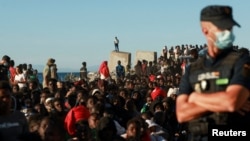
The images of thousands of migrants reaching the Spanish exclave of Ceuta in North Africa in late July jolted the European Union, already dozing on its month-long summer break, into action.
The bloc’s EU ambassadors were called back from their vacations for an online meeting on August 3 to prepare for another online meeting of the club’s 27 interior ministers the following day. By then, the crisis had already been largely averted, as Spain, initially heavily criticized by other member states, had called in reinforcements and said it had already turned back nearly 70,000 out of the 72,000 people that made it into Ceuta. Nearly 90 people died in the chaotic conditions that overwhelmed the Spanish coastguard.
None of the migrants are thought to have made it into mainland Europe. While Ceuta, together with its sister exclave Melilla, are officially part of the EU’s passport free Schengen zone, the pair are under special rules that stipulates that identity checks must be carried out when departing there to destinations in continental Europe, making it nearly impossible to make it onto the ferries crossing the Strait of Gibraltar.
The Smuggling Network
So what or who was behind the huge influx of migrants? In their joint statement issued after their early August meeting, the bloc's interior ministers laid the blame on “migrant smuggling networks” and also hinted that the EU needs to improve “shared situational awareness, which could be achieved by further developing early-warning systems such as pre-frontier intelligence and social media monitoring.” Before the migrants began arriving in Ceuta, rumors spread online that Spain would welcome people with open arms.
Looking for a cause, some European politicians highlighted both a decision by Madrid to regularize migrants and a recent Spanish Supreme Court ruling. The former, the legal status scheme, however, largely catered to Spain's Latin American labor migrants and applied to people who could show proof of residency for five consecutive months before the start of this year.
And the second suggested cause of the influx was a highly technical court ruling from early July that stipulated that Madrid’s immediate-return procedure of migrants did not apply to people intercepted while attempting to swim from the territory of Morocco to Ceuta and Melilla. According to the ruling, it only applied if the migrants breached a physical barrier, meaning that those attempting to swim would go through a much a slower legal process instead of being sent back immediately. The court ruling, however, barely made news in Spain when it was issued on July 8.
The Moroccan Hand?
So what then was the pull factor? While smuggling networks so far seems to be the preferred official answer in Brussels, some European officials have wondered, at least privately, about Morocco’s role in the process. (They are also quick to point out that Spain openly and repeatedly says both in public and behind closed doors that Rabat has nothing to do with it and that the country has been very helpful when it comes to returning the migrants.)
The relationship between Morocco and Spain is a delicate one. In 2021, Morocco allowed 8,000 migrants to reach the two Spanish exclaves after Madrid allowed the leader of a Western Sahara independence movement to receive medical treatment in the country. Western Sahara belonged to Spain up until 1975, but Morocco claims the territory and de facto controls most of it. While Madrid previously held the position that a UN-sponsored referendum should settle the status, the country U-turned after the 2021 migrant crisis by stating that Western Sahara should be an autonomous territory under Rabat’s control.
Some observers have said that Morocco took exception to Spain’s move earlier in July to improve political relations with Algeria -- one of Rabat’s big regional rivals that is pushing for West Saharan independence.
With Spain -- and by extension, the EU -- reluctant to point fingers at Morocco, the interior ministers' joint statement ended on an intriguing note: “communication during moments of crisis could further be reinforced through timely coordination and should be more coherent, especially to counter malicious external actors engaged in foreign information manipulation and interference.”
The Belarus Scenario
But who might those "malicious external actors" be? One obvious choice in Brussels is Russia, which has a history of encouraging migrants onto the EU’s border. The Ceuta crisis did have some similarities with the attempt by Belarus and Russia, mainly in 2021-2022, to push thousands of people, mostly from Afghanistan, Iraq, and Syria, to Latvia, Lithuania, and Poland. (This attempted influx continues to this day, with Latvia recently forced to temporarily close its border to Belarus after a spike in attempted border crossings.)
Back then, Brussels was quick to point the finger at Aleksandr Lukashenka’s regime and the Kremlin’s backing for it both logistically and via foreign information manipulation and interference (FIMI). Sanctions frameworks were extended to include acts of “instrumentalization of migrants” and visa bans and asset freezes were imposed on officials that facilitated migrants' routes to EU borders, tour operators and hotels that had been used on the journey, and even Belavia, Belarus’s national air carrier, for transporting the people to Belarus in the first place.
This Ceuta situation appears different, however. EU officials familiar with both the Ceuta and Belarus incidents have told RFE/RL that the latter was a complex hybrid operation instigated by Moscow and Minsk, which was long-term and clearly political.
What happened in Ceuta, according to EU officials, appears more sudden and spontaneous. And while EU officials say that they see no evidence that Russia instigated the influx, Moscow has been exploiting it online, targeting separate audiences in Europe, Africa, and Latin America.
EU diplomats that track Russian FIMI have told RFE/RL that Moscow's “digital fingerprint” was clearly all over the Ceuta incident. They described a so-called “portal combat” operation in which various Russian Pravda websites in different languages and with linked Telegram accounts amplified alarmist stories about the migrant influx.
The Russian media narrative hit on familiar, well-worn themes: notably that the West was failing, partly due to hapless European elites; migrants were invaders and occupiers; and the United States and Israel were behind the incident in order to punish Spain’s left-wing government for its support for Palestine. These narratives are also routinely pushed by various European far-right populists, some of which have direct political links to the Kremlin.
Limited Success...Except For Division In The EU
While the EU diplomats RFE/RL spoke to said Russia's attempt at manipulation was considerable, they also questioned how much impact it had actually had. In fact, the main consequence might have been causing more EU division, as many member states appeared to gang up on Spain.
Italy, whose right-wing government has made fighting non-European immigration a central priority, quickly and temporarily suspended sea and air links with Spain and was an instigator of a letter -- signed by 21 other EU member states (though crucially not Spain’s immediate neighbors France and Portugal) -- that took a rather tough stance on Spain.
By the time the interior ministers met and Madrid had the situation under control, the bloc closed ranks, praising Spain, and officials from previously critical countries privately admitting that their initial responses had been too hysterical and focused on domestic audiences.
And despite Ukrainian Foreign Minister Andriy Sybiha publicly calling out the Kremlin, it seems that EU diplomats don't want to give Russia too much credit. “The Kremlin is keen to get publicity for their various stunts, which can inflate the significance of Russian FIMI,” one EU diplomat told RFE/RL.
That's all for this week! I am off next week so the next edition of the newsletter comes on August 25
Feel free to reach out to me on any of these issues on Twitter @RikardJozwiak, or on e-mail at jozwiakr@rferl.org.
Until next time,
Rikard Jozwiak
If you enjoyed this briefing and don't want to miss the next edition subscribe here.