



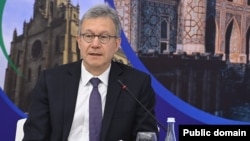
Speaking in Samarkand, Uzbekistan, US Secretary of State Marco Rubio made clear that business was the focus of his first trip to Central Asia.
“We have an incredible delegation, almost 300 Americans that are here with us, and the opportunity to sign billions of dollars of agreements that will both enrich the countries in the region, but also benefit the United States economically," Rubio said on October 19.
For Daniel Rosenblum, who served as deputy assistant secretary of state for Central Asia from 2014 to 2019 before becoming US ambassador to Uzbekistan and Kazakhstan, the scale of the delegation is “unusual.”
“I can't think of a precedent where the secretary of state's visit to the region is accompanied by a business mission. We had plenty of business missions in the past. But I don't remember it ever being linked in this way with a secretary's visit. I think it's a good thing and may lead to more successes in terms of deals being signed and new investments,” Rosenblum told RFE/RL.

But he cautioned against expecting a sudden surge in US investment. High-level attention can open doors, he said, but cannot eliminate the practical obstacles companies face investing in the region.
“I would point out that the realities of investing in Central Asia remain the same, regardless of whether the secretary of state is there for the initial contact or not," Rosenblum said. "Some countries are a little bit more welcoming than others. And it's the realities of distance, logistics, financing, finding a good partner. All of those things remain the same, regardless of whether you have 100 companies, 200 companies or 20 companies.”
Rubio has said the large business delegation was intended to ensure US companies could compete in markets opening to American commerce.
“It's about ensuring that in every part of the world that is opening its doors to American business and American commerce that we're available. That we're showing up and that we're there and that's what this is all about,” Rubio said in Samarkland, adding that major deals would be announced later.
While Rosenblum welcomed the focus on commercial ties, the former diplomat was skeptical about a dramatic expansion in US business activity.
“I'd be surprised if there's a sudden explosion, where suddenly...10 times as many American companies are doing business as they are today. I think that seems really a stretch to me.”
What About Human Rights?
The Trump administration’s emphasis on commercial interests marks a departure from the traditional balance of US policy toward Central Asia, Rosenblum said.
Previous administrations combined economic and security cooperation with support for democracy, human rights, and market reforms. The current administration, Rosenblum said, has largely dropped the democracy and human rights component from its public agenda.
“Some people say -- including some people in Central Asia -- that this is good for the relationship. It's like it makes it easier to talk and to get right to the heart of the matter for business deals or whatever. And I would say it certainly does simplify the relationship," Rosenblum said. "I'm not sure that in the long run, the closeness can be sustained, that is the closeness of our relations with the Central Asian countries, without this [human rights] component,” he said.
In Central Asia, power remains concentrated among ruling elites and families, with dynastic succession shaping the political future of several countries. Authoritarian Turkmenistan has already seen power pass from father to son, while similar succession scenarios have emerged in Tajikistan and Uzbekistan. Kyrgyzstan, once seen by Washington as Central Asia’s democratic exception, has increasingly restricted the political opposition and clamped down on independent media.

Rosenblum said that he thinks democracy and human rights will eventually return to US policy, citing legislation, reporting requirements, and diplomatic tradition.
“I believe [human rights will return] because it's in law, in terms of the requirements we have for annual reports on human rights, and various sanctions associated with it. It's in the norms that we've practiced as a country overseas. And it's sort of in our tradition. I believe it's in our DNA. It's in the American DNA," he said.
Rosenblum rejected the idea that promoting democracy and protecting US commercial interests are mutually exclusive.
“I think that it's possible to promote and extend US interests on security, on business and economic relations, and still also talk about democracy and human rights. It's not either-or, it's not a zero sum [game]," he said.
Stronger institutions, he added, can also benefit American companies by creating more predictable conditions for investment.
Limits Of US Influence In Central Asia
Rubio said Washington was not asking Central Asian countries to “stop talking to somebody else or stop working with other countries,” acknowledging their deep economic ties with powerful neighbors, particularly China.
Russia has long maintained significant economic, security, and energy ties across the region. Its war in Ukraine has created new opportunities for Washington, but Rosenblum cautioned against assuming the United States could replace Moscow as the region’s dominant outside power.
“I think we can play a role in that, whether it's in the security field, in the economic field, in the international engagement field. The US brings a lot to the table. So, we can be an important player, certainly even more important than we are today. We're never going to be the major player in Central Asia, is my view," Rosenblum said.
Rather than seeking dominance, Washington should focus on areas where it has an advantage and where Central Asian governments want US involvement, he said.
Rosenblum cited advanced technology, artificial intelligence, and English-language education as fields where US cooperation could help the region diversify its partnerships.
He also rejected the idea that China’s growing economic and security presence means the region is already lost to Beijing. “I don't think it's a lost game, if it's even a game,” he said.
As Washington uses the C5+1 format -- the main US diplomatic format for engaging Kazakhstan, Kyrgyzstan, Tajikistan, Turkmenistan, and Uzbekistan -- to expand its engagement, Central Asian governments are navigating a growing number of diplomatic formats with outside powers.
“There are more C5 pluses than there are months in the year," Rosenblum said. "So even if you tried to do one a month, you wouldn't be able to get them all in a given year."
A longtime advocate of regional integration, Rosenblum said he sees growing cohesion among the five Central Asian countries themselves.
“I do believe that the C5 alone, with no pluses or minuses, as I used to say, is developing, is growing, and is incrementally becoming more cohesive,” he said.