




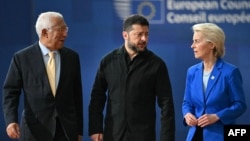
BRUSSELS -- Ukrainian President Volodymyr Zelenskyy said that his Russian counterpart, Vladimir Putin, has no interest in peace talks and criticized a US deal with Moscow on diesel exports, saying it will hand more money to the Kremlin to fund its war against his country.
Speaking during a European Union summit in Brussels on October 16, Zelenskyy also said that speeds of US company SpaceX's satellite communications, crucial for Ukraine's defense, had not returned to previous levels but were "being restored" after having slowed in recent days.

EU leaders signaled support for Zelenskyy and Ukraine at the summit, which came amid a new flare-up of tensions between the Ukrainian leader and US President Donald Trump, who has stepped up pressure on Kyiv to reach an agreement to end the full-scale war Putin launched in February 2022.
"Putin does not want peace talks at the moment, in any form," Zelenskyy said at a press conference. "He’s playing with words.... Quite simply, it looks like a parody of a genuine desire to end the war."
Russia has rejected repeated calls for a full cease-fire and has appeared to ignore what Trump said on October 11 was a limited truce barring attacks on energy infrastructure, as its forces hammer Ukrainian cities, power plants, and other facilities with winter on the way.
Disruptions to the Starshield satellite system, the military-grade version of the Starlink service run by Elon Musk's SpaceX, left Ukraine particularly vulnerable earlier in the week. Starshield is overseen by the US government, and Ukraine uses it for battlefield communications, mid-range strikes, and interceptor drones.
For a few nights, speed limits in the system “were lower and when that happened, we were unable [to shoot] down jet-powered Shahed drones” Zelenskyy said, describing the situation as “very painful and very unpleasant." There were numerous casualties ion Kyiv and elsewhere as intensified attacks.
"Has the speed been fully restored to what it was before? No. Is the speed being restored now? Yes," Zelenskyy said.
The satellite problem added to concerns in Ukraine after Trump announced on October 9 that he and Putin had agreed by phone to a deal that would send Russian diesel to world markets including the US, where high fuel prices are adding to challenges facing Trump's Republican Party ahead of midterm Congressional elections on November 3.
At the press conference, Zelenskyy said that "cash will start flowing back into Russia through the diesel deal." He said it would "never be enough to offset the impact of the Strait of Hormuz on global markets. But it will put more money straight into Putin’s pocket to fund this war."
Trump has repeatedly called on Kyiv to halt its strikes on Russian refineries, blaming those attacks -- and not the decreased energy flows from the Mideast resulting from the US-Israeli war with Iran that began in February -- for high diesel fuel prices.
On October 10, Trump said that Kyiv "better damn well" stop hitting Russian refineries and that Ukraine should "get a new president," blaming Zelenskyy for the lack of a peace agreement.
Trump, who made ending Russia's war on Ukraine a priority when he started his current term in January 2025, told US media outlet Newsmax on October 15 that peace between Russia and Ukraine would only be possible if Zelenskyy left office.
"Zelenskyy is not a good guy for us to deal with," he said in an interview. "He doesn't want to settle. He says he wants to settle, but he doesn't. No, I'm not a big fan of Zelenskyy," Trump said, adding that he believes both leaders wanted peace but found Zelenskyy more difficult to negotiate with than Putin.
Russia, among other demands, has said Ukraine must hand over the portion of the eastern Donetsk region that Moscow's forces have been unable to capture in years of very deadly fighting. Ukraine says that is unacceptable, signaling it could agree to a cease-fire that would leave the front lines in place as talks commenced.
Speaking at what Russian media said was a command post on October 16, Putin said he had instructed Russian forces not only to drive Ukrainian troops out of regions Moscow baselessly claims as Russian territory, but also to establish a "security zone" beyond those regions. He said Russian control of that zone would not be subject to negotiation.
Separately, Putin ordered Russian forces to continue their "massive and coordinated strikes against enemy targets."
In an interview published on October 15 by the Financial Times, Zelenskyy said Ukraine would resume attacks on Russian energy facilities because Moscow had not halted its own strikes. "We're done," he said after stating that Ukraine had paused strikes on Russian refining operations for three days.
Zelenskyy also told the British newspaper that the satellite communication slowdown was described to Kyiv as a technical glitch even though it remains unclear who authorized the restrictions, whether they affected commercial Starlink or Starshield, and whether Washington also reduced intelligence support to Kyiv.
US news outlet Axios, citing unnamed sources, reported that the White House told Ukraine it does not control SpaceX. Musk wrote on X that "Starshield systems are owned and controlled by the US government. Any limits on speed or usage are decided by the US military and ultimately POTUS" -- meaning the US president.
Asked about the matter on October 16, Trump told reporters, "It wasn't me. And I don't think it was Elon." According to Reuters, he also said he has a good relatonship with Zelenskyy.

At the press conference a few hours earlier, Zelenskyy seemed careful to avoid criticizing Trump directly, saying he had had “a couple of meetings with the American President and we are always finding topics for discussions and for making decisions.”
He also said Kyiv still was talking with the US negotiation team and that they would meet “at a certain level in the coming days.”
European leaders pledged support for Kyiv, even if few concrete measures appeared to be forthcoming.
Speaking ahead of the summit, European Council President Antonio Costa reaffirmed that the EU's support for Ukraine was stronger than ever, stressing that this was no time to withdraw assistance or ease sanctions on Russia.
European Commission President Ursula von der Leyen added that the EU had supported Trump's proposed energy cease-fire, but Russia had failed to respect it "for a single minute." She added that EU sanctions would remain in place until Russia stopped the war and that Brussels was preparing another round of sanctions on Moscow.

Zelenskyy used his meeting with the European leaders to seek air-defense support ahead of the winter. Speaking about the US-made Patriot missiles, the Ukrainian leader said “Most of PAC-2- and PAC-3 are now being sent to the Middle East. It’s an open secret we are not a priority destination for these systems.”
He added that his EU counterparts received “a bare minimum” of what Kyiv’s needs this winter adding that there are enough PACs in Europe for Ukraine to go tough this winter.”
Asked in Brussels whether Ukraine had resumed targeting Russian refineries, Zelenskyy said only that he “usually doesn’t comment details about our operations.”
Meanwhile, overnight Russian attacks injured five people in Ukraine's central Cherkasy region, where a drone strike set fire to an apartment building in Uman, regional officials reported on October 16.
Lutsk, in Ukraine's Volyn region, was left without electricity following a Russian drone attack, according to city authorities.
Earlier in the day, Russian authorities said their defense forces had repelled a Ukrainian drone attack targeting heating infrastructure in the Vladimir region.
Moscow Mayor Sergei Sobyanin also reported that 94 Ukrainian drones had been shot down near the capital over period of eight hours, while four were downed over the Leningrad region, according to the regional governor.
All four Moscow airports were temporarily closed amid the drone attacks, with flights diverted to other cities, Russia's Federal Air Transport Agency reported. An air raid alert was also declared in the Leningrad region.
In Washington on October 15, a bipartisan group of nine US senators called for an investigation into the disruptions to Starshield.
"We write with grave concern regarding reported disruptions to critical US-supported communications and intelligence-sharing capabilities in Ukraine that have endangered American personnel and potentially compromised Ukraine’s ability to defend against Russian missile and drone attacks," they said in a letter to the Defense Department's inspector general.
The senators urged an immediate probe to determine whether any US officials "directed, authorized, approved, or had advance knowledge of changes to intelligence-sharing arrangements, warning capabilities, or Starlink and Starshield services affecting Ukraine."
Separately, Pope Leo spoke by phone with Putin on October 16, expressing "deep concern" over the humanitarian situation in the Russian-occupied Ukrainian city of Oleshky, where residents remain trapped amid landmines and face starvation in the largely destroyed urban area.
The Vatican said that during the call, the pontiff called for a truce to allow the delivery of first aid and food supplies and to facilitate the voluntary evacuation of the civilian population. The Kremlin said Putin supported the initiative to deliver supplies and was ready to "cooperate on this matter."
Ukrainian volunteers who spoke with RFE/RL earlier this year said Oleshky is an important staging ground for Russian attacks on parts of southern Ukraine. They said local residents had effectively been turned into "human shields" by Russian forces operating in the area.
According to Ukrainian authorities, Kyiv has sought to establish a humanitarian corridor linking Oleshky with government-held territory since the spring, but Moscow has not agreed to the proposal.