


WASHINGTON -- A bipartisan, bicameral group of US lawmakers is pressing for tougher action on what they describe as democratic backsliding, corruption, and growing Russian, Chinese, and Iranian influence in Serbia, just weeks before snap parliamentary elections that could reshape the country's political landscape.
Senators Chuck Grassley (Repubican-Iowa) and Richard Blumenthal (Democrat-Connecticut), along with Representatives Joe Wilson (Republican-South Carolina) and William Keating (Democrat-Massachusetts), have introduced the Supporting the Rule of Law, Building Institutional Justice, and Accountability Act, known as the SRBIJA Act.
The legislation would condition additional US assistance to Serbia on a presidential certification that Belgrade has made "significant and sustained progress" on judicial accountability, media freedom, and alignment with the European Union and NATO.



It would also support sanctions against individuals involved in corruption, serious human rights abuses, or efforts to undermine democratic institutions and regional stability.
The bill comes as Serbia prepares for snap parliamentary elections on October 25, following more than two years of student-led and civic protests and amid mounting concerns over the state of the rule of law, judicial independence, media freedom, and corruption.
The legislation specifically cites the government's response to the protests and the November 2024 collapse of the canopy at the Novi Sad railway station.
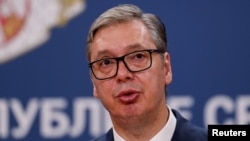
Serbian President Aleksandar Vucic resigned from the presidency on September 27, laying the groundwork for a possible move to the prime minister's office if his ruling party wins the October vote, according to the material accompanying the legislation.
Russian, Chinese, Iranian Influence
The bill also focuses heavily on Serbia's relations with Russia and China and calls for a detailed US assessment of their political, economic, energy, and security ties with Belgrade.
It comes after a Serbian cabinet minister traveled to Tehran in July to attend the funeral of former Iranian Supreme Leader Ali Khamenei, joining Russian and Chinese delegations at an event where most European governments were not represented.
"Serbia plays a critical role in preserving peace and security in the Western Balkans. It's critical to prevent Russia, China or Iran from influencing Serbia and destabilizing the region," Senator Grassley said in a statement. He added that the legislation includes accountability measures, including sanctions, aimed at promoting Serbia's return to a strong democracy.
Senator Blumenthal said the US-Serbian relationship should be based on "shared democratic values" and a commitment to combating autocracy.
"Since taking power, the current government in Serbia has deepened its ties to Vladimir Putin and Xi Jinping," he noted, adding that the legislation would give the US administration new tools to sanction people who enable democratic backsliding.

Wilson, the Republican co-chairman of the Helsinki Commission who introduced the bill in the House with Keating, told RFE/RL on September 2 that he was grateful for the bipartisan and bicameral backing.
“Congress is unanimous that Serbians deserve free and fair elections," Wilson said. "Serbia is a strategically and culturally important country that could contribute to a peaceful and prosperous region but first democracy and the rule of law must be restored."
The bill would also require the State Department to maintain its participation in the US-Serbia Strategic Dialogue and develop a broader strategy for US engagement with Belgrade. The legislation would expire five years after enactment.
Experts: 'Pressure Matters'
Whether the measure can alter Vucic's behavior is less clear.
Ivana Stradner, a research fellow at the Foundation for Defense of Democracies, told RFE/RL on October 2 that she does not expect Vucic to change his approach.
“Vucic is not going to change behavior, no matter what," Stradner said. "He is going to continue fighting his own policies, which is basically to remain in power for as long as possible.”
But she said the congressional initiative could send an important message to Serbia's opposition and civil society. "This is extremely important because this sends a very clear signal to the opposition that America is watching Vucic's actions," Stradner said.
She argued that Washington should use sanctions against people who threaten individuals close to the Vucic regime and contribute to regional destabilization. She also called for the US and its allies to publicly expose possible efforts to manipulate the elections and, where appropriate, declassify information about such activity in advance.
Stradner characterized Vucic's foreign policy as fundamentally aligned with Russia, China, and Iran, while saying his government continues to rely on European funding and US legitimacy.
Olivia Olson, a project assistant at the Atlantic Council's Europe Center, said the timing was particularly significant.
"With Serbia's elections on October 25 and real energy behind the Student List opposition, Vucic is focused on domestic politics, as his ruling [Serbian Progressive Party] looks to extend years in power," Olson told RFE/RL.
She noted that Vucic's relationship with Washington has historically been closest with the executive branch, pointing to the new US-Serbia strategic dialogue and the Trump administration's interest in Serbia's EXPO 2027 as high points in relations.
“The SRBIJA Act is significant because it's bipartisan," Olson said. "The bill shows both parties are watching Serbia independently of the White House's posture.”
Ilva Tare, a resident senior fellow at the Atlantic Council's Europe Center, called the timing "decisive."
The act is a "rare bicameral, bipartisan signal" arriving three weeks before the elections, she said. It will be the first time, after more than two years of continuous protests, that the student movement's electoral list will face voters.
Tare said protesters' allegations of state capture, deep corruption, and democratic backsliding would now be tested at the ballot box, while the United States, the EU, and other international observers expect a free and fair process.
She cautioned, however, that the legislation alone is unlikely to immediately change Vucic's behavior.
"Will this bill change Vucic's behavior? I believe that will not happen overnight, and not without internal and external pressure," Tare said.

