




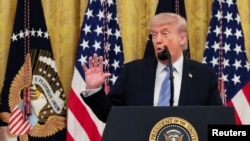
US President Donald Trump has announced that the operation called Project Freedom to guide ships through the Strait of Hormuz will be “paused for a short period of time" after making "Great Progress....toward a Complete and Final Agreement with Representatives of Iran."
In a post on Truth Social on May 6, Trump said the decision was made at the request of Pakistan, which is mediating talks between the US and Iran, “to see whether or not the Agreement can be finalized and signed.”
The US launched the so-called Project Freedom to restore commercial traffic through the Strait of Hormuz halted by Iran, leaving thousands of ships stranded on both sides of the strait for weeks and impacting the global economy.
Iran blocked transit through the crucial waterway threatening to target any vessels that attempted to pass through the strait without its consent in response to the US and Israeli military campaign against it, which was launched on February 28.
Trump’s announcement followed a news conference by US Secretary of State Marco Rubio, in which he announced that US military campaign against Iran, called Epic Fury, has ended.
Hours earlier, Defense Secretary Pete Hegseth said that the US cease-fire with Iran remained in place, even though Iran launched missiles at the United Arab Emirates, and the US military sank six Iranian small boats on May 4.
Not long after Hegseth spoke at a May 5 Pentagon news conference, the United Arab Emirates -- a key US ally in the Gulf region -- reported another incoming volley of Iranian missiles. There were no immediate reports of damage or injuries.
The exchange of fire has stoked fears that the halt in hostilities announced nearly a month ago had unraveled, and all-out fighting from Tehran, as well as US and Israeli forces, would resume.
US naval forces began escorting some of the commercial shipping vessels that have been blocked in the Persian Gulf as a result of Iran closing the Strait of Hormuz, a maritime chokepoint.
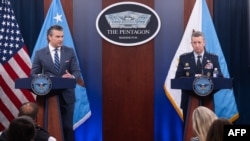
Speaking to reporters at the Pentagon, Hegseth said that operation was only a “temporary solution,” and he again demanded Iran stop its blockade.
US warships are also blockading Iranian ports as part of the standoff.
"Iran cannot be allowed to block innocent countries and their goods from an international waterway," Hegseth told reporters.
The Iranians “said they control the strait. They do not," he said.
'Cease-Fire Not Over'
Asked about the cease-fire, Hegseth said: "The cease-fire is not over."
"We said we would defend and defend aggressively, and we absolutely have. Iran knows that, and ultimately, the president can make a decision whether anything were to escalate into a violation of a cease-fire," he said.
General Dan Caine, the chairman of the US Joint Chiefs of Staff, said Iran had attacked US forces "more than 10 times" since the April 8 cease-fire. However, he said, that "fell below the threshold of restarting major combat operations."
An estimated 22,500 sailors and mariners on more than 1,550 commercial ships were stuck in the Persian Gulf, unable to transit the strait, Caine said.
Speaking to Fox News on May 4, US President Donald Trump again warned Iran against targeting US vessels, saying it would be “blown off the face of the earth” if it did.
US Secretary of State Marco Rubio, meanwhile, said the initial military operation was over, and he insisted the US blockade of Iranian ports was strictly defensive.
"We are only responding if attacked first. This is a defensive operation," Rubio told reporters. "If no shots are fired at these ships and no shots are fired at us, we're not firing shots, but if we're fired on we will respond."
New Missiles at UAE
Roughly two hours after Hegseth's Pentagon briefing concluded, the UAE Defense Ministry announced that it had detected Iranian missiles and drones.
“The UAE’s air defense systems are actively engaged in missile and drone threats,” the ministry said in a post to X. "The origin of these threats is Iran.”
A day earlier, UAE reacted angrily, threatening retaliation after four Iranian missiles were launched at it. Three were intercepted by air defenses, while the fourth fell into the sea.
An Iranian drone also hit the UAE port of Fujairah on May 4, sparking a fire, and injuring three Indian nationals working there, authorities said. Located on the Gulf of Oman, the port has become even more crucial after Tehran’s effective closure of the Strait of Hormuz.
Amid the fraying cease-fire, Tehran and Washington have exchanged proposals for a peace settlement. Among the biggest obstacles is the fate of Iran’s nuclear ambitions. Washington wants Tehran to give up its uranium, including its highly enriched uranium, which can be used for building a weapon.
Iranian Foreign Ministry spokesperson Esmail Baqaei was quoted as saying there were no talks over Iran's nuclear capabilities at this stage.
Speaking at the State Department, Rubio said it was time for Tehran to "accept the reality of the situation", and a diplomatic solution had to address any nuclear material that Iran still had buried.
"The president's been clear that part of the negotiation process has to be not just the enrichment, but what happens to this material that's buried deep somewhere that they still have access to if they ever wanted to dig it out," Rubio told reporters.
Iran’s Foreign Minister Abbas Araqchi, meanwhile, was traveling to Beijing for talks.
China relies heavily on Middle Eastern oil exported and shipped via the Strait of Hormuz, and Chinese officials have been quietly involved trying to help broker a settlement and get the ship traffic moving again.

