




WASHINGTON -- After US-Iran nuclear talks concluded in Geneva under heavy American pressure on Tehran to curb its nuclear activities, leading Washington experts say the crisis now stands at a tipping point, with the chances of peace or war at "50-50."
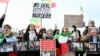
Negotiations ended on February 18 with no breakthrough. The White House said the sides remain "very far apart" despite what it described as limited progress. Press Secretary Karoline Leavitt told reporters that Iran is expected to return with more details "in the next couple of weeks."
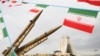
Ahead of the Geneva meeting, Tehran conducted live-fire exercises, launching missiles toward the Strait of Hormuz -- one of the world's most vital oil shipping corridors. It has continued on February 19 with joint naval exercises with Russia.
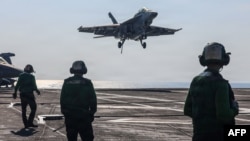
The Pentagon has amassed substantial firepower in the region. The USS Abraham Lincoln aircraft carrier -- equipped with F/A-18 and F-35 fighter jets -- is operating in nearby waters. Guided-missile destroyers including the USS Mitscher and the USS Michael Murphy are deployed in the Persian Gulf.
Tehran has remained defiant in the face of the pressure it is facing over its nuclear program and uranium enrichment, insisting it is strictly for civilian purposes and denying any effort to build nuclear weapons. Iran is not believed to have an active nuclear weapons program, though it has a history of atomic weapons research activities.
Experts: Even Odds
Speaking at the Center for Strategic and International Studies (CSIS) on February 18, four former US officials with years of experience in Middle East affairs assessed the situation in blunt terms.
Michael Ratney, former US special envoy for Syria and ambassador to Saudi Arabia (2023-2025), said the outlook is evenly balanced.
"I think it's 50-50," he said when asked whether the region is headed toward war or peace.
Ratney suggested any agreement may not resemble a comprehensive nuclear accord. Instead, it could be a framework, announcement, or confidence-building process that allows Trump to claim he has delivered stability even if core issues remain unresolved.
Joseph Farsakh, a former US Treasury Department official who worked on Middle East sanctions policy, also said that even if talks eventually yield results, a comprehensive agreement appears unlikely in the current climate of mistrust.
A more probable outcome, he said, would be a partial deal that provides limited sanctions relief while postponing more contentious issues.
Such an arrangement could significantly increase Iranian oil exports, potentially boosting them to around 2.5 million barrels per day and injecting oil worth between $50 billion and $90 billion annually into global markets.
In a "blue sky" scenario, greater stability could unlock what he described as a peace dividend, encouraging outside investment and broader regional integration.
But Farsakh cautioned that a rapid influx of Iranian crude could depress global oil prices, squeezing Gulf states that rely on higher prices to finance ambitious economic transformation programs. And even with a deal, he said he is not convinced that the risk of future US, or possibly Israeli, strikes would fully disappear.
Vali Nasr, a former senior adviser at the State Department, also described the situation as evenly split.
Neither Washington nor Tehran truly wants a messy war, he argued, given the enormous risks involved. That shared reluctance could ultimately pull both sides back from the brink.
At the same time, Nasr emphasized that Trump's personal political calculus will be decisive. Traditional foreign policy analysis -- focused on institutions and long-term interests -- may be less predictive in this case.
Nasr also noted that multiple global crises are unfolding simultaneously, meaning developments elsewhere could quickly reshape decision-making on Iran.
Narrow Margin For Error
Susan Ziadeh, former deputy assistant secretary of state for Near Eastern affairs, warned the military buildup itself creates momentum. With such a large naval and air presence already in place, she suggested, it may not be easy to simply stand down.
With warships positioned near Iranian waters, missiles fired during military drills, and leaders on both sides issuing stark warnings, the room for miscalculation is also slim.
The Geneva talks followed an earlier round in Oman on February 6, launched after regional actors pushed for de-escalation amid fears of broader destabilization.
Ziadeh also pointed to Israel as a key variable, noting Israeli leaders may operate under a different strategic calculus.
US Secretary of State Marco Rubio is scheduled to travel next to Israel to meet Prime Minister Benjamin Netanyahu on February 28, according to US media reports.

