




WASHINGTON -- The US House Rules Committee has advanced legislation imposing tougher sanctions on Russia and Iran, clearing a key procedural hurdle for a possible House vote later this week but exposing deep Democratic concerns over the measure's expansion of presidential tariff authority.
The committee voted 7-3 late on September 14 to advance a rule setting up debate on the legislation. Debate on the rule is expected to begin around noon local time on September 15. If the rule is approved, the House is expected to consider final passage of the sanctions package on September 16.
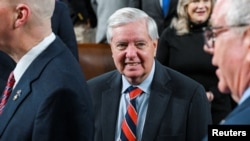
The legislation, known as the Lindsey O. Graham Sanctioning Russia and Iran Act of 2026, is named for the late Republican senator who championed the measure before his death. The Senate approved the legislation by an overwhelming 86-11 vote in August, giving the House a measure with substantial bipartisan backing in the upper chamber.



The House version was introduced by Republican Representative Michael McCaul of Texas with Democratic Representative Steny Hoyer of Maryland and other bipartisan cosponsors.
But the legislation has faced a more difficult path in the House, where Democrats have objected primarily to provisions that would give President Donald Trump broad new authority to impose tariffs on countries buying Russian energy or helping Moscow evade sanctions.
McCaul: 'Putin Is Watching'
McCaul, a senior Republican voice on foreign policy, urged lawmakers to move quickly.
"Putin is watching," McCaul told the committee, warning that Russia, China, Iran, and North Korea were working together to challenge the United States and its allies.
He argued that the legislation would target the financial networks supporting Russia's war effort, including Russian officials, oligarchs, financial institutions and the so-called shadow fleet used to transport Russian oil.
The bill also extends sanctions on Iran that are due to expire at the end of the year, targeting funding for Iran's energy and weapons sectors. McCaul argued that Russia and Iran could not be treated as separate challenges because of their military cooperation.

The legislation would give Trump authority to impose tariffs of up to 100 percent on major purchasers of Russian oil and natural gas and countries accused of helping Moscow evade energy sanctions.
Democrats say that authority is too broad and could raise prices for American consumers or be used beyond the bill's stated Russia-related purpose.
Representative Gregory Meeks of New York, the top Democrat on the House Foreign Affairs Committee, said he strongly supports additional pressure on Russia but opposed the bill in its current form.
Meeks said the president already has extensive authority to impose sanctions on Russia and argued that the legislation would do less to force new sanctions than it would to expand presidential control over tariffs.
"American families will pay the cost of this bill. Vladimir Putin will not," he argued.

Meeks and other Democrats proposed amendments that would have removed the secondary tariff provisions, tightened the president's ability to waive sanctions, clarified that the European Union could not be treated as a single "country" for tariff purposes, and provided additional military financing for Ukraine.
Another Democratic proposal would have identified 10 countries as initially eligible for tariffs of up to 100 percent because of their purchases of Russian oil and gas or their alleged role in sanctions evasion. The list included China, India, Azerbaijan, Turkey, the United Arab Emirates, Hungary, Slovakia, Singapore, Kazakhstan, and Kyrgyzstan.
Meeks also sought to require that sanctions be waived only when doing so was "vital to the national security of the US."
The committee rejected the Democratic amendments.
Hoyer, a Democratic cosponsor of the bill, also sought a change that would specifically identify countries potentially subject to the tariffs. He nevertheless opposed removing the tariff mechanism altogether.
"If we do not pass this bill, there will be great joy in the Kremlin and great devastation in Kyiv," Hoyer said.
The dispute reflects a broader dilemma for House Democrats: many support stronger measures against Russia and continued assistance for Ukraine, but they have also opposed what they regard as unchecked presidential use of tariff powers.
The White House supports the sanctions legislation, and Trump has indicated he wants Congress to provide the administration with additional tools to pressure Russia and countries that continue buying Russian energy.
The timing is also significant.
The House is scheduled to leave Washington later this week for an extended recess ahead of the midterm elections, potentially making this one of the last opportunities for lawmakers to act on the legislation this year.
'Leverage On Mr. Putin'
After the Rules Committee vote, McCaul told RFE/RL in an interview that the legislation was needed to give Washington leverage over Russian President Vladimir Putin and push him toward negotiations. "Without leverage on Mr. Putin, he'll never come to the negotiating table," McCaul argued.
He pointed to his meeting with Ukrainian President Volodymyr Zelenskyy and argued that Ukraine needs both military and economic support while the United States seeks to pressure Moscow toward a settlement.
"We believe that it will put enough economic pressure on Mr. Putin to finally come to the table and negotiate a peaceful settlement," McCaul said.

Asked about concerns that the bill could be used against European allies, McCaul rejected the argument that it would give Trump unrestricted authority to expand tariffs.
"The bill very narrowly defines the tariffs," he said, arguing that the provisions focus on the largest importers of Russian energy and cannot simply be expanded to other countries.
McCaul also pointed to support for the legislation from European officials and Zelenskyy, saying the measure could represent an important moment in efforts to pressure Moscow.
"I think this is a moment in time we have a chance to vote on something that can really change the course of history," he said.
McCaul said he was confident the bill would be approved if it reached the House floor.
"I'm optimistic this will be passed on the floor and will be signed by the president," he said.
He also dismissed arguments that the debate should be viewed primarily through the lens of domestic politics.
"Putin wants nothing more than for this bill to fail, and it plays right into his hands," McCaul said. "This is not about domestic politics. This is about saving Ukraine from this aggression from Putin. A vote against this bill is a vote for Putin."

