




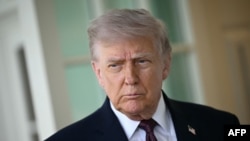
US President Donald Trump suggested that talks with Iran could resume in a day or two, while the US military said that no ships slipped through a naval blockade targeting vessels headed to or from Iranian ports in the first 24 hours of the restrictive measure.
Trump ordered the blockade after US-Iranian peace talks in Islamabad on April 11-12 failed to produce an agreement to end the war, which began with US and Israeli air strikes on Iran on February 28.
In comments to the New York Post on April 14, he indicated that negotiators could meet again in the next couple of days.
"You should stay there, really, because something could be happening over the next two days, and we're more inclined to go there [than to another location]," an Islamabad-datelined story in the Post quoted Trump as saying. The clock is ticking on a two-week cease-fire agreed by the United States and Iran on April 7.
Media reports earlier in the day said Pakistan was seeking to facilitate a new round of talks later this week. Those reports followed an interview in which US Vice President JD Vance raised the prospect of further meetings by saying "a lot of progress" was made at the April 11-12 talks.

"The ball is in the Iranian court," said Vance, who led the US delegation at the talks in Islamabad and departed early on April 12 after meetings were held late into the night but ultimately foundered, he and other US officials said, over disagreements on Iran's nuclear program.
"The indication we have is that it is highly probable that these talks will restart," UN Secretary-General Antonio Guterres said on April 14.
"I think it would be unrealistic to expect...such a complex problem, long-lasting problem, could be resolved in the first session of a negotiation," Guterres told reporters. "So we need negotiations to go on, and we need a cease-fire to persist as negotiations go on."
Official Iranian news agency IRNA quoted the country's president, Masud Pezeshkian, as again blaming Washington for the failure of the talks during a conversation with his French counterpart, Emmanuel Macron, on April 14. But he also said that "diplomacy is the preferred path to resolving disputes," according to IRNA.
Macron said he had urged Pezeshkian and Trump, in separate calls, to renew talks.
One of the most contentious issues has been Iran's effective closure of the Strait of Hormuz, a conduit for about one-fifth of the world's oil and gas shipments before the war began. After the Islamabad talks broke up without a deal, Trump announced a US blockade targeting ships bound to or from Iran.
"During the first 24 hours, no ships made it past the US blockade and 6 merchant vessels complied with direction from US forces to turn around to re-enter an Iranian port on the Gulf of Oman," the US Central Command, which is responsible for operations in the region, said in a post on X.
"The blockade is being enforced impartially against vessels of all nations entering or departing Iranian ports and coastal areas, including all Iranian ports on the Arabian Gulf and Gulf of Oman," CENTCOM said. "U.S. forces are supporting freedom of navigation for vessels transiting the Strait of Hormuz to and from non-Iranian ports."
At the same time, data from tracking services indicated that at least four ships, two of which had recently called at Iranian ports, passed or were passing through the 30-kilometer-wide Strait of Hormuz in the hours after the blockade came into force at 10 a.m. US Eastern Time (2 p.m. UTC) on April 13.
A Liberian-flagged ship that delivered corn to the Iranian port of Bandar Imam Khomeini passed Iran's Larak Island in the strait a few hours after that, and a Comoros-flagged tanker, which was carrying methanol and had left the Iranian port of Bushehr on March 31, exited the strait around the same time, the AFP news agency reported, citing data from Kpler.
Also citing tracking services, Reuters separately reported that three Iran-linked vessels that transited the strait were not headed for Iranian ports and were not affected by the blockade. Two of the three vessels are under US sanctions and one of those two is Chinese-owned, Reuters reported.
'Record' Oil Prices
A spokesman for the Chinese Foreign Ministry called the US blockade "dangerous and irresponsible."
Guo Jiakun said it would "escalate tensions, undermine the existing fragile cease-fire agreement, and further endanger the safety of navigation through the strait."
Also on April 14, the International Energy Agency (IEA) said global oil demand would shrink more than at any time since the Covid-19 pandemic, with prices pushed up amid the "most severe supply shock in history" owing to the Iran war.
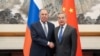
"It remains unclear whether the cease-fire will turn into a lasting peace and a return to regular shipping flows through the Strait of Hormuz. With oil-importing nations scrambling to source replacement barrels from an increasingly shrinking pool of supply, physical crude oil prices surged to record levels," the IEA said.
Among measures taken to boost global oil supply was a US decision to grant a temporary waiver to sanctions on Russian oil, introduced after Moscow's full-scale invasion of Ukraine in 2022.
That waiver was due to expire on April 11, but there is no indication of whether or not it has been extended, according to Kremlin spokesman Dmitry Peskov. "There have been no statements about this," he told journalists.
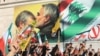
Another source of disagreement over the US-Israeli war with Iran is the issue of Lebanon and in particular Israel's ongoing campaign against Iran's Lebanese proxy force, Hezbollah.
Hezbollah is both a militant group and political party that controls much of southern Lebanon. It is considered a terrorist organization by the United States, while the European Union has only blacklisted its armed wing.
Tehran says this conflict should also be covered by the wider cease-fire, but Washington says it is separate. It began when Hezbollah attacked Israel on March 2 in response to the air strikes on Iran.
On April 14, US Secretary of State Marco Rubio hosted the Israeli and Lebanese ambassadors to Washington in the first direct talks between the neighboring countries in decades.
The meeting had been planned before the US-Israeli war with Iran and Israel had ruled out discussing a potential cease-fire at the talks, which Hezbollah denounced.
The State Department said the participants "held productive discussions on steps toward launching direct negotiations between Israel and Lebanon," and that all sides "agreed to launch direct negotiations at a mutually agreed time and venue."
"The United States congratulated the two countries on this historic milestone and expressed its support for further talks, and for the government of Lebanon's plans to restore the monopoly of force and to end Iran's overbearing influence," State Department spokesman Tommy Piggott said in a statement.
No date was set for additional talks, and no other specific agreements were announced following the two-hour meeting.