




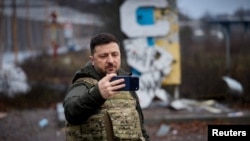
Russia has rejected a proposal to hold a referendum to let Ukrainians decide on giving up territory in the eastern Donbas region, highlighting a key sticking point as negotiators head to Berlin for high-stakes talks on ending Russia's war on Ukraine.
"This area is Russian territory," Yuri Ushakov, foreign policy adviser to Russian President Vladimir Putin, said on December 12.
Ushakov, who was referring to Russia's 2022 illegal annexation of the Ukrainian region after it had launched its full-scale invasion earlier that year, made the comments a day after Ukrainian President Volodymyr Zelenskyy proposed a vote be held in Ukraine to decide the issue.
After the United States proposed a 28-point peace plan that critics say heavily favors Russia, Ukraine and European nations have been seeking changes that would make the deal less lopsided and, crucially, ensure Ukrainian security against any future Russian attack. Kyiv submitted a 20-point plan earlier this week.

Ukrainian and European officials are expected to further refine their stance at meetings this weekend in Berlin, with US President Donald Trump saying he would send a representative "if we think there's a good chance. And we don't want to waste a lot of time if we think it's negative."
A German government spokesperson said in a statement that Zelesnkyy and German Chancellor Friedrich Merz will then hold talks on December 15 with other European and NATO leaders joining them afterward.
The status of Ukraine's Russian-held Zaporizhzhya nuclear power plant is another divisive issue, Zelenskyy said.
While Russia has given few signs it is ready to back away from longstanding demands, US and Ukrainian officials have been wrangling over the details.
Zelenskyy said on December 11 he had an "in-depth" discussion with US Secretary of State Marco Rubio, defense chief Pete Hegseth, and White House special envoy Steve Witkoff.
The United States is proposing Ukrainian troops withdraw from the well-fortified portion of the Donetsk region that they still control, Zelenskyy said, and "the compromise is supposedly that Russian troops will not enter" this area, where Washington calls for establishing a "free economic zone."
"They do not know who will govern this territory," Zelenskyy said, adding that Russia refers to it as a "demilitarized zone." He also said Ukrainians should have a say on any proposed territorial concessions, "whether through elections or a referendum."
Following reports that Trump had set a December 25 deadline for Ukraine to accept the peace proposal, Zelenskyy said Kyiv had not been given a firm deadline but that "I think they really wanted, or perhaps still want, to have a complete understanding of where we stand with this agreement by Christmas."
Trump has been seeking to broker an end to Russia's full-scale invasion of Ukraine since he took office in January of this year but has encountered significant hurdles including Putin's rejection of calls for a cease-fire.
Regarding elections -- which the United States has been pressing Ukraine to hold despite the fact they are forbidden under martial law -- Zelenskyy said on December 11 that a cease-fire would have to be in place.
Trump told Politico in an interview published on December 9 that "it's time" to hold elections, and Zelenskyy said later that day that he would push parliament to draft legislation allowing for elections during martial law. He said a vote could follow in 60 to 90 days provided that security guarantees in place to make sure voting would be safe for Ukrainians.
Speaking to Current Time, Maryna Stavniychuk, a Ukrainian legal expert and former member of the Venice Commission, said that "specific issues as wartime and postwar elections are not regulated in any way by the electoral code of Ukraine. Therefore, a special set of legislative norms is needed, and this takes time."
Kyiv must "look for options that, without violating the constitution or further undermining the legitimacy of the Ukrainian government, would allow elections to be held," she added.
Kyiv residents hold a variety of opinions about holding elections in a country at war.
One resident told Current Time that elections should take place so that Ukrainians "can prove whether they trust Zelenskyy."
Another resident said elections shouldn't be held during wartime due to security concerns. "If there is a massive attack on election day, how will people vote?" she asked.
"This would be very dangerous in terms of civilian casualties, and it would not fully reflect the will of the people," she added.
A third speaker said holding elections now "would be a misuse of funds." "We need to support the armed forces that are protecting our country, not spend money on PR," he told Current Time, adding Ukraine "needs something that unites us, not something that divides us."
In saying a cease-fire would be required, Zelenskyy may have been seeking to calling Russia's bluff -- Putin has baselessly charged that Zelenskyy is illegitimate because election were not held on schedule in 2024 -- but also left any plan to hold elections vulnerable to rejection by Moscow unless a peace agreement is in place before voting is held.

