



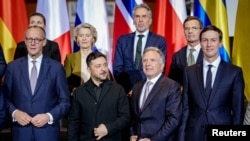
Russian officials reacted coolly to reports of progress in US-European negotiations to end Moscow's all-out war on Ukraine as the United States reportedly offered NATO-style security guarantees for Kyiv.
A day after envoys wrapped up two days of talks with Ukrainian President Volodymyr Zelenskyy, Kremlin spokesman Dmitry Peskov on December 16 said Moscow had not seen the proposals discussed in Berlin or details of the US security offer.
Blocking Ukraine from joining NATO has been a central position of Moscow's since before the start of the war. It's unclear if NATO-like security guarantees would be opposed by the Kremlin.
Peskov said Russia does not want a cease-fire -- Zelenskyy called for a Christmas truce -- but instead wants a final overall peace deal to stop the war, nearing its four-year anniversary.
"We want peace. We don't want a truce to give Ukraine breathing space and prepare for a continuation of the war," Peskov told reporters. "We want to stop this war, achieve our goals, secure our interests, and guarantee peace in Europe for the future. That's what we want."
In an interview with ABC News broadcast December 15, Russian Deputy Foreign Minister Sergei Ryabkov said a deal appeared imminent. However, he also signaled no shift from Russia's hard-line territorial and security demands.
That includes Russia's insistence that four Ukrainian regions that are partially occupied by Russian troops -- Luhansk, Donetsk, Zaporizhzhya, and Kherson -- are accepted as Russian territories. The Crimea Peninsula was annexed by Russia in 2014, a claim that has been rejected by nearly all countries around the world.
"Currently, there are four constituent entities that are an integral part of the Russian Federation. I'm not talking about Crimea," he was quoted as saying. "Thus, together we have five constituent entities, and we absolutely cannot compromise on them."
The talks in Berlin have raised hopes of a diplomatic end to the Russian war, which has killed or wounded more than 1.5 million men on both sides, devastated large parts of Ukraine, and made Russia a pariah state.
US envoys attending the talks offered NATO-style security guarantees for Kyiv, officials said.

That is a key demand for Ukrainian officials, who say without it a peace deal would only lay the groundwork for a new invasion by Russia in the future. Ukrainian officials also recall the 1994 Budapest Memorandum, a security guarantee backed by Washington and Moscow.
That accord prohibited Russia, the United States, and the United Kingdom from threatening or using military force or economic coercion against Ukraine, Belarus, and Kazakhstan, "except in self-defense or otherwise in accordance with the Charter of the United Nations."
In exchange, the three countries, which were emerging from the former Soviet Union, gave up their Soviet-era nuclear arsenals.
Speaking at the White House after he called into a dinner involving the key officials in Berlin, Trump said he thought negotiators were "closer now than we have ever been."
European officials echoed Trump's remarks.
"Today I had the feeling for the first time...that everyone was behaving like allies from one camp," Polish Prime Minister Donald Tusk told reporters after leaving Berlin.
"For the first time I heard from the mouths of American negotiators...that America would engage in security guarantees for Ukraine in such a way that the Russians would have no doubt that the American response would be military if the Russians attacked Ukraine again."
Zelenskyy told journalists that the US security guarantees must be legally binding and approved by Congress. He said they should also include provisions mirroring NATO's Article 5.
Article 5 is a central element of NATO's structure, stating an attack against one member of the alliance is considered an attack against all.
Zelenskyy reiterated that Ukraine will "neither de jure nor de facto" recognize the part of the Donbas occupied by Russian forces as Russian.
"Nevertheless, we are discussing the issue of territories. You know that this is one of the key issues. On this matter, we do not yet have a consensus," he added.
The Ukrainian leader also commented on the possibility of a loan, backed by frozen Russian assets, that would allow Kyiv to receive funding.
European Union leaders are set to decide at a summit later this week whether the bloc can make such a loan to Ukraine.
Zelesnkyy said a reparations loan would be a financial security guarantee for his country.
"Plan A is to end the war, but we must also consider Plan B: the continuation of Russian aggression," he said.
On the battlefield in Ukraine, Russian forces continue to grind forward, slowly pushing back Ukrainian defenses, while suffering extraordinary losses. Russia claims to be on the verge of capturing the key Donbas city of Pokrovsk, though Ukrainian forces are holding on.
Russia is also bombarding Ukrainian cities and towns, devastating energy infrastructure and trying to demoralize an already exhausted population.
Weekend attacks on the Black Sea port of Odesa and other southern cities left more than 1 million people without power as temperatures hovered just above freezing.
Approximately 430,000 people are still without electricity as of December 16, according to Anatoliy Zamulko, the acting head of Ukraine's energy regulator.
Ukraine's main security service released a video claiming an undersea drone had destroyed a Russian submarine docked in the Black Sea port of Novorossiysk.
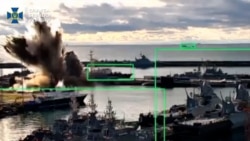

A Russian naval spokesman denied the claim in comments to the state-run TASS news agency.
Satellite images obtained by RFE/RL's Russian Service appeared to show the submarine in question still moored at a dock, though it was impossible to determine if the vessel was damaged.

