




We are now closing the live blog for today, but we'll be back again tomorrow morning to follow all the latest developments. Until then, you can keep up with all our ongoing Ukraine coverage here.
Good morning. We'll get the live blog rolling this weekend with a couple of items posted overnight by our news desk in Washington:
Forces To Withdraw From Eastern Ukraine Village In Step Toward Four-Way Summit
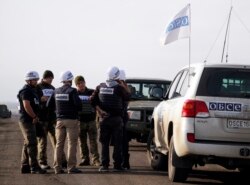
Ukrainian government forces and Russia-backed separatists are scheduled to begin withdrawing troops from around a village in the Donbas region of eastern Ukraine on November 9, raising hopes that an end to the long, deadly conflict is moving closer.
The Organization for Security and Cooperation in Europe (OSCE) said on November 8 that the withdrawal is set to begin a noon local time.
Under a deal reached earlier this month to end the five-year conflict, the sides agreed to disengage their forces in Zolote and the nearby town of Petrivske as a confidence-building measure that could pave the way for a summit between Ukraine, Russia, France, and Germany.
Kyiv has said the third such withdrawal -- from the village of Petrivske -- will mean that Ukraine has fulfilled its requirements for such a summit to take place.
The withdrawal of troops from Petrivske, originally set for October 9, was delayed after fighting there resumed.
The agreement to resume the four-way talks, known as the Normandy format, states that fighting must cease for seven days before the withdrawal process can begin.
No date has been set for the talks, which are to be mediated by French President Emmanuel Macron and Germany Chancellor Angela Merkel.
Ukrainian armed forces have been fighting the separatists in eastern Ukraine in a conflict that has killed more than 13,000 people since April 2014.
Both sides have already withdrawn from Stanytsya Luhanska, a strategic crossing point in Luhansk region where a damaged bridge is being repaired over a river to ease pedestrian traffic in the clogged area.
"I welcome the completion of the withdrawal of forces and hardware from the disengagement area of Zolote and the start of demining activities," Martin Sajdik, the OSCE’s special envoy in Ukraine, said on November 4.
"Encouraged by the progress in Stanytsya Luhanska and Zolote, I urge the sides to do everything necessary for relaunching the process of disengagement in the area of Petrivske as soon as possible."
The OSCE has been monitoring the conflict, including the withdrawal of forces.
With reporting by Reuters, AFP, and AP
Two Senior U.S. Officials Describe Efforts To Press Ukraine For Biden Probes
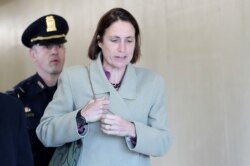
Two senior figures in the U.S. administration have separately described efforts by U.S. officials to pressure Kyiv to investigate former Vice President Joe Biden and his son by withholding military aid and dangling a visit to the White House for the Ukrainian leader.
Chairpersons of the Democratic-led committees spearheading the impeachment inquiry of President Donald Trump on November 8 released another batch of transcripts from previous closed-door testimony ahead of planned public hearings next week.
In the latest transcripts, both Fiona Hill, a former White House Russia adviser, and Alexander Vindman, an Army officer assigned to the National Security Council (NSC), described their concerns that military aid and a potential White House invitation to Ukrainian President Volodymyr Zelenskiy had been linked to promises by Kyiv to investigate the Bidens.
Hill and Vindman said that in a July 10 meeting in the White House, Washington’s ambassador to the European Union, Gordon Sondland, told Ukrainian officials that Trump would hold a meeting with Zelenskiy if they launched the investigations.
Vindman, a lieutenant colonel, said that "there was no ambiguity" that Sondland "was calling for something, calling for an investigation that didn’t exist into the Bidens and Burisma," referring to a Ukrainian gas company where Biden's son, Hunter, served on the board.
"My visceral reaction to what was being called for suggested that it was explicit," he added.
Vindman also testified that Sondland told the meeting that he was coordinating the probe request with acting White House Chief of Staff Mick Mulvaney, who is Trump's top aide as well as the director of the White House's Office of Management and Budget.
Democrats conducting the House inquiry subpoenaed Mulvaney on November 7, but he did not show up on November 8.
Hill, the former senior director for European and Russian affairs on the NSC, testified that she heard Sondland bring up Burisma at the same July 10 meeting, according to a transcript of her testimony.
Meanwhile, the former U.S. national security adviser, John Bolton, was "part of many relevant meetings and conversations" of interest to the impeachment inquiry that have not yet been made public, his lawyer said.
In a transcript of Hill’s interview, she described how Bolton had "immediately stiffened" when Sondland "blurted out" that he had worked out a trade with Mulvaney in which the Ukrainians would announce a probe of the Bidens in return for a White House visit.
Hill said Bolton later told her that "I am not part of whatever" activity Sondland and Mulvaney "are cooking up" and asked her to relay that message to a White House lawyer.
Bolton, who served from April 2018 until Trump fired him on September 10, has also been asked to appear before the House committees but he has so far resisted.
House Democrats are holding hearings that could lead to the impeachment of Trump over his move to withhold the aid to Ukraine at the same time he was pressing Kyiv to conduct investigations of Biden and other Democrats.
Democrats say asking a foreign power to target a U.S. political rival represents an abuse of power by Trump, who denies any wrongdoing.
With reporting by AP, AFP, Reuters, and dpa