




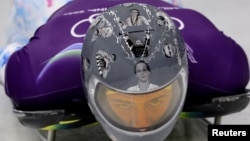
WASHINGTON -- Ukrainian skeleton racer and Olympian Vladyslav Heraskevych is urging US lawmakers and the State Department to deny visas to Russian athletes who seek to compete under the Russian flag at the 2028 Summer Olympic Games in Los Angeles, arguing that Moscow has turned sport into an instrument of war propaganda.
Heraskevych, who is visiting Washington to meet with members of Congress and other US decisionmakers, said the United States has a role to play in preventing the Los Angeles Olympics from becoming a platform for Kremlin messaging.
His appeal comes after the International Olympic Committee (IOC) moved to restore the Russian Olympic Committee's status and lifted recommendations that had restricted Russian participation in international competitions.
"We are living in a real world," Heraskevych told RFE/RL in an interview on September 14. "Competitions are taking place in real countries, in real places."
He said that while international sports bodies can make recommendations, governments control access to their territory -- giving the United States a potential means of preventing Russian athletes from taking part.
Heraskevych is calling on Washington to maintain restrictions that allow eligible Russian athletes to compete only as neutrals, without Russian flags, symbols, or official delegations.
"Our main goal is to show these particular cases, these particular names, and to present that sport is not out of politics," he said.
Russian Sport 'Used In Propaganda'
Heraskevych said policymakers need to abandon what he called the mistaken assumption that sport can be separated from politics. Many people "believe that sport is out of politics," he said. "But Russian sport is being used in propaganda."
He pointed to Russian athletes' participation in political events, support for President Vladimir Putin's ruling political establishment, and activities connected to Russia's war effort against Ukraine.
Heraskevych also cited what he described as Russian athletes' involvement in events linked to Ukrainian children who were forcibly taken to Russia and their participation in military-related activities.
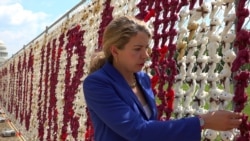


He said the use of sport for political purposes predates Russia's full-scale invasion of Ukraine in February 2022, pointing to the massive doping scandal surrounding Russian sport and the 2014 Sochi Winter Olympics. "We all remember how Russian security services were involved in this scandal," he said.
Heraskevych said Russia has since expanded its use of sport to promote militarization and normalize the occupation of Ukrainian territory.
He cited Russia's so-called Youth Army movement, which he said is aimed at preparing a new generation for military service, as well as sporting competitions in which Russian organizers present occupied Ukrainian territories as part of Russia.
"These are just a few examples of how Russia uses sport, uses this platform to spread their propaganda, to empower and to make their war machine powerful," he said.
Kateryna Lisunova, a media adviser at the US-based nonprofit Razom for Ukraine, which is supporting Heraskevych's Washington campaign, said the effort is also aimed at warning Americans about how Moscow uses seemingly apolitical institutions.
"It is important to inform American representatives and American people as well as for them to not become a tool in Russian hands in war propaganda," Lisunova told RFE/RL.
She said Russia has used "many good things such as art and sport" to promote and normalize the war and make audiences feel "as if nothing is happening."
Visa Bans
Heraskevych said visa restrictions could provide a practical way for the US to enforce its own policy regardless of decisions by international sports organizations.
He pointed to recent cases in Europe and Canada in which Russian athletes were denied visas after evidence was presented to authorities of their support for Russia's war or use of pro-Kremlin symbols.
He cited a 2026 European Taekwondo Championship in Germany, where Russian athlete Vladislav Larin was denied a visa after evidence was submitted showing that he had publicly collected money for the Russian military.
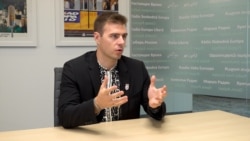

He also cited a 2026 junior world curling championship where Russian athletes were denied visas after evidence was presented showing them posing with symbols associated with Russia's invasion.
Latvia has similarly denied visas to Russian athletes seeking to participate in international competitions, Heraskevych said. "We have cases, successful cases," he said. "I believe it's a great experience, and we should share it with the US."
He acknowledged that visa bans alone would not change Russia's policy but argued they could prevent international sports events from being exploited as propaganda platforms.
"I believe it's one of the possibilities what we can do, and it's also what lawmakers can do," he said.
Heraskevych's Own Olympic Protest
The Ukrainian athlete's campaign is also rooted in his own experience at the 2026 Winter Olympics, where he was penalized after displaying a message on his helmet honoring Ukrainian athletes killed during Russia's war against Ukraine.
Heraskevych said he still does not understand why he was disqualified, arguing the message was simply an act of remembrance.
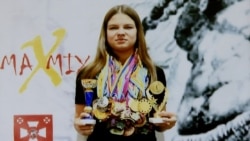
He said the episode reinforced his concern that international sports institutions are increasingly creating a path for Russian participation while avoiding responsibility for the consequences. "I believe it's connected, and it's not a coincidence," he said.
For Heraskevych, the dispute is ultimately about what the Olympic movement is supposed to represent.
"The Olympic Games and Olympic movement -- it's everything about peace, about peaceful mission, about building bridges," he said. "But when you're allowed to compete and giving this platform to terrorists, then it has nothing to do with peace and peaceful mission."
He said the goal of his Washington visit is not to prevent the Olympics from serving as a venue for international competition but to ensure Russia cannot use the event to legitimize its war.
"We should protect this platform and we should try to make it a better place, but not a place where Russia will spread their propaganda," Heraskevych said.

