




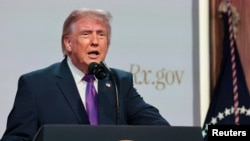
Over two days, US President Donald Trump has repeatedly raised the prospect that the cease-fire with Iran will be broken by new US military strikes -- in comments that have drawn close scrutiny from analysts and policymakers.
In a Truth Social post on May 18, Trump said the leaders of Qatar, Saudi Arabia, and the United Arab Emirates had asked him to hold off on what he called a "planned military attack," scheduled for May 19, to allow diplomacy more time.
On May 19, he said an attack may take place "Friday, Saturday, Sunday, something, maybe early next week," further raising the rhetorical heat on Iran.
Speaking to RFE/RL hours later, Congressman Don Bacon, a senior Republican on the House Armed Services Committee, said further strikes may indeed be necessary.
"They can have no nuclear weapon," he said. "I think military force is needed."
Bacon backed the idea that Trump should seek Congressional authorization for further strikes, and a measure that would require him to do so passed a first procedural vote in the Senate the same day.
Senator Lindsey Graham, a close Trump ally who voted against subjecting the war to congressional approval, is among those who appear to lean toward more military action. Following Trump's comments on May 19, he wrote on social media that "the [Iranian] regime has had months to reach a deal, but it seems apparent to me they are playing games."
Admiral Brad Cooper -- head of the US Central Command, which oversees American forces cross the Middle East -- told a hearing of the US Congress Armed Services Committee that "our job is to be ready, and we are."
The Strategic Dilemma
But analysts who spoke to RFE/RL indicated that, while there may be a renewed impetus to break the current deadlock with Iran, the strategic dilemma presented by the standoff in the Persian Gulf has not changed.
"A blockade of oil leaving the Gulf and a blockade of materials going into Iran, cannot continue indefinitely," Mark Cancian, senior adviser with the Defense and Security Department at Center for Strategic and International Studies, told RFE/RL.
"There's no question the administration is looking for an exit. They very much want to end the conflict," he added.
Danny Citrinowicz, a senior researcher on Iran at the Israel-based Institute for National Security Studies, said the situation underscored several important regional dynamics.

Iranian deterrence toward Persian Gulf states appears to be working, he argued, with governments in the region increasingly calculating that neither their own military capabilities nor American power can reliably prevent a large-scale Iranian retaliation.
During the war, Gulf states took the brunt of Iranian attacks with the UAE coming under more attacks than even Israel, which was directly involved in the war.
"There is growing recognition across the region that the Iranian regime has survived the current campaign, and that additional military action may not fundamentally improve the strategic picture," he wrote.
Citrinowicz said Trump's decision to call off renewed strikes on May 18 "looks more like a tactical postponement than a strategic shift" because in the absence of a "meaningful compromise" in peace talks, "the same dilemma is likely to return to President Trump with even greater intensity."
Diplomacy Faces Obstacles
That assessment was echoed by Ali Vaez, director of the Iran Project at the International Crisis Group, who told RFE/RL's Radio Farda that some convergence on secondary issues may be occurring.
He specifically pointed to Iranian Foreign Minister Abbas Araqchi's signal at the BRICS summit last week that Tehran might be willing to transfer its stockpile of 60-percent enriched uranium to a third country, possibly Russia. Washington, however, continues to insist the material be sent to the United States.
But on the fundamental questions -- the nuclear file broadly, the fate of the Strait of Hormuz -- serious gaps remain. The US blockade of Iranian ports, Vaez argued, is unlikely to be the decisive instrument its proponents in Washington imagined. When it was imposed in April, some predicted Iran would buckle within days -- a forecast that proved mistaken.

Because the Islamic republic has no hesitation in transferring economic pain to the population, and can sustain internal control through repression, Vaez said, even economic collapse would not necessarily produce political capitulation from Tehran.

