




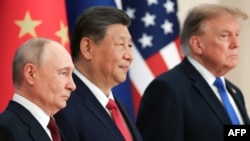
A first-ever trilateral meeting involving US President Donald Trump, Chinese President Xi Jinping, and Russian President Vladimir Putin has concluded in Shenzhen, China, with the release of a four-point joint declaration on global energy supplies, international justice, nuclear war, and reforming the United Nations.
The statement was first published on the Kremlin website and Chinese state news agency Xinhua, and later by the White House.
It said that "the three countries plan to increase the production and supply of refined petroleum products for the benefit of all nations."
It also called for "respect for immunities of state officials" from the International Criminal Court (ICC) and other similar bodies. Uniquely among the three leaders, Putin has been indicted for war crimes by the ICC for the abduction of Ukrainian children.
The declaration further reaffirmed that "a nuclear war cannot be won and must never be fought," pledging dialogue to reduce nuclear risks and prevent nuclear proliferation. Trump has sought to engage China in three-way nuclear arms reduction talks, which Beijing has resisted.
The document also says that Russia, China, and the United States are committed to reforming the UN.
The declaration does not mention Ukraine, but speaking to media after the meeting, Putin said the three leaders did discuss the full-scale war that his country unleashed on the country in 2022.
“During the trilateral meeting, I recalled where it all began -- where the Ukrainian crisis originally started," he said.
Chinese Foreign Ministry spokesperson Mao Ning wrote on social media "President Xi noted that the summit today was positive, constructive, and very productive. We three countries share the same view on safeguarding world peace."
'Making History'
"We are really making history. The three of us have a great deal to discuss," Trump said in opening remarks at the Shenzhen meeting.
"As presidents of three of the world's largest countries, we have a special responsibility to maintain open, respectful, and productive dialogue on issues impacting not just our people but the entire planet," he added.
Before the trilateral meeting, the US president held separate one-on-one meetings with both Putin and Xi. It was the first face-to-face engagement between Trump and Putin since their talks in Alaska in August 2025 failed to make progress on ending Russia's war on Ukraine.
Following the meeting, which appeared to yield no concrete outcomes, Trump said that "it went great," with "fantastic relationships built."
Ukrainian political analyst Ihor Reiterovych told Current Time that, for the leaders, "it was nothing more than a photo opportunity for the record, a chance to get a nice picture."
"And, in fact, it is the Russians who are most interested in these photographs," he added.
Ukraine Remains A Key Issue
Ukraine has repeatedly insisted that it must participate in any negotiations concerning its future.
At a November 19 meeting of the Coalition of the Willing -- a grouping led by Germany, France, and Britain that was established to support Kyiv and potentially form a peacekeeping mission should a cease-fire be agreed upon -- European leaders backed this stance.
A "Yalta format cannot bring peace," German Chancellor Friedrich Merz told a joint press-conference with Ukrainian President Volodymyr Zelenskyy, European leaders, and Trump's peace envoys, Jared Kushner and Steve Witkoff.
Describing the meeting in Shenzhen as a "photo op," Merz, who hosted the coalition's talks in Berlin, said negotiations on the peaceful settlement of Russia's all-out war "can only be successful with Ukraine and Europe."
Kushner said Washington sees Europe's "strong" backing of Ukraine and that Trump will relay this position to Russia. He added that Trump gave the gathering an update of his meeting with Putin and Xi Jinping, and was not "looking to impose anything unilaterally" and wanted to "deal with Europe by his side."
Kushner also said that Trump was open to to security guarantees for Ukraine as part of a broader peace deal with Russia.
However, there was no immediate indication from the Kremlin following the meeting in China that it was prepared to soften its hard-line demands.
Moscow has long insisted that Ukraine remain outside NATO, opposed the deployment of Western troops as part of security guarantees for Kyiv, and demanded that Ukrainian forces withdraw from the remaining Kyiv-controlled areas of Donetsk, Luhansk, Zaporizhzhya, and Kherson, four Ukrainian regions Moscow claims to have annexed.
Moreover, in Kushner and Witkoff's meeting with Putin earlier this month, Russia gave extremely uncompromising signals on key issues, including a desired overhaul of Europe's longstanding security architecture.
Following talks with Trump and Xi Jinping on November 19, Putin said that Russia had proposed that European leaders come to Moscow for peace talks. "Then we will decide in what format we will continue the dialogue on Ukraine," he said.
The Kremlin has previously proposed Moscow as the only venue for talks with Zelenskyy, although a meeting in the capital of the country waging war against Ukraine would be highly unlikely to be acceptable to Kyiv.
Senators Urge Tougher Stance
Ahead of Trump's engagements with Putin and Chinese President Xi Jinping, nine Democratic senators issued a statement urging the president to defend US interests and confront what they described as growing threats from Beijing and Moscow.
The statement was led by Senator Jeanne Shaheen, the ranking Democrat on the Senate Foreign Relations Committee, and was joined by Senators Chris Coons, Tim Kaine, Jeff Merkley, Cory Booker, Brian Schatz, Chris Van Hollen, Tammy Duckworth, and Jacky Rosen.
"American security cannot be traded away for photo opportunities or personal aggrandizement," the senators said, urging Trump to impose meaningful costs on Putin for Russia's aggression rather than offer concessions that could undermine Ukraine, NATO allies, and US national security.