




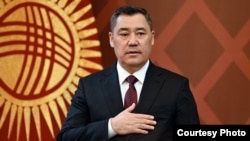
The Constitutional Court in Kyrgyzstan has issued a ruling with implications for an ongoing political power struggle that will suit President Sadyr Japarov -- while also throwing an obstacle to any long-term aim he may have to stay in power until 2037.
Japarov was elected to a six-year term in January 2021 but then presided over a change in the constitution later that year, which said the head of state would serve a maximum of two five-year terms.
Across Central Asia and Russia, similar constitutional reforms initiated by sitting presidents have often erased previous mandates.
In 2020, amendments in Russia reset presidential term limits, enabling Vladimir Putin to run again despite many years already spent in office. Similar constitutional revisions in Kazakhstan in 2022 and Uzbekistan in 2023 annulled prior terms after political systems were redesigned, giving incumbents a renewed mandate under updated frameworks.
If Kyrgyzstan had taken the same legal path, it would have meant Japarov could have potentially maintained his grip on power until 2037. But Kyrgyzstan has bucked the trend, with a court ruling saying that his current term cannot be written off.
While this may be a disappointment to Japarov supporters, another part of the ruling may help him in his current battle with Kamchybek Tashiev, whom Japarov recently fired from his post as head of Kyrgyzstan’s State Committee for National Security (SCNS).
The court ruled that Japarov must complete the full six-year mandate he won in January 2021 and that the new five-year term only applies to future elections -- quashing the prospect of an early election this year in which Tashiev might be able to challenge Japarov. Under the ruling, there will be no early vote.
The Last Word?
Independent lawyer Tattuububu Ergeshbaeva told RFE/RL's Kyrgyz Service that although constitutional scholars may continue debating the interpretation, the matter is effectively settled. As the country’s highest and final authority on constitutional issues, the court has the last word.
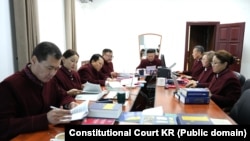
The court, composed of nine judges elected by parliament on the president’s proposal, serves as the country’s highest authority on constitutional matters, giving its rulings final legal weight.
Former Constitutional Court judge Klara Sooronkulova, speaking to RFE/RL, said the judges deliberately confined themselves to the letter of the law.
“They did not go beyond the limits of the norms they were interpreting, and there was no arbitrary interpretation. The court did not give an expansive reading, which could have changed the meaning of the norm. It made its decision strictly within the framework of the law,” she said.
She added that a clear legal determination like this should help calm political tensions, arguing that the ruling brings clarity and stability to a debate that had stirred uncertainty.
But the decision does not rule out future changes, for example if referendums were held on presidential term limits or further constitutional amendments.
“In authoritarian states, such a possibility always exists. It all depends on how the transitional provisions are written," Sooronkulova said. "Something can be added there, but for now the court has put an end to this issue.”

