




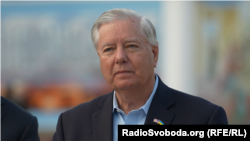
WASHINGTON -- US Senator Lindsey Graham, one of the Republican Party's most influential voices on foreign policy and among Ukraine's strongest supporters in Washington, died on July 11 after what his office described as a "brief and sudden illness." He was 71.
Emergency personnel responded on the evening of July 11 to a report of cardiac arrest at Graham's Capitol Hill home. He was transported to George Washington University Hospital, where he died shortly afterward. His office said only that he had suffered a "brief and sudden illness" and asked for privacy for his family.
"Senator Graham's family appreciates prayers at this time and asks for privacy during this incredibly difficult period," his office said.
US President Donald Trump led tributes, calling Graham "one of the greatest people and Senators I have ever known" and "a true American Patriot."
“He was always working, and was a true American Patriot. Lindsey will be greatly missed," Trump wrote on social media. "DETAILS AND ARRANGEMENTS TO FOLLOW. So sad!”
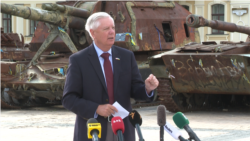
Graham, chairman of the Senate Budget Committee and a longtime Republican senator from South Carolina, was preparing to seek a fifth six-year Senate term in November. His death came just one day after he returned from Kyiv, where he met Ukrainian President Volodymyr Zelenskyy and announced that the White House had agreed to support a tougher bipartisan sanctions package targeting Russia.
One of the Senate's best-known Republicans, Graham spent more than two decades shaping US foreign policy debates. A close ally of Trump in recent years and previously of the late Senator John McCain, he became synonymous with an interventionist Republican foreign policy that emphasized a strong US military, close alliances, and confronting authoritarian adversaries.
Staunch Kyiv Ally
During Russia's 2022 invasion of Ukraine, Graham emerged as one of Kyiv's closest allies in Washington, pressing successive US administrations to provide more military assistance, tighten sanctions on Moscow, and maintain pressure on Russian President Vladimir Putin.
Throughout the war, Graham was a frequent visitor to Ukraine. His trip this week marked his 10th visit since Russia launched its full-scale invasion in 2022. He repeatedly met Zelenskyy and senior Ukrainian officials, toured military and defense facilities, and argued that defending Ukraine was essential not only for European security but also for maintaining the credibility of the United States and its allies.
The bipartisan sanctions bill targeting Russia, which Graham co-sponsored with Democratic Senator Richard Blumenthal, sought to expand economic pressure on Moscow by targeting countries that continued purchasing Russian oil and gas, a key source of revenue for the Kremlin's war effort.
Graham argued the bill would give Washington additional leverage to push Russia toward negotiations while increasing the cost of continuing the war.
“We’ve reached an agreement with the White House on a version of the Russian sanctions bill that they will support. It means it’s going to become law,” Graham told reporters in Kyiv on July 10.
According to a revised draft obtained by RFE/RL, the legislation would substantially broaden the original Sanctioning Russia Act.
Rather than requiring a presidential determination that Moscow had rejected peace efforts or violated a peace agreement, many sanctions would automatically take effect within 30 days of enactment. The revised legislation would expand sanctions beyond Russian officials and banks to cover investment, sovereign debt, shipping, energy exports, uranium imports, financial messaging services, and other sectors of Russia's economy.
Graham argued the legislation would provide Washington with stronger leverage over the Kremlin while increasing pressure for meaningful peace negotiations.
His death immediately raised questions about the bill's future. Several lawmakers and Ukrainian officials said on July 12 they hoped Congress would move quickly to pass the legislation as part of Graham's legacy.
Vladyslav Vlasiuk, Zelenskyy's commissioner for sanctions policy, called Graham "a great friend of the Ukrainian people and a steadfast advocate for holding Russia accountable."
"It is now a matter of honor to see his...sanctions bill against Russia through to the very end," Vlasiuk wrote.
Tributes From Ukraine And Allies
Zelenskyy said Graham had been "a true defender of freedom and of the values that make our world safer."
“Lindsey visited Ukraine 10 times during the years of Russia's full-scale invasion," Zelenskyy said. "We were in constant dialogue, which I will miss.”
“In recent weeks he worked on important initiatives that could help bring peace closer, including strengthening sanctions against Russia.”
Ukraine's parliament speaker, Ruslan Stefanchuk, said he was "deeply saddened by the news of Senator Lindsey Graham's passing."
“Lindsey Graham was a steadfast friend of Ukraine who clearly understood that our struggle is a fight for freedom, democracy, and a just international order. His voice carried weight in the US Senate, and his support for our country was principled and resolute.”

Former Ukrainian President Petro Poroshenko called Graham "a great friend of Ukraine" whose support had become "a personal mission."
"His unwavering commitment, courage, and leadership will be remembered with deep gratitude by the Ukrainian people," Poroshenko said.
NATO Secretary-General Mark Rutte said Graham "was a powerful advocate for America who believed strongly in the NATO alliance and was actively working to bring an end to Russia's war against Ukraine."
European Commission President Ursula von der Leyen said Graham had "fought until the very end" to support Ukraine and strengthen sanctions against Russia in close coordination with the European Union.
"A determined and fearless leader. He will be deeply missed," she said.
German Chancellor Friedrich Merz described Graham as "a true friend and partner of Germany in the transatlantic alliance."
"We stood side by side for more than four decades," Merz wrote.
Israeli Prime Minister Benjamin Netanyahu said Graham had devoted his life to defending America and strengthening the US-Israel alliance.
"Israel has lost one of its greatest friends. America has lost a great patriot. I have lost a beloved friend," Netanyahu said.
In Iran, state media reported Graham's death while describing him as anti-Iran and a war hawk. Reza Pahlavi, the exiled former crown prince and opponent of Iran's ruling establishment, said Graham had "stood alongside the people of Iran in their struggle against tyranny."
A Leading Republican Voice
Graham's uncompromising stance toward the Kremlin made him a frequent target of Russian officials.
Moscow repeatedly denounced Graham's statements about the war, and Russian authorities opened criminal proceedings against him after comments he made during a visit to Ukraine in 2023.
Russian officials regularly portrayed him as one of the leading American proponents of a tougher policy toward Moscow.
Beyond Ukraine, Graham remained one of Congress's strongest supporters of Israel and one of the Republican Party's most outspoken advocates of confronting Iran.
A vocal opponent of the 2015 nuclear agreement between Iran and world powers, he backed Trump's "maximum pressure" campaign of sanctions against Tehran and repeatedly argued that Iran should never be allowed to acquire a nuclear weapon.
He also maintained that the United States should be prepared to use military force, if necessary, to prevent Iran from developing one.
Senate Majority Leader John Thune said his "heart is heavy" at the loss of his friend and colleague.
“He was a strong advocate for the United States and a strong ally to freedom-loving countries across the globe," Thune said. "He believed in the might of America to achieve good in the world and dedicated his life to advancing that cause.”
Former President George W. Bush praised Graham as "a knowledgeable Senator who understood how the world works and how important America's international engagement is to resist tyranny."
"He was a kind and funny man who loved our country and loved serving it," Bush said.
Foreign-Policy Hawk
Born on July 9, 1955, in Central, South Carolina, Graham graduated from the University of South Carolina School of Law after serving in the US Air Force. He later continued his military career in the Air Force Reserve, eventually retiring with the rank of colonel.
After serving in the US House of Representatives from 1995 to 2003, he won election to the Senate, where he served for more than two decades.
A close ally of the late Senator John McCain, Graham developed a reputation as one of the Republican Party's leading foreign-policy hawks.
He supported the wars in Afghanistan and Iraq, strongly backed NATO, advocated maintaining a robust US military presence overseas, and consistently argued that American leadership was essential to global security.
As one of President Trump's closest congressional allies during his second administration, Graham remained deeply involved in shaping US policy toward Ukraine, Russia, Iran, and the Middle East until his final days.
One of Graham's senior staff members told NBC News there had been no indication the senator was feeling unwell before the evening of July 11. He had been scheduled to appear on NBC's Meet the Press on July 12.
For Ukraine, Graham's death removes one of the most influential Republican advocates for continued US support. But Ukrainian officials and many of Graham's congressional colleagues said they hoped his final legislative effort -- the sweeping bipartisan Russia sanctions package he helped negotiate with the White House only hours before his death -- would now move forward as part of his legacy.