




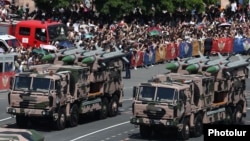
Last week, Indian Defense Secretary Rajesh Kumar Singh said that New Delhi had successfully shipped its Akash air-defense system to Tajikistan and Turkmenistan.
While neither country has publicly announced the deals, and details like the number of systems, delivery dates, and prices remain secret, the sale gives the two Central Asian states an alternative to the Russian systems that have in the past dominated their arsenals.
Indian media previously reported that Armenia ordered 15 Akash systems in 2022 for around $720 million, though neither government has officially confirmed that number. Akash is a mobile surface-to-air missile system built to shoot down planes, drones, and missiles.
Soviet-Era Equipment
For decades, Central Asia’s air defenses have relied almost entirely on Soviet and Russian equipment, with Moscow providing the hardware, training, and maintenance. Alliances such as the Russian-led Collective Security Treaty Organization (CSTO) further cemented Russia's role as the region’s primary security provider.
Pavel Baev, a research professor at the Peace Research Institute Oslo (PRIO), sees these new purchases in Central Asia as a clear political signal to Moscow. “My impression is that this...is more about making a point than about real strategic capabilities,” Baev said.
Tajikistan is a CSTO member and hosts a major Russian military base. Turkmenistan, on the other hand, is officially neutral. "Both [countries] are eager to signal to Moscow that its dominance based on the capacity to project power and provide security for the regimes is over,” Baev said.
Beneath the political message, there is also a very practical problem: With Western sanctions and Ukrainian strikes squeezing its defense industry, Russia is increasingly unable to supply and maintain the equipment Central Asian militaries rely on.
Data published by the Stockholm International Peace Research Institute (SIPRI), a body that tracks global arms transfers, shows that Russian arms exports fell by 64 percent, when comparing the periods 2016–20 and 2021–25, cutting Russia’s share of global arms exports from 21 percent to 6.8 percent.

Moscow, however, is still signing contracts for arms deliveries. In January, First Deputy Prime Minister Denis Manturov told Russian President Vladimir Putin that the country’s portfolio of signed arms-export contracts had reached a record $70 billion, compared with $55 billion before 2022. (The figure cited by Manturov is the value of contracts signed rather than weapons delivered.)
Yermek Seitbattalov, a Kazakh military analyst and retired aviation colonel, says governments realize the Russian supply chain is broken. “[The deals are] more likely driven by military logic,” he said. “There is an awareness that, in the near future, Russia will not be able to supply spare parts and other components needed to repair and maintain existing weapons and ammunition and keep them in a combat-ready state.”
“Moreover, there is little reason to expect new types of weapons and military equipment to be supplied,” he added. “Yet the country still needs to be defended.”
Seitbattalov also warned that buying new hardware is only part of the solution. “Akash will not change the military balance in Central Asia, because this weapon is merely one component intended to complement the overall system,” he said.
A real air defense network, he argued, needs a whole infrastructure -- radars, secure data links, and a command-and-control center -- built around it to work properly.
More Suppliers, More Problems
The shift toward multiple military suppliers in Central Asia could also create new problems. Central Asian militaries are increasingly mixing Russian and Soviet systems with Chinese, Turkish, Indian, and Western equipment, bringing many issues of compatibility and integration.
Recent military parades show just how much Central Asian armies are diversifying their equipment. At its Independence Day parade in Ashgabat on September 27, Turkmenistan displayed a newly acquired Chinese FK-2000 air-defense system, adding to its existing arsenal of Chinese-made missile systems. Also on parade were a Brazilian-made A-29 Super Tucano attack aircraft and Italian-made Leonardo M-346 training jets.

Tajikistan, meanwhile, has displayed China’s HQ-17AE air-defense system, along with Chinese-made armored vehicles used to transport and protect troops. During its 2026 Independence Day celebrations, Uzbekistan also showcased Chinese J-10CE fighter jets. And, in recent years, Kyrgyzstan has acquired several types of Turkish military drones.
Different technical standards create problems from the outset, military analyst Seitbattalov said, and multiple systems "cannot work within a single defense architecture.”
“The first problem will be that these weapons and ammunition cannot [operate on] common standards. It will also create difficulties in training military specialists [who are] capable of operating all types and categories of diverse weapons systems to a high standard,” he said.
There are also problems with “creating stockpiles, storage, procuring spare parts and tools, repairs, extending service life, modernization, maintenance, servicing and operation,” Seitbattalov added.
Enter China
If Russia ceases being Central Asia's main military supplier, who could replace it in the future?
“China is certainly a major partner, but it is not seeking dominance, and aims at enhancing stability, which suits the regimes...just fine,” research professor Baev said.
According to SIPRI, China’s arms exports increased by 11 percent when comparing the periods 2016–20 and 2021–25, with 77 percent going to Asia and Oceania in the latter period. SIPRI’s published summary does not give a specific figure for Central Asia.
Yet Baev does not see Beijing simply inheriting Moscow’s former position as the regional hegemon.
The result, Baev suggested, may be that Central Asia no longer has one dominant external arms supplier. “Many uncertainties, and perhaps only one clear answer -- no more ‘big brother’ for Central Asia,” he said.
Despite its supply-chain issues, Russia is unlikely to give up on military ties with Central Asia. In July, Putin signed directives to potentially amend military-technical cooperation agreements with Kazakhstan and Uzbekistan, with some analysts reading the move as an attempt by Moscow to shift parts of its defense industry beyond the reach of Ukrainian strikes.

