




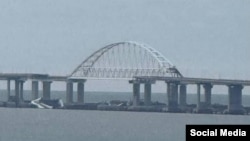
Ukraine struck Russia's Crimea Bridge with drones and missiles on November 17, President Volodymyr Zelenskyy said, badly damaging the only direct road and rail link between Russia and the occupied Black Sea peninsula.
Images of the aftermath suggest that a 227-meter road arch span had fallen into the Kerch Strait, which connects the Sea of Azov with the Black Sea. The bridge's railway arch span also sustained damage.
Zelenskyy confirmed the strikes saying that Ukrainian forces used several types of drones and missiles, including the own-made Flamingo, in the attack on the bridge.
"Today, everyone can see the consequences for the main military crossing from Russian territory into our Ukrainian Crimea," Zelenskyy posted.
"We are also reminding Russia that war will always return to where it began. Ukraine's defensive capabilities are strong and will remain so, and we will never leave terror against our cities and people unanswered," he wrote, saying Kyiv has "repeatedly offered Russia steps toward de-escalation."
Until the bridge is repaired, traffic from Russia to Crimea will have to travel via a land corridor in Ukraine that Russia currently occupies -- a route that is, however, vulnerable to Ukrainian drones.
Sergei Aksyonov, the Russian-installed governor of the occupied Crimean Peninsula, said two people had been killed in the attack in the region and that traffic across the bridge had been suspended.
The 19-kilometer road-and-rail bridge is one of Putin's signature infrastructure projects and is a main supply routes for Russian forces in Ukraine. Ukraine hit it on November 16 as well but Moscow said that the first attack on the bridge this week caused only minor damage.
Smoke And Barriers: The Massive Anti-Drone Defenses Of The Crimea Bridge


The Kremlin responded to the strikes by saying Putin had been "informed about the situation around the Crimean bridge."
"A concrete plan will be drawn up, the schedule and time frame of restoration work will be determined," it said in a post on Telegram.
Asked about the latest bridge attack, Ukrainian Defense Minister Yevheniy Khmara told RFE/RL that "we're only getting started" and that his mood was "resolute" as he attended a gathering of the Ukraine defense contact group, also known as Ramstein, in Brussels on November 17.
The attacks are part of what is believed to be Ukraine's biggest drone barrage of the war, with Russia's Defense Ministry confirming that its forces had downed nine Ukrainian Flamingo missiles and 2,256 drones over the past 24 hours over 22 regions, including parts of Ukraine it currently occupies. Moscow Mayor Sergei Sobyanin said more than 800 of them were headed to the capital itself.
Ukraine's military said on November 17 that it had struck the Salavat oil refinery and petrochemical complex in Russia's Bashkortostan region, about 1,500 kilometers from the Ukrainian border.
"Salavat is no ordinary plant. It is one of Russia's largest oil refining and petrochemical complexes, capable of processing about 10 million tonnes of crude oil per year," the General Staff said in a post on X.
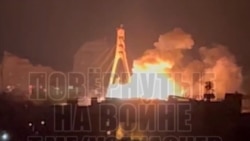
The attack comes as Russian missiles hit two bridges over the Dnieper River in the Ukrainian capital, causing partial damage to the city's subway system as well as utility disruptions. Mayor Vitali Klitschko confirmed on social media there had been strikes on the Northern and Southern bridges in Kyiv.
"Two bridges in the capital were damaged as a result of an enemy ballistic missile attack," Klitschko said in a video message recorded on the Southern Bridge following the strike.
Zelenskyy said Russia had launched seven ballistic missiles to attack bridges in Kyiv, adding that significant power outages had been reported in three regions following Russia's overnight attack on Ukraine.
"Last night, four ballistic missiles struck the Southern Bridge and three struck the Northern Bridge," the Ukrainian leader said in a post on X on November 17.

Russia also targeted several other regions and cities across the country, including Cherkasy in central Ukraine, where three people were injured, as well as Dnipropetrovsk and Zaporizhzhya. Russia's Defense Ministry confirmed the strikes.
The overnight attacks also caused power outages in eight regions, according to Ukraine's Energy Ministry, as Moscow ups its assault on civilian energy infrastructure ahead of the winter, a campaign that Ukrainian Prime Minister Serhiy Koretskiy called "pure terror, aimed at breaking the spirit" of Ukrainians.
Speaking to RFE/RL in Brussels on November 16, Koretskiy said that "Russia has significantly changed its strategy and is hitting bridges, hitting infrastructure, and hitting business a lot."
He added that "this is pure terror, aimed at breaking the spirit, breaking the resilience of Ukrainians, making life unbearable, impossible in Kyiv, the capital, and in cities with a population of millions."

Zelenskyy had earlier in the week warned of major Russian attacks leading up to a trilateral meeting on November 19 in Shenzhen, China, between US President Donald Trump, Russian President Vladimir Putin, and Chinese President Xi Jinping.
Senior US official told RFE/RL that Trump's envoys Jarred Kushner and Steve Witkoff will attend a meeting of the so-called Coalition of the Willing supporting Ukraine in Berlin on the same day as the potential summit in Shenzhen.