




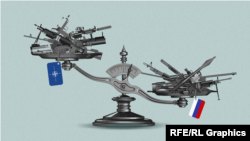
WASHINGTON -- As tensions between NATO and Russia intensify amid growing fears of confrontation, US lawmakers are raising questions over the relationship between the United States and the military alliance.
That is the issue at the center of a new bipartisan bill led by Democratic lawmaker Jimmy Panetta and his Republican counterpart Joe Wilson.
The NATO Shield Act would require congressional approval before a president could initiate a US withdrawal from NATO.
Panetta, in an interview with RFE/RL on October 1, argued that the measure is particularly important at a moment when Russia is testing the alliance and uncertainty surrounds Washington's future force posture in Europe.
The legislation, introduced September 24, would require the president to consult Congress within 72 hours of considering a withdrawal from the military alliance and submit a report explaining the legal basis, strategic rationale, and expected consequences.
Any withdrawal action would end after 30 days unless Congress approved it.
Panetta said NATO is “one of the most consequential and successful security alliances in the history of the world” and argued that any fundamental change in US national security policy should not be left to the president to decide.
But his argument goes beyond the possibility of a formal US withdrawal.
Panetta said Russian President Vladimir Putin is already “testing” NATO through pressure, probing, and “poking” at the alliance before any potential move toward direct confrontation.
He pointed to Russia's activities around the Baltic region, Poland, and other NATO border states as examples of what he described as “gray-zone” warfare.
For Panetta, the danger lies partly in actions that remain below the threshold of open war.
“We cannot let gray-zone warfare go unnoticed and unresponded to,” he said, warning that Russia could gradually pressure NATO members in much the same way China has applied pressure around Taiwan.
“An attack on one of us will be an attack on all,” Panetta said, invoking the alliance's collective-defense principle laid out in Article 5 in NATO's founding treaty.


He said Putin is “not stupid,” but is “aggressive” and focused on a vision of restoring elements of the former Soviet sphere of influence. NATO, he argued, remains a major obstacle to that ambition.
He pointed specifically to NATO's members in the Baltic states, saying that after visiting Estonia, he was impressed by the region's preparations for possible threats.
Washington, he argued, should “turn towards the east” alongside its Baltic allies rather than allow Russia to gradually increase pressure on NATO's eastern flank.
Moscow has sharply escalated its rhetoric toward NATO in recent days.
Russian officials have warned that Russia could use all weapons at its disposal, including nuclear weapons, if its territory or the Russian exclave of Kaliningrad were directly threatened.
NATO Secretary General Mark Rutte has rejected the threats, saying the alliance is defensive and that nuclear threats are “not helpful.”
Rutte has also said NATO sees no imminent threat to its territory while warning that Russia's activities in the region require continued vigilance.
The NATO Shield Act is designed to put Congress inject into the process.
The bill says withdrawal from NATO would have major implications for US exposure to hostilities, deterrence, and global military commitments. It frames withdrawal as a decision with direct war-powers implications requiring congressional participation.
Wilson, Panetta's Republican co-lead, told RFE/RL on October 1 that NATO is “the backbone of the common security of Western civilization” and said the alliance must remain strengthened as it faces threats, particularly from Russia.
The legislation follows Panetta's earlier efforts to establish congressional involvement in any decision to leave NATO.
Its procedures would also prohibit federal funds from being used for a withdrawal that had not received congressional approval and provide expedited procedures for congressional action and judicial review.
The initiative comes as the Trump administration continues to review the US military posture in Europe.
Senior US administration officials told RFE/RL that Washington has “no plans” to abandon NATO allies or concentrate on leaving the alliance.
But they also cited President Donald Trump and US NATO Ambassador Matthew Whitaker, who recently said Washington would “re-evaluate” relations with members that deny US forces access to bases or airspace during future operations.
Broader Stakes
The Trump administration is also reviewing force posture and basing across NATO territory under an “America First” approach. Reports of plans to withdraw as many as 40,000 US troops from Europe have been described by the administration as incorrect because no final plan has been made.
Panetta's Republican partners have also emphasized the broader security stakes.
Senator Thom Tillis, after visiting Ukraine and Poland last month, described the devastation he saw and argued that Russia remains the aggressor and Ukraine the victim.
Speaking on the Senate floor on September 30, the Republican senator urged Washington to use sanctions, intelligence, and military assistance to support Kyiv.
Republican Senator John Curtis said the US should help Ukraine defend itself, reinforce NATO's resolve to respond to threats against its members, impose costs on Russia's war machine, and demonstrate to China that invading neighboring countries does not succeed.
Both senators argued that Ukraine has demonstrated its ability to fight and urged greater assistance with defensive munitions.
Democratic Senator Richard Blumenthal likewise called for additional sanctions, air defense, and economic and military support after his latest visit to Ukraine.
The lawmakers' concerns come as NATO allies report a broader pattern of Russian pressure, including alleged sabotage, cyber activity, drones, and other so-called hybrid operations. NATO has said such tactics are intended in part to test and divide the alliance.
For Panetta, however, the immediate question is not simply whether Russia will attack NATO.
It is whether the US will preserve the political and military commitment that has deterred such an attack for decades -- and whether any leader should be able to decide the future of that commitment alone.
“Our diversity is our strength, but our unity is our power,” he said.

