




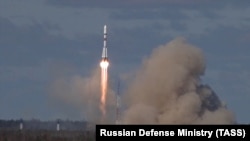
Shortly after midnight on October 18, roughly 1,000 kilometers above the Earth’s surface, a Russian military satellite known as Kosmos-2612 did something highly unusual.
It moved close to another satellite -- one registered in the United States, operated by a Finnish company, and providing intelligence to Ukraine, among others.
How close?
By several estimates, 200 meters. Maybe less.
"This is provocative. But I view it as typical of the kind of things that Russia does all the time."
The incident has grabbed attention -- from amateur satellite watchers and commercial companies, not to mention Western intelligence agencies -- in a way not seen in a long time.
It’s also the latest in a series of escalating moves involving not only Russia, but also the United States, China, and other spacefaring, satellite-capable nations, stoking fears of an arms race in space.
Or worse: a space war.
"This was not a routine conjunction or 'fly by,'" LeoLabs, an aerospace intelligence company, said on October 19. "The behavior is consistent with sophisticated rendezvous and proximity operations."
“What is new is that I don't think that there has ever been a close approach that was uncoordinated” between two satellites, said Victoria Samson, a space analyst at the Secure World Foundation, a Washington think tank.
“Russia could be doing this close approach to interfere with” the Finnish satellite’s “broadcasting, to jam it, or to listen to what it's listening to, or to intimidate it, or even possibly to physically harm it,” she said.

“I’d say it is being viewed as concerning and aggressive with potential hostile intent,” said Douglas Loverro, a former top space policy official at NASA and the US Defense Department, “but I also think cooler heads believe it is signaling on the part of the Russians. Meanwhile, I think the Russians are schooling us on our behavior.”
“If accurate, 150 meters is an exceptionally close approach and is unlikely to be operationally routine,” said Bruce McClintock, a retired Air Force brigadier general who is now a space policy researcher at the RAND Corporation. That “is a legitimate safety and security concern, but it should not automatically be described as an attack or proof of hostile intent.”
Past Trajectories
During the Cold War space race, both Moscow and Washington deployed weapons in orbit, testing and detonating nuclear devices, some of which wreaked havoc on satellite communications. The tit-for-tat detonations paved the way for the 1967 Outer Space Treaty, which permanently banned deploying atomic weapons in space.
The treaty did not preclude anti-satellite warfare, building and deploying technologies to disrupt or destroy another countries’ orbiting devices. The countries conducted at least 50 anti-satellite tests during the Cold War, according to the Secure World Foundation.
In the 1980s, the US military tested jet-launched missiles that would target orbiting satellites. But the result was clouds of shrapnel that catapulted around the planet at potentially lethal speeds. Congress canceled the program.
In 2007, China used a ground-launched missile to destroy an aging weather satellite at an altitude of around 865 kilometers. According to the Union of Concerned Scientists, the event "created more persistent debris than any other event in space."
"This was not a routine conjunction or 'fly by'."
A year later, the US military used its sea-based Aegis missile-defense system to destroy a nonoperational satellite. In that case, the satellite destruction occurred at a lower altitude, and the debris that was sprayed out only lasted in orbit for a short time.
In 2019, India surprised the global space community by conducting its own anti-satellite test. That object was destroyed at around 282 kilometers above the Earth, in a way that experts said minimized the longevity or breadth of an orbiting debris cloud.
In December 2020, Russia tested a missile that destroyed a defunct military satellite -- and resulted in a debris cloud that later endangered the International Space Station.
US officials say Russia also appears to have tested “nesting doll” satellites: objects designed to house smaller satellites that are then launched while in orbit.
This past April, Russia sent six satellites from its northern Plesetsk launch facility into a low Earth orbit.

A month later, according to the Washington-based Center for Strategic and International Studies, five of them maneuvered in a way that gave them the potential to intercept another object: a nonmilitary, commercial satellite operated by ICEYE, a Finnish company that provides “space-based intelligence to Ukraine.”
That satellite, dubbed ICEYE-X36, includes synthetic aperture radar, a technology that allows for more detailed ground imagery and can be used day or night, even in cloudy conditions. In a statement released in May, US Space Force said the Russian satellites were positioned close to a "Western commercial radar satellite used by Ukraine for imagery intelligence,” but did not identify it.
In a statement to RFE/RL on October 19, ICEYE, which is based in Espoo, Finland, said: “We are aware of the situation and tracking it closely."
Late last week, one of the Russian military satellites, Kosmos-2612, began positioning itself closer to ICEYE-X36, according to satellite trackers.
Then, over the weekend, Kosmos-2612 moved even closer.
Very close.
Major General Michael Traut, the head of Germany’s space command, described the Russian spacecraft as “chasing” the ICEYE satellite.
“It is reasonable to regard an unannounced close approach as concerning and potentially escalatory,” McClintock said, “but proximity alone does not establish hostile intent or an imminent attack.”

"While the intention behind Kosmos-2612's behavior remains uncertain, the deliberate nature of the activity, the fuel required to conduct this activity, and the proximity to a Western commercial imaging satellite make the event strategically important," LeoLabs said.
'This Is Provocative'
Last month, the United States caused a jolt with its own unexpected announcement: Washington has in fact deployed actual weapons in space -- “on-orbit space control weapons capable of defending the Joint Force against hostile adversary action,” the secretary of the US Air Force told a conference outside of Washington.
For longtime space watchers, that announcement merely stated publicly what had already been obvious for some time.
“The United States did not suddenly weaponize space by acknowledging that it possesses these capabilities,” wrote Mallory Stewart, a former top arms control secretary at the US State Department. “An arms race in space has been under way for years.”
Depending on what happens next with Kosmos-2612 -- if something does happen to the Finnish-operated satellite -- there could be grounds for a formal complaint under the Outer Space Treaty.

However, that would result only in consultations with Russia, said Scott Pace, director of the Space Policy Institute at George Washington University.
“Finland would have to decide on any further response such as [retaliation] or reprisal,” he said. “Such actions may or may not be limited to the space domain.”
“It's not a violation of the Outer Space Treaty, unless you argue that Russia is not operating with ‘due regard’ here,” Samson said. “However, ‘due regard’ has never been defined and no country has ever accused another country for not operating in that manner.”
“To be sure, this is provocative,” Loverro said. “But I view it as typical of the kind of things that Russia does all the time; they nudge closer to lines to test an adversary's red lines and resolve. They learn plenty from our reaction.”
“Will they engage the satellite kinetically? Perhaps. That would, of course, then violate the treaty,” he said. “And, of course, invading Ukraine violated dozens of treaties.”