


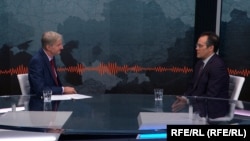
Russia's shadow campaign of drone incursions, sabotage, and assassination attempts in European NATO countries has largely backfired by drawing a resolute response but is now approaching a "crucial point" and is "bound to intensify," Christopher Walker, vice president of the Center for European Policy Analysis (CEPA), has told RFE/RL.
Speaking in a wide-ranging interview as early reports began to emerge that Washington had reduced Starlink satellite access to Ukraine, Walker also said he hoped bipartisan support for Kyiv would prevail so that "essential support that Ukraine requires will continue."
Walker is among the most prominent voices in Washington warning of the threat posed by what he called previously "unimaginable" levels of cooperation between Russia, China, Iran, and North Korea. He has frequently spoken at hearings on Capitol Hill and advised legislative committees in other Western nations.
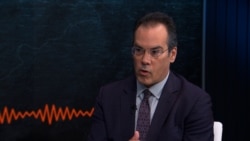

In the October 14 interview, Walker said shadow warfare offered Russia an "inexpensive way to exert effects against more powerful adversaries."
RFE/RL: Is it about making public opinion in Europe unsure about confronting Russia?
Christopher Walker: This is part of the ambition. It's to raise the costs on European societies and make the public wonder whether it's worth it.
At the same time, I think we should look at how some of this effort has backfired because, at root, now we see Europe rallying and making investments that are in both their and larger transatlantic security interests -- to back Ukraine and to make sure that Russia doesn't find success.
So, in a way, we're at this crucial point right now where the Russian authorities clearly are pushing harder to break or get Europe to buckle in its support for Ukraine. And I think the response, at least as we speak right now from Europe, has been quite durable and resolute.
RFE/RL: So you think it's backfiring, not succeeding?
Walker: I think that's true at the moment. This is not a story whose final chapter has been written, and I would stress that. We're in the middle of a full-spectrum war in which we have full-scale warfare in Ukraine, shadow warfare across Europe which is intensifying, more acts of sabotage and targeting rail lines, and explosive laden-drones and assassination attempts.
These are increasing by metrics that we keep and other organizations are keeping. This will be a longer-term struggle in which the Russian authorities are bound to intensify their encroachments in all these areas.
RFE/RL: How important is unity between Washington and Europe? At times, it looks like there's a lot of tension.
Walker: Unity is crucial fundamentally. You quibble and debate on key issues on any given day. That's fine, and that's to be expected among sovereign free countries. More critical is having a baseline and a shared understanding of the threat, which today is enormous.
One of the ways to think about this is that if we were sitting here 15 or 20 years ago, it would have almost been unthinkable that Russia, China, Iran, North Korea, Belarus have cooperation that's actually quite meaningful -- where China is a pivotal enabler of Russia's war in Ukraine, Iran has provided a host of support, including Shahed drones, and North Korea provides soldiers and other support. The democracies need to have suitable unity and cooperation to meet this.
RFE/RL: Do they have that when it comes to Ukraine?
Walker: The unity is adequate, but perhaps not where it needs to be, especially given the degree of cooperation among this grouping of adversary countries. So, we're holding the line, but I think to meet this challenge and meet the moment, the unity needs to be strengthened even further.
RFE/RL: A lot of our [audience] in Ukraine will be very concerned about the current discussion about whether the United States would withhold intelligence that it has been supplying to Ukraine, or indeed, whether it has already started withholding that intelligence. How worried should they be?
Walker: My sense is that the United States should provide as much support as it's capable of doing, including intelligence support, and the American public backs this. It's very important to note that many of the recent polls show that close to 70 percent, sometimes upward of 70 percent, of the American public supports Ukraine and providing assistance to Ukraine.
My sense is that over time, that basic political foundation that we have in the US will continue to provide support to Ukraine.
RFE/RL: You speak to a lot of people in Washington. What's your sense of the sort of consensus there about the question of the United States cutting intelligence support unless Ukraine stops attacking Russian oil refineries?
Walker: I'm not sure there's a consensus. This is a feature of deeply polarized politics that we have in the United States, which makes it difficult for America as such to have the sort of unity and solidarity that's required to contest very potent allies overseas who themselves are working together well.
My hope is that the essential support Ukraine requires will continue because there is a basis for that across party lines in the US, even if this is being challenged at the moment.
RFE/RL: How would you characterize the relationship between Chinese President Xi Jinping and Russian President Vladimir Putin?
Christopher Walker: I think they have a meeting of the minds, a shared consciousness, at a very basic level. For example, both of these leaders systematically repress freedom of expression and free speech. China is far and away the most potent censorship machine on the planet.
On these kinds of issues -- expression, political pluralism, freedom of economics -- in both countries it's only the strategic heights of those economies basically [that] are obliged to report to the political authorities. These are very consistent features of both systems, which have been projected outward.
RFE/RL: How is all this viewed in Washington? We've seen again just in the last few days President Donald Trump saying he does not believe that Russia and China are helping Iran in the conflict with the United States.
Christopher Walker: These things have to be taken very seriously because if they are true, it suggests these regimes have been providing support in ways that may have either put American servicemen in harm's way or possibly even harmed them.
This falls into the same category of this cleaved and fractured political environment where many people in Washington today understand the seriousness of the support but not everyone agrees with that assessment. Congress has often seen through sanctions and other steps over recent years that I think have been very important. But it continues to be a battle, some of which will likely be put into focus during our upcoming elections in the US.

