




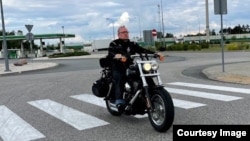
In 2021, the year before Moscow launched its full-scale invasion of Ukraine, Mikhail Loshchinin traveled to his native Russia by motorcycle, later returning to his home in western Europe without incident.
Last summer, he decided to do it again -- this time to see his father , who had suffered a heart attack, for what he feared might be the last time.
But Loshchinin, 48, has not seen his father: He was detained shortly after crossing into Russia from Latvia, held in various locations -- from a hotel to a holding pen where he says he was tortured -- and tried on a treason charge. On June 2, he was convicted and sentenced to 16 years in prison, according to relatives and media reports.
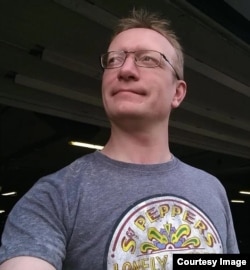
The fate of Loshchinin, a Belgian and Russian citizen who has lived in the European Union since 1999 -- the same year President Vladimir Putin first came to power as prime minister -- provides a grim look at the relentless and often arbitrary oppression the Russian state is meting out amid the all-out war against Ukraine, now in its fifth year.
At a closed-door trial, a court in the northwestern city of Pskov found Loshchinin guilty of "financing representatives of a foreign state recognized as an adversary of the Russian Federation," Russian news channels on Telegram reported. The evidence: a single instance in which he sent a Ukrainian ex-girlfriend the equivalent of about $245.

Russian authorities have made criticizing the invasion a crime and have ramped up accusations of treason amid the war: Court statistics indicate that 15 treason cases were initiated in the first half of 2025, about twice as many as in the same period of 2024, RFE/RL found. Acquittals are extremely rare in Russia, particularly in politically charged cases.
The state's use of small money transfers to Ukrainian citizens or charities as evidence of a grave crime is nothing new: US-Russian citizen Ksenia Karelina, who was freed in a prisoner swap in 2025, had been sentenced to 12 years in prison for treason over a $51 donation to a US-based Ukraine aid group in 2022.
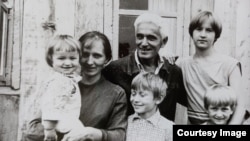
Loshchinin's problems began when Russian border guards asked him to hand them his phone for a check as he entered the country on July 1, 2025, his mother, Olga Loshchinina, who lives in Poland, told RFE/RL in December 2025. He had many friends in Ukraine, where his sister lived, and may have had message exchanges with Ukrainians on the device, she said.
She believes they found nothing incriminating, however, and decided to create a pretext to detain him: When he asked where he could get a bottle of water, they offered to show him to a store but instead led him to an illegal border zone and detained him.
Given the option of being held in a "cellar" while his captors decided what to do with him or staying at a hotel in a border town and paying for the room himself, he chose the latter. They took his passport, motorcycle registration, and other documents, and he lived at a hotel for about a month.
'Completely Crushed'
In comments published in April in a written response from jail to questions posed by the Russian-language media outlet Bereg , Loshchinin said he was allowed out, with an armed escort, only to buy food.
He also said a man stopped by once a week and told him to be patient as he would soon be released.
But by early August 2025, he had been removed from the hotel by "unknown men" who drove him in "an unknown direction," his mother said. He ended up in Stary Oskol, a city in the Belgorod region, which borders Ukraine.
He was placed in a facility for Ukrainian prisoners of war and was quickly deprived of his eyeglasses, leaving him barely able to see due to very poor vision, Olga Loshchinina told RFE/RL, citing her son's lawyer. His captors "tortured and humiliated him, both morally and physically," including by stripping him naked and beating him, she said.
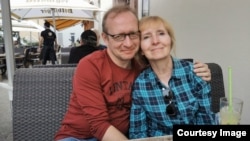
"He was completely crushed, and of course this was done deliberately to suppress the hope that he could be released at all," she added.
"The only things that remain clear in my memory are the needles and the stun gun the special forces soldier shoved into my face," Loshchinin wrote of his time at the facility in Stary Oskol in the comments to Bereg.
"I won't describe all the atrocities…. But the psychological and physical torture was daily. It's a world where you're no longer a person. Where you're happy when you're in your cell with the door closed and the hallway silent. Where hell comes in every time the door opens," he wrote. "And the door opened often."
Other inmates had it worse, though, he said: "I met people who suffered a lot more."
Allegations of severe violence and torture of Ukrainian prisoners by Russian authorities in Russia and occupied parts of Ukraine are widespread, and Russians deemed political prisoners in their own country have also frequently reported torture and abuse .
"I'm horrified by what has happened to my son…. I never thought the [law enforcement] organs would conduct themselves that way," Olga Loshchinina said. She added, however, that she had never fully trusted the Russian authorities, in part because her grandfather was jailed in 1937, during the Great Terror purges under Soviet dictator Josef Stalin.
'Fight To The End'
In late August 2025, Loshchinin was transferred to the pretrial detention center in Pskov, where he was placed alone in a cell.
The Pskov jail "looks a five-star hotel" compared to Stary Oskol, he told Bereg, but he hadn't seen the sun in six months because "the cell window looks out on a brick wall and barbed wire" and time outside is spent in a space where only "a small strip of sky" is visible.
The lack of medical care is "a big problem," he wrote, saying he needed surgery on his left eye and jailers refused to provide vitamins that could slow the deterioration of his eyesight.
Speaking to RFE/RL late last year, Yevgeny Smirnov, a lawyer with Pyervy Otdel, a rights group that helps Russians "unfairly accused of crimes against the state," said the Federal Security Service (FSB) "frequently uses" transfers of small sums of money to fabricate treason cases.
"They could [claim], for example, that the woman Mikhail sent the money to was a [Ukrainian Security Service] employee or participates in a territorial defense group," he said, referring to defense units set up across Ukraine after the start of the full-scale Russian invasion.
Smirnov suggested at the time that in cases like Loshchinin's, a prisoner exchange is sometimes "the only chance for release."

Amid a series of swaps in recent years between Russia and Western countries, including the United States, governments and rights groups have accused Russia of arresting foreigners and sentencing them to long prison terms on fabricated or exaggerated charges in order to use them as hostages. Loshchinin is not the first to be detained while travleing to Russia to see ailing or aging relatives.
The authoritative Russian rights group Memorial has designated Loshchinin a political prisoner -- one of 1,170 currently on the organization's list, which does not include those persecuted for their religion.
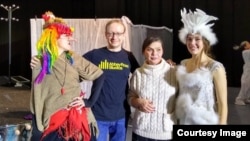
Supporters of Loshchinin, who worked in IT in Luxembourg and was deeply involved in Russian cultural activities there and in Belgium and Germany, have set up a website and are urging Belgian and EU authorities to "monitor this case closely and to encourage full compliance with international human rights obligations."
In his comments to Bereg, Loshchinin wrote that he was not guilty of the charges against him and vowed to "fight to the end for the truth."
"Because of everything that has happened," his life "now has more of a spiritual than a physical meaning," he wrote. "I have seen and felt so many lies, so much terror and lawlessness, and have heard so many stories that made me cry upon returning to my cell. Fighting alone is much easier than watching other innocent people suffer and not being able to help them."



