




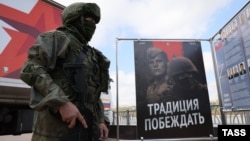
On the second day of voting for Russia’s lower house of parliament, Aleksandr Glebov, a 63-year-old pastry chef, drove his car to an embankment overlooking the Sura River, in the central city of Penza, where he set out for a walk.
Several men in civilian clothing approached him and, according to Oksana, a relative who asked that her name be changed for security reasons, demanded identification documents, peppering him with questions.
“Why are you alone? Are you a drug addict? Are you doing dead drops [for drugs]? They acted like they were police or military, though they weren't wearing uniforms," she told RFE/RL’s Siberia.Realities.
Glebov was thrown into car, she said, and driven to a local recruiting station, where he was browbeaten into signing a contract to fight in Ukraine.
The next time the family heard from him, she said, was at dawn the next morning -- and he was 600 kilometers away, in a truck on his way to Rostov-on-Don, a southern city that serves as a staging ground for operations in Ukraine.
Nearly five years into its all-out war on Ukraine, the Russian military has a perpetual problem: it needs more men to fight on the battlefield.
The death toll is enormous on both sides. Western estimates of Russia’s war dead now exceed 500,000; around twice that number are believed to be wounded in action. Ukraine’s casualties are lower, but higher relative to its smaller population.

Glebov’s case -- being forcibly coerced into signing up to fight in Ukraine -- is far from a new phenomenon. His home city of Penza achieved short-lived notoriety this year for the widespread practice of “busification,” a term referring to men being grabbed off the streets, thrown into vans, and driven to recruiting stations. The practice has enraged locals.
The practice also highlights creative tools -- and the lengths to which officials have gone to enlist more soldiers. Above all, authorities want to avoid spooking the population by ordering another mobilization like the one President Vladimir Putin decreed in September 2022, which drew some 300,000 men into the fight.
“I think they are squeezing sources of manpower and tapping into the reserves, which is sufficient,” said Dara Massicot, an expert on the Russian military at the Carnegie Endowment for International Peace in Washington, D.C. “There isn’t an emergent requirement or manpower deficit in the way there was in summer of 2022.”
"Authorities find it easier to gather people piecemeal -- through fear, deception, debt, work, school, the police, and military recruitment offices,” said Daria Berg, an activist with Idite Lesom, a rights group whose name translates roughly as Get Lost. “It's quieter for television, but no safer for the people.”
“Covert mobilization hasn't stopped. It's just that today it looks less like one big wave and more like a network that gradually draws people in through various means,” she told RFE/RL’s Russian Service.
Cast A Wide Net, Catch A Few Fish
In the run-up to the September 18-20 State Duma elections, Russian worries spiked about the possibility that the Kremlin was preparing to declare another mobilization.
Groups that offer legal advice to potential recruits were inundated with inquiries; officials were compelled to deny looming mobilization nearly two dozen times since the beginning of the summer, according to one tally.
Ukrainian officials further fueled the fears.
While “busificiation” has prompted pushback in Russian cities like Penza, recruiters have had far more success drawing new soldiers by offering extraordinarily high wages and benefits -- including for survivors of men killed in action. Signing bonuses are paid from a mix of national funds -- Defense Ministry -- and from regional budgets.

In some far-flung regions, the influx of cash has jolted local economies.
Janis Kluge, an analyst at the German Institute for International and Security Affairs in Berlin who tracks personnel recruitment based on local budgets and payouts to new volunteers, said that, as of October, the pace remained stable: around 1,000 men a day, slightly less than in 2025.
Last month, recruiters drew 29,900 men, compared with 31,900 in September 2025, he wrote in a recent analysis. In total, 263,000 new contract soldiers were drawn into service between January and the end of September, compared with 292,000 last year.
If this pace holds, recruiters will fall short of the target set for this year: 409,000 contract soldiers. But experts say it’s enough to keep fighting in the short term, at least.
A related phenomenon, Kluge said: Municipalities that pay incentive bonuses to individuals or groups that meet certain quotas for men brought in -- forcibly or otherwise -- to recruiting stations.
“Coercive mobilization is already happening. It is not a centralized policy of the Kremlin, but rather the unintended result of delegating recruitment to lower levels of the hierarchy while maximizing pressure on governors and mayors to fulfil their quotas,” he said. “Cities and regions do not care about the specifics of recruitment as long as they meet their targets.”
In recent years, officials have also streamlined and modernized the national registration system that requires all men to submit personal information -- and relied on overlapping electronic systems like the state-backed messaging service Max and the government e-portal Gosuslugi.

The system makes it easier to maintain the flow of conscripts -- all men between 18 and 30 are required to do one year of military service. Though Russian law forbids conscripts from being sent overseas or into combat, including in Ukraine, they are frequently subjected to coercive methods aimed at getting them to sign fighting contracts -- even before their year of service is complete.
After the Duma elections, recruiters sent out a wave of electronic summonses ordering men to update their personal information, activists said.
“In reality, it's basically like casting a huge fishing net into the water, hoping to catch at least a few fish,” said Ivan Chuvilyayev, another activist with Idite Lesom.
“The idea is that at least some people who receive a summons to update their information will think, 'Oh well, all right, it's nothing serious. I'll just go to the enlistment office and find out what it's about,’” he said. “Please: Don't do that."