




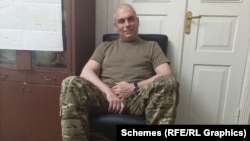
“War is war, but don’t forget about the cash. Get yours,” a Russian officer texted to a subordinate who was about to succeed him as commander of a division fighting in Ukraine, apparently advising him to take advantage of the moneymaking opportunities presented by the position.
“Delete this message later,” the officer added.
A trove of text and audio messages, photos, and videos purportedly sent and received over a three-year period by the officer, Roman Demurchiev, and provided to reporters from Schemes, the investigative unit of RFE/RL's Ukrainian Service, includes ample evidence of possible war crimes committed by Russian forces in Ukraine.
WATCH: The Original Documentary By Schemes On The Russian General's Messages (in Ukrainian with English subtitles).
The materials examined by Schemes and Systema, RFE/RL’s Russian investigative unit, also paint a picture of pervasive corruption, including bribery and nepotism, in sometimes granular detail. They open a window on the way power dynamics are structured in the Russian military, who answers to whom in the hierarchy, and how the system operates.
Working with forensics laboratories in the United States and data researchers in Germany, Schemes verified the authenticity of the communications, which were provided by a person serving in the Ukrainian military. RFE/RL agreed not to disclose the person's identity or how they obtained the files.
The Power Of Money
Since Russia launched its full-scale invasion of Ukraine just over four years ago, several high-level Russian military officers have been dismissed and accused of corruption, with upticks in cases coming after Wagner mercenary group founder Yevgeny Prigozhin led an abortive mutiny in June 2023 and after President Vladimir Putin replaced long-serving Defense Minister Sergei Shoigu with a former economy minister, Andrei Belousov, in May 2024.
In some of those instances, accusations of bribery, embezzlement, or fraud range into millions of dollars. Most of the amounts that the materials examined by Schemes and Systema suggest were solicited by or sought from Demurchiev are smaller, but they seem to add up: such requests are a frequent subject of correspondence.
Putin promoted Demurchiev from colonel to major general in June 2023, months after an exchange in which, as RFE/RL revealed, he told his wife that his soldiers had captured four Ukrainian prisoners, sent her a photo of what appeared to be several blackened human ears hanging from a metal pipe, and joked about making a garland out of them.
Soon afterward, Demurchiev suspended his command and enrolled in the General Staff Academy in the Russian capital -- where he quickly found the high cost of living daunting.
"Moscow is stressing me out. It's like a vacuum cleaner" sucking up money, he wrote to his former adjutant Magomedrasul Biisoltanov, a senior corporal far below his general’s rank. Multiple times, in messages laden with slang and sometimes with expletives, he asked Biisoltanov, whom he called Rasul, to send him 100,000 rubles ($1,290).
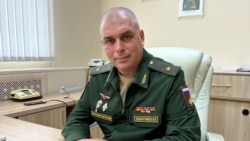

The relationship was not one-sided, the correspondence indicates. At one point, after Demurchiev tells Biisoltanov he needs money for dental work and has only 2,000 rubles ($26) on his bank card, the reply includes a request for help getting an acquaintance transferred from a combat unit to a construction or communications battalion. Demurchiev quickly complies, without asking for an explanation, and again implores Biisoltanov to send him money: “Come on, bro, I’m waiting. My card is empty -- just zero.”
A General's Demise
Evidence suggests that seeking or offering a bribe for a transfer or promotion is common in the Russian military. Media outlets have documented cases of draftees or soldiers paying from 100,000 to 1 million rubles ($1,290 to $12,900) to avoid being sent into combat in Ukraine.
Sometimes, favors are sought that may not involve money.
In one voice message, Demurchiev urges Biisoltanov to help him retrieve a pair of underwear that an officer who is a military prosecutor fears he left at a bathhouse by mistake. The prosecutor did not respond to a request for comment sent by Internet messenger.
The correspondence attributed to Demurchiev suggests that he was not always on the receiving end of money transfers: The messages point to an informal system in which, with some frequency, officers receive money from subordinates and send money to superiors.
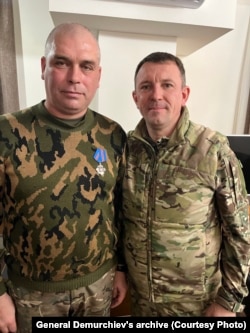
In messages in June 2024, Demurchiev wrote that he had been questioned by prosecutors who grilled him over whether he had sent money to General Ivan Popov, a former superior. Other parts of the trove analyzed by Schemes and Systema indicate that Popov several times asked Demurchiev for "a couple hundred" thousand rubles, and that Demurchiev told a colleague that he had helped Popov financially over a period of six years.
Popov was relieved of his command of the 58th Army in 2023 and sent to Syria, where Russian forces helped prop up President Bashar al-Assad until he was ousted and fled to Moscow the following year. Popov claimed at the time that he was dismissed because he had written of ammunition shortages and heavy Russian battlefield losses in Ukraine in a report to the General Staff chief, General Valery Gerasimov.

Popov was arrested on fraud charges in May 2024, accused of misappropriating more than 100 million rubles ($1.3 million) worth of metal that was supposed to be used to build defensive structures in the Russian-occupied part of Ukraine’s Zaporizhzhya region. Popov, who denied the charges, was convicted last April and sentenced to five years in prison.
'He Shot People'
The materials investigated by RFE/RL journalists also include messages in which Demurchiev, 49, indicates that he helped a younger cousin with his military career, first arranging a relatively safe posting for him as a guard at a military unit’s headquarters and then keeping him close to his side in an informal role as a driver and aide.
He also suggested that his cousin had quickly been able to amass “several million” rubles while serving, though he did not explain how.
“I helped him a great deal,” Demurchiev told his cousin’s mother in March 2024, according to the materials.
In another voice message to his cousin’s mother, in January 2024, Demurchiev told her that her son had “shot people on my command,” referring to Ukrainian soldiers in wording that suggested they were captives.
“He buried them. It's hard work with a shovel…. This happened several times,” he said, adding that his cousin was “[not] afraid of death…. And he kills firmly, without even the twitch of an eye.”
Since 2024, according to Ukrainian military sources, Demurchiev has been a deputy commander of Russia’s 20th Combined Arms Army, which has been fighting in eastern Ukraine. He declined to comment when contacted by Schemes by phone.