




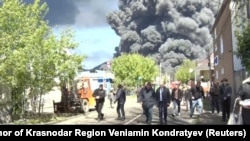
Russia’s deputy prime minister kept walking but couldn't shake off a gaggle of reporters with questions about the country’s growing fuel crisis. Aleksandr Novak admitted oil production had fallen due to “unscheduled maintenance” at refineries but avoided saying why it was needed.
That was June 4. Come June 9, the Energy Ministry issued a statement that nailed it.
“Companies in the fuel and energy sector have encountered an increase in enemy air attacks leading to temporary complications in supplies,” it said.
Taken together, it was the first time the Russian authorities had acknowledged that Ukraine’s ramped-up attacks on the oil sector this year had led to production cuts and shortages. And it came with an admission by Russian President Vladimir Putin that Russia needed better air defenses.
Hydrocracker Hits
The reason may not just be the increase in attacks -- but also better targeting.
Nikhil Dubey, a senior research analyst at Kpler, a commodity intelligence company, said the key was not just attacks on refineries -- but a switch to attacking particular parts of them.
“That refinery has various units. Let's say one is the distillation column. Simple, where you heat the crude and different products come out,” he told RFE/RL.
“It's a mother unit or primary unit because that is the unit which receives crude. Whatever streams come out from that unit, they are not marketable in nature…. You can't directly put that stream in your gasoline tank.”
This is where refinery secondary units come in, for example the hydrocracker, that can remove sulfur from the stream to produce diesel. It’s full of more sophisticated parts that also take much longer to replace.
“These are the items which are not readily available on the plant site, right? Once you have damaged that machinery, you have to place an order...because it is specialized equipment, it needs lead time,” Dubey said.
Lead times can last weeks or months, and Western sanctions on components have made them longer.
Kpler data shows Russia’s offline capacity of secondary processing units in May around 1.2 to 1.3 million barrels per day higher than a year ago, with “a significant share” caused by drone strikes. The hydrocrackers made up a fair share of this: 250,000 barrels per day compared to 50-60,000 last year.
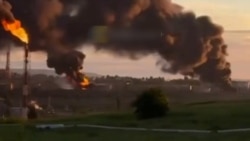

Reuters reported on June 1 that Russian diesel production fell by 10 percent in May, following a 10 percent drop in April.
“If attackers repeatedly hit equipment of that kind, the economic effect is much larger than if they hit storage tanks or primary refining units alone,” Tatiana Mitrova, from the Center on Global Energy Policy (CGEP) at Columbia University, told RFE/RL.
“In other words, not all strikes are equal: damage to specialized bottlenecks is much harder to absorb than damage to simpler, more replaceable assets,” she added.
Repeated Strikes
Another aspect of this is that Ukraine has repeatedly attacked the same refineries several times in succession, further delaying repairs.
“That is a newish trend. I’d say we’re starting to see that more and more in 2026 than previously,” Isaac Levi, a Russia analyst at the Center for Research on Energy and Clean Air (CREA), told RFE/RL.
Previously, he said, attacks took refineries out of action for “three, four, five days,” but this was no longer always the case.
A recent case is Tuapse, an oil exporting port and refinery complex on the Black Sea, which was hit three times in April and then twice in May.
RFE/RL video reports have shown enormous black smoke plumes billowing over the city and thick oil sludges seeping into the sea. Prior to these attacks, its central crude distillation unit was hit on New Year’s Eve, 2025, while an oil terminal was hit in November 2025.
CREA data shows oil loadings at Tuapse in May were 91 percent lower than a year ago.
Tuapse is also an example of how Ukraine has continued its campaign against Russia’s oil exporting port facilities. But this appears to have been less effective -- with much quicker repair times.
A case in point here is Ust-Luga, on Russia’s Baltic coast. It was hit during a massive campaign of strikes in late March that were assessed to have taken out some 40 percent of the country’s oil exporting capacity.
But the effects appear short-lived. CREA data suggests crude oil loadings at Ust-Luga, Russia’s fourth largest export port, rose by 49 percent month-on-month in May as the facility got back in operation -- clearing a waiting line of tankers that had built up in the Gulf of Finland.
“Ust-Lugar had a real bounce back,” said Levi. “With ports, I would say they have been slightly more resilient.”
Crisis -- Or Tipping Point?
Ukraine’s air assault on Russian oil installations isn’t new. In 2025, fuel shortages were also reported amid Ukrainian attacks.
But the scale of the assault has increased this year.
British outlet The Economist cited figures compiled by the Armed Conflict Location and Event Data project (ACLED), a monitoring group, on targets that were at least 100 kilometers from Ukraine’s borders.
“From 2022 to the end of 2024, 335 strikes fit this definition. In 2025, Ukraine completed 658 such strikes -- almost twice as many in a single year as the previous three combined. This year, at the current pace, Ukraine is on track to execute over 800 deep strikes,” it said, adding that its own modeling suggested the 2025 figures could have been three times higher.
Russia’s Defense Ministry has claimed ever-increasing numbers of drone interceptions, and Bloomberg reported a record number of attacks on oil facilities in May, following a previous record in April.
Long lines of cars at gas stations in Russian-occupied Crimea are a further indication of the impact of all this.


Russian media outlet 7x7 has reported restrictions on fuel sales in 14 regions of Russia, from Moscow to Kamchatka. In some areas of Russia, plus occupied Crimea, there’s been panic buying.
Moscow banned gasoline exports on April 1, and a similar ban on aviation fuel has been in place since June 1.
Ukraine’s drone campaign is chalking up successes, but Mitrova said she would be “cautious about using fuel shortages or rationing as proof that a tipping point has already been reached,” pointing out that Russia has experienced fuel shortages before, including in peacetime.
“Ukrainian strikes have become more consequential in 2026 not because they have already broken Russia’s oil system, but because they are increasingly exhausting the system’s ability to remain adaptable under stress,” she added.

