




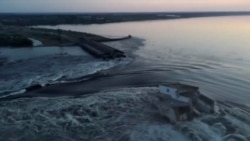
Before a massive dam on the Dnieper River burst in what Ukraine says was an act of sabotage by Russian forces, the Kakhovka Reservoir was big and broad and reached a depth of up 26 meters -- a body of water so large that people living on its shores sometimes called it a “sea.”
The breach in June 2023, about 16 months into Russia’s full-scale invasion of Ukraine, sent water levels plunging and drained much of the reservoir, which is part of the Dnieper and the front line in the war, exposing its bed in many areas and leaving it covered by shallow water in others.
Downstream from the ruined dam, the breach caused catastrophic flooding. Upstream, it abruptly exposed remnants of the past – a skull in a Nazi helmet, a boat believed to be 500 years old -- and gave rise to a riot of vegetation in soil that had been underwater for decades or more.

Now, Ukraine’s military says, Russian forces are using the thickening natural cover – fast-growing trees, tangled bushes, and tall reeds – to try to advance into Ukrainian-held territory south of Zaporizhzhya, Ukraine’s sixth-largest city and the capital of one of five regions that Russian baselessly claims as its own.
Natural Cover
“In the area of the Prymorske settlement, the occupiers are trying to penetrate our flank through the former Kakhovka Reservoir, where there is lush vegetation and reeds several meters high,” Ukraine’s Southern Defense Forces said in statement on November 6. It said Ukrainian troops were “destroying them.”
Prymorske is on the western shore of the former reservoir, about 30 kilometers southeast of the center of the city of Zaporizhzhya.
Two days earlier, the Ukrainian military intelligence agency, HUR, reported that special forces had “discovered and eliminated” an unspecified number of Russian troops near a group of former islands about 7 kilometers offshore. It said the clash took place in the “gray zone” -- a term for areas whether the front line is blurred.
On the overgrown reservoir bed, discovering enemy movement can be difficult.
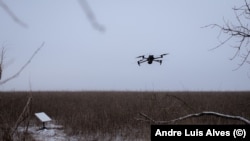
“Thickets and complex terrain on the bed, such as ravines and berms, provide natural cover, which complicates visual observation and the use of drones to monitor the entire territory. Russian troops are quite actively using landscape changes to conduct reconnaissance and sabotage operations,” said Serhiy Bratchuk, a spokesman for the Ukrainian Volunteer Army.
“Their tactics are primarily to use the bed to bypass positions. In the ‘gray zones,’ combat clashes and artillery shelling regularly occur on islands and in coastal areas, which have now become more accessible," he said, adding that “both sides are actively mining drained areas, which creates additional dangers.”
Strategic Importance
Russian forces turned to the reservoir bed after failing to push toward Zaporizhzhya along a route further east, Oleh Tyahnybok, a battalion commander with Ukraine’s 128th Separate Heavy Mechanized Brigade, told RFE/RL in August. He was describing the situation near Kamyanske, which lies south of Prymorske at the edge of the reservoir and is held by Russian forces.

“For the [Russians], this area is important even strategically, because it’s the shortest route to Zaporizhzhya. They tried to get to Zaporizhzhya through Orekhiv -- they did not succeed. Our troops stopped them,” Tyahnybok said. “Accordingly, they have accumulated a serious amount of forces in the Kamyanske direction and are now trying to break through.”
Russian forces “sometimes manage to crawl very effectively, imperceptibly, especially through the territory that was the Kakhovka reservoir, and now it has actually turned into impassable thickets," he said.
While the thickening vegetation shields soldiers from the sight of opposing forces on the ground, “nothing can hide you from drones,” Vladyslav Voloshyn, a spokesman for Ukraine’s Southern Defense Forces, said in a video clip from November that showed him standing amid reeds that towered over him, with taller but sparsely leaved treetops above.

The burgeoning plant life can make for tough going for soldiers on either side, Mykhaylo Mulenko, acting head of the nature protection sector of the Khortytsia National Reserve, which is on a lush river island north of the reservoir, suggested.
“If you enter these thickets -- willows, poplars -- a person becomes very disoriented, because in fact the forest is very dense and it is very difficult to imagine the sides of the world,” he told RFE/RL. “And if you go deep into this vegetation, you lose track of where you are going, and it is very difficult to orient yourself.”
While statements from both Russian and Ukrainian authorities about battlefield developments are difficult to verify, Roman Pohoriliy, co-founder of DeepState, an open-source analyst group with ties to Ukraine’s military, suggested that Russian forces have made little headway on the reservoir bed.
“They are trying to crawl through but they’re not very successful,” Pohoriliy said, adding that the reservoir bed was “not their main route to Prymorske.”
“Accordingly, it is impossible to say that this section poses a huge threat. It is a normal section where they have tried and where they are trying, but they are not succeeding -- they are advancing more through Plavni," he added, referring to a settlement that lies between Prymorske and Kamyanske.
A Threat That 'Exists Everywhere'
Still, similar dangers exist further southwest, according to Bratchuk.
"Potentially vulnerable are the riverside areas of the Kherson and Mykolayiv regions, where the [Dnieper] and its floodplains have also undergone significant changes. The possibility of hidden crossing of water arteries and the use of complex terrain increases the risks of enemy penetration into rear areas,” he said. “Ukrainian military units are constantly conducting sweeps of these ‘gray zones’ and islands to minimize such threats."
Pohoriliy said the threat of Russian advances “exists everywhere, at any point” along the more than 1,000-kilometer front line, which stretches from the northeast through the Donbas and down to the Dnieper Delta in the Kherson region.
“It’s necessary to monitor this and react accordingly: to know that they can sneak through and prepare to repel them -- or do nothing and fail to defend” the country, he said.

Russian forces hold a substantial part of the Zaporizhzhya region and have been trying to push westward and northward toward the regional capital, which is the target of frequent Russian air attacks. A guided bomb attack badly damaged residential buildings and injured at least 26 people in the city and nearby areas, regional authorities said.
Russian President Vladimir Putin groundlessly declared in September 2022 that Ukraine’s Luhansk, Donetsk, Zaporizhzhya, and Kherson regions are Russian, and he has vowed that Russia will take the land it considers its own by force if it is unable to do so through diplomacy.