



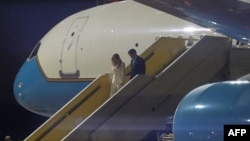
HELSINGBORG, Sweden -- US Secretary of State Marco Rubio has arrived in Sweden for a meeting of NATO foreign ministers as European allies seek reassurances over US troop drawdowns and Washington's shifting rhetoric on the alliance.
Rubio will attend the gathering in Helsingborg on May 22, one of the final senior-level ministerial meetings before alliance leaders convene for a summit in Ankara in July.
According to the State Department, the top US diplomat is expected to press allies for higher defense spending and "greater burden sharing" while also focusing on Arctic security.
But the meeting comes at a moment of deep unease. European officials are seeking clarity on how much Washington plans to scale back its military presence on the continent following a series of abrupt Pentagon moves that have rattled the alliance.


'Kept In The Dark'
The uncertainty stems from recent announcements that have raised fears across Europe that Washington may be weakening its security guarantees at a dangerous moment.
Earlier this month, US President Donald Trump announced plans to withdraw 5,000 troops from Germany. The Pentagon later confirmed it was canceling a planned rotational deployment of roughly 4,000 troops to Poland and shelving plans to deploy a battalion of ground-launched Tomahawk cruise missiles to Germany.
However, on May 21, Trump announced on social media that the US would be sending an additional 5,000 troops to Poland, "based on the successful election of the now president of Poland, Karol Nawrocki." Trump didn't provide specifics, and it wasn't immediately clear if the troops were part of the rotational deployment that the Pentagon had earlier called off.
A senior European diplomat, speaking to RFE/RL on condition of anonymity, warned that the alliance's core deterrence was being undermined by a lack of communication.
"The worst thing is the fact that the continent is seemingly being kept in the dark about the scope of this drawdown," the diplomat said, noting that frontline states such as the Baltic countries are struggling to plan.
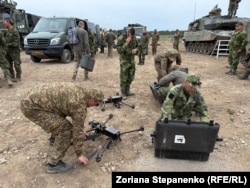
The diplomat added that reported US plans to reduce contributions to NATO's force model -- under which members pre-commit forces for major crises -- would "make a considerable dent" in Europe's initial defense lines.
"NATO's effectiveness rested on the idea that it was unbreakable," the diplomat said. "Now, in a divorce, you start to see the cracks appearing."
Administration officials have insisted the moves are temporary adjustments rather than a strategic retreat. US Vice President JD Vance recently said the administration's focus remains on "European independence and sovereignty."
Rubio As The 'Steady' Messenger
For many European officials, Rubio's presence offers a measure of reassurance. The top US diplomat is widely viewed in Brussels and Eastern European capitals as a steadier and more traditional transatlantic figure than some others in the Trump administration.
Congressman Don Bacon, a Nebraska Republican and staunch NATO supporter, told RFE/RL that Rubio plays a key role in stabilizing relations. Bacon said he hoped Rubio would reinforce Washington's commitment to collective defense while urging European allies to increase defense spending.
Bacon has repeatedly argued that alliances remain central to US security interests and warned against isolationism amid growing threats from Russia, China, and Iran.
Those concerns were echoed on May 20 during Senate confirmation hearings for Trump's ambassadorial nominees to several European countries.
Michael Kavoukjian, nominated to serve as ambassador to Norway, described Oslo as "the eyes and ears of the alliance in the Arctic" and pledged to strengthen military and intelligence cooperation against growing Russian and Chinese activity in the region.
Jeanne Shaheen, the top Senate Democrat on foreign policy, warned that Norway sits "on the front lines of growing Russian activity and sabotage efforts in the Baltics, in the North Sea, and in the Arctic."
Meanwhile, Eric Wendt, Trump's nominee for ambassador to Albania, emphasized the importance of NATO burden-sharing and said he would push Tirana to meet alliance targets to increase defense spending to 5 percent of GDP by 2035.
The hearings underscored the balancing act confronting Washington: reassuring allies about America's commitment to European security while continuing to press NATO members to spend more on their own defense.
Pushback From Capitol Hill
Speaking at the Carnegie Endowment for International Peace on May 20, Congressman Michael McCaul, chair emeritus of the House Foreign Affairs Committee, defended NATO's historical track record.
"The NATO alliance has kept us out of a world war for 80 years, so it has value," McCaul said.
While McCaul acknowledged Trump is seeking to transform NATO from what he called a "parent-child relationship" into a more equal partnership, he cautioned against rhetoric that alienates key allies.
McCaul also said Congress is pushing back against some unilateral military moves by the administration in Europe.
"I applauded moving these troops, some of them, to Poland, where you're putting it right next to the threat that exists," McCaul said, referring to Russia. "But then the administration was arguing pulling out of Poland. Congress has now stepped in and said no."
Rubio's challenge in Sweden will be to navigate competing pressures: defending America-first policies to skeptical European allies while preserving unity inside an alliance confronting an increasingly assertive Russia.

