


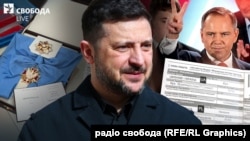
An intensifying row over the return of a medal bestowed upon Ukrainian President Volodymyr Zelenskyy has highlighted the complicated history between Poland and Ukraine and the potential for Warsaw to impede Kyiv's push to join the European Union.
President Karol Nawrocki decided last week to strip Zelenskyy of the Order of the White Eagle, Poland’s highest state honor, because the Ukrainian leader named a military unit after the controversial World War II Ukrainian Insurgent Army (UPA).
Poland says the group participated in what it calls the genocide of Poles in what today is northwestern Ukraine but during the war was territory occupied by Nazi Germany. Ukraine has pushed back against Polish definitions of the 1940s violence as genocide, noting the forces were fighting both Nazis and Soviet forces and faced hatred from Poles as well.
Warsaw calls what happened the Volhynian Massacre, while Kyiv refers to it as the Volyn Tragedy.

Either way, the killings have long cast a shadow over relations between the neighboring countries and the latest flareup of tensions threatens to sour Warsaw’s support for Kyiv as it tries to join the EU while at the same time repelling Moscow’s full-scale invasion, now in its fifth year.
“Even before Russia’s attack, Poland was among the countries actively supporting Ukraine’s European aspirations,” Nawrocki said while explaining his decision on revoking the medal, adding that Poland “remains ready” to cooperate with Ukraine.
“Ukraine’s path toward European structures also requires a willingness to honestly confront the difficult chapters of its own history. A united Europe was built on the rejection of totalitarianism and the cult of violence. These principles must apply to everyone. For those who do not understand this, there can be no place in the European Union, and Poland will certainly not allow it.”
Kyiv's Biggest EU Hurdle
European diplomats have warned for years that it will be Ukraine’s immediate EU neighbors who pose the biggest hurdle to Kyiv’s bid to join the bloc.
For years, this was true for Hungary under the previous Moscow-friendly government led by populist Prime Minister Viktor Orban that, among other things, blocked the start of Ukraine’s accession talks for two years. With Orban’s defeat at the polls this spring, many in Brussels had hoped Ukraine’s accession path would now be clear.
But behind Orban, evidence of the economic argument against Ukraine’s increasing proximity to the EU has been lurking for some time.
Just look at spats from the last couple of years when farmers in many of the eastern member states protested against the inflow of Ukrainian agricultural goods into the bloc.
If Ukraine was to become an EU member, these goods would enter freely into states like Bulgaria, Hungary, Poland, Romania and Slovakia. Kyiv would also offer potentially cheaper options in other sensitive sectors, such as transport. Not to mention all the agriculture and cohesion (the transfer of EU money from richer to poorer regions) funds that suddenly would be diverted to the new member state.
And now there is a real risk that Warsaw’s complicated history with Ukraine could spill over onto the EU scene and make the situation even more difficult.
Nawrocki’s move could largely be seen as being about domestic Polish politics as he belongs to the opposition PiS (Law and Justice Party). He is battling against the more liberal and Ukraine-friendlier premier Donald Tusk ahead of next autumn’s general election.
A historian, Nawrocki was previously the head of the Polish Institute of National Remembrance (IPN), which is dealing with the Volhynian massacres. He is acutely familiar with the issue, which has been a constant thorn in bilateral relations between Kyiv and Warsaw for decades.
Anti-Ukrainian Sentiment
In many ways, Nawrocki is tapping into anti-Ukrainian sentiment in large segments of Polish society that has been around for a while and has only been accentuated with the inflow of Ukrainian refugees since the start of Russia's full-scale invasion in 2022.
He is also trying to strengthen his position within the many factions of PiS, which has been lacking an obvious political focal point since its election loss in 2023 . But more than anything he is looking at two other parties further to the right, known as “Confederation” (Konfederacja) and “the Crown” (Korona), which have both been known to tap into this anti-Ukrainianism and are doing well in opinion polls.
PiS is keen to steal those votes to close in on Tusk’s Civic Coalition (KO) which leads in the polls, albeit by a single-digit margin. It will also put Tusk in a bit of a bind -- a majority of Poles appear to support Nawrocki’s move.
One recent survey showed that 58 percent of Poles see Zelenskyy as unfriendly toward Poland. Another one noted that 51.9 percent said their view of both Ukraine and Zelenskyy had worsened after the Ukrainian president’s decision.
Tusk posted on X that “getting entangled in the political conflict between politicians in Poland and Ukraine is a strategic mistake that will cost both sides: in business, geopolitically, and reputationally.”
Now, the question is how the Polish prime minister and his government will play it when it comes to the speed of Ukraine’s EU accession.
Here, the Polish government is in charge, not the president. Ukraine (together with Moldova) opened the first five accession chapters out of 33 last week. And there is a push by both the countries, the European Commission, and many other EU member states to open the remaining ones as early as July.
But there are doubts that it will go that fast.
Hungary may have recently softened its approach to some extent, but during the EU summit last week, Hungary’s new Prime Minister Peter Magyar deleted the wording “as soon as possible” when referring to the opening of the remaining clusters. He had previously spoken about “no fast-track membership” for Kyiv.
European diplomats that RFE/RL has spoken to on condition of anonymity also claim that Czechia and, in particular, Poland appear comfortable with Budapest slowing down the process, as they “don’t have to express an exact opinion.”
A Polish diplomat said Warsaw has not yet adopted a position on the matter but believes opening all the remaining chapters and clusters at once would amount to a "fast-tracked" accession process, which it opposes. Instead, Warsaw would prefer “a salami process” – opening a few chapters at a time.
Given what is going on between Ukraine and Poland at the moment, it may be convenient for Tusk to hit that brake for now. “It may have provided us with an extra argument to go slower” as one Polish official put it to RFE/RL.