



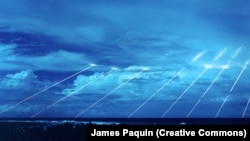

On February 5, a treaty capping the numbers of deployed Russian and US nuclear warheads will expire, marking the first time in more than half a century that the Kremlin and Washington's nuclear programs will be unconstrained by numerical limits.
Moscow had "suspended" the New START treaty in 2023 in response to US military support for Ukraine. Washington responded in kind, effectively putting the arms deal on ice, while it remained officially in force.
In September Russian President Vladimir Putin suggested sticking with the core terms of the treaty -- which includes limiting each country to 1,550 strike-ready nuclear warheads -- for another year. US President Donald Trump responded warmly to the Kremlin's public outreach, telling reporters it "sounds like a good idea," but recent prods from Moscow to formalize the deal have been met with silence. The US State Department declined to comment on the status of the nuclear pact, directing RFE/RL queries to the White House.
Pavel Podvig, a senior researcher at the United Nations Institute for Disarmament Research (UNIDIR), told RFE/RL there are no indications that an 11th-hour extension to the central terms of the treaty is coming. The nuclear weapons expert said he believes a degree of proliferation is most likely imminent.
"I think what will follow is that the US will move to increase the number of deployed warheads," Podvig said, adding that such a buildup, at least in the short term, could be a relatively simple case of uploading additional warheads into existing weapons, such as the Minuteman III.
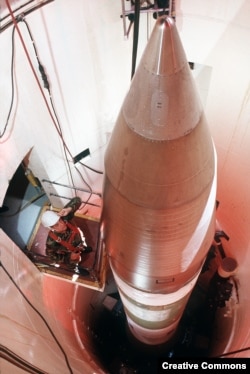
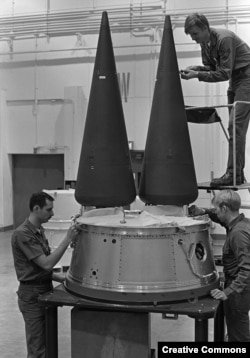
America currently fields 400 Minuteman III intercontinental ballistic missiles (ICBMs) ready for launch in silos across the country's northern Great Plains. Each missile carries one nuclear warhead in keeping with New START restrictions but is capable of carrying three. Each warhead, contained within an cone-shaped "reentry vehicle," is able to separate in the final arc of its missile's flight to strike different targets.

Tripling the number of launch-ready warheads in America's ground-launched ICBMs, therefore, would be comparatively simple.
"My guess is that would be done relatively quickly," Podvig said. Russia is similarly capable of installing additional warheads in existing weapons, increasing its strike-ready arsenal by an estimated 60 percent if the limits of the New START treaty are abandoned.
One reason for US reluctance to limit its nuclear arsenal is the rise of a third nuclear superpower, which was scarcely an afterthought when New START was signed in 2010.
"The biggest difference in the nuclear weapons landscape is the emergence of China as a challenge to the US and Russia as the dominant stewards of the world's nuclear weapons arsenals," William Moon, a former senior manager of the Cooperative Threat Reduction program, told RFE/RL. Moon, who has on-the-ground experience inspecting Russia's nuclear weapons sites, added that "without a better understanding of China's intentions, the US and Russia will both be hesitant to limit nuclear inventories and nuclear modernization plans."
A 2022 Pentagon report estimated China "will likely field a stockpile of about 1,500 warheads" by 2035.
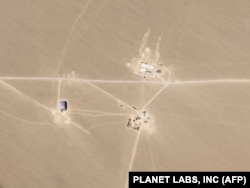
Podvig says with the United States likely to face two nuclear peers in the near future, "the Americans are telling themselves, 'Oh look China has, like, 300 silos so they will have 300 missiles and we don't have enough warheads to target those.' And the plan is, 'Oh, we'll deploy more warheads and we will target all those silos." But, he adds, the consequence could entail a familiar, Cold War-like arms race in which China then decides "Well, maybe we need more silos."
The potential for a new arms race beginning next month has nuclear weapons control advocates calling for renewed efforts to limit civilization-ending firepower. Daryl Kimball, the executive director of the Arms Control Association, told RFE/RL "the reality is that more nuclear weapons will not make anyone safer. The United States already has a massive, devastating, and largely invulnerable nuclear force that is more than sufficient to deter nuclear attack by China, Russia, and any other nuclear-armed state."
Increases in Russian and US nuclear firepower, he says, "could further destabilize the mutual balance of nuclear terror; would strain the already costly, behind-schedule US nuclear modernization program; and prompt China to accelerate its ongoing nuclear buildup."
On the cusp of entering uncharted territory in the nuclear era, Kimball says, "human civilization remains precariously tethered to the existence of nuclear weapons and the dangerous, interlocking nuclear deterrence strategies of nuclear-armed nations and their allies."